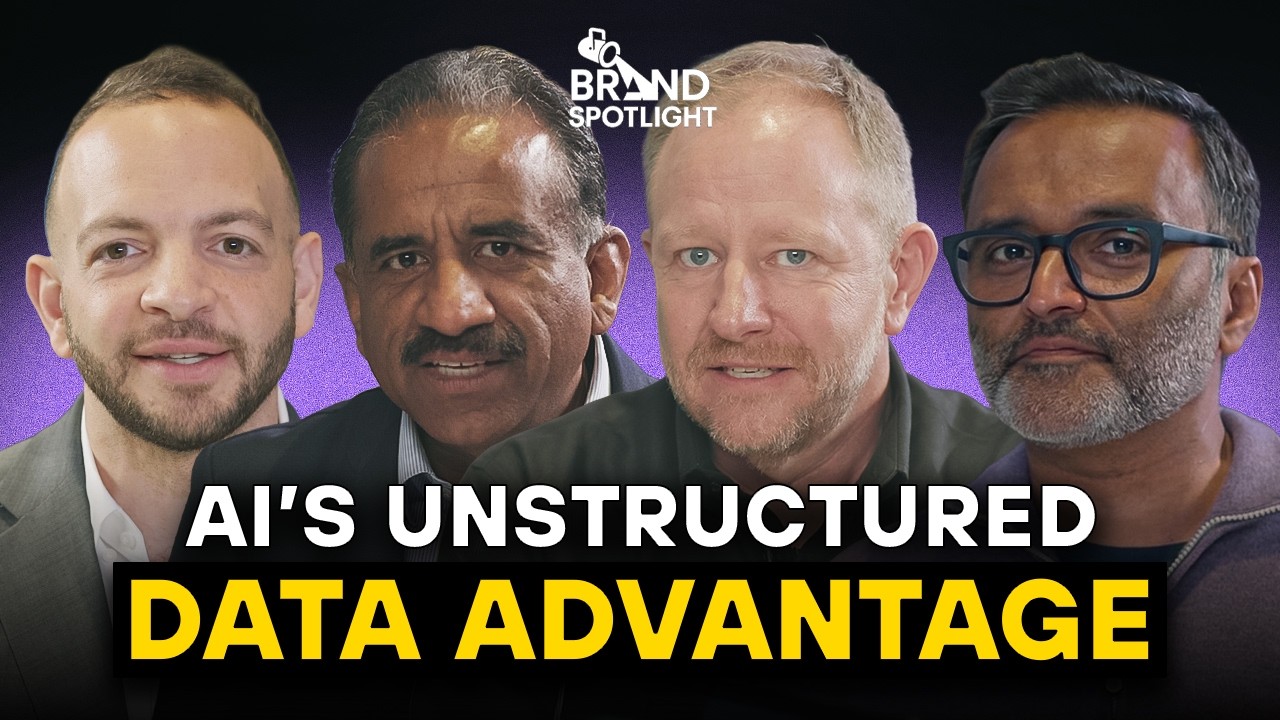
📺 Today’s recommended deep-dive video: https://www.youtube.com/watch?v=9-4kiL6tEOw
From Pilot Purgatory to Production: The Blueprint for the Agentic Enterprise
The current landscape of corporate AI is littered with well-funded experiments that fail to survive the transition from the laboratory to the high-stakes production environment. While “token maxing” on commodity models provides a temporary sense of progress, true ROI remains elusive for organizations that haven’t mastered their own internal data. By shifting the focus toward a governed, agentic architecture, companies can finally transform their unstructured content into a primary driver of business acceleration.
Core Question: How can enterprises move beyond experimental AI pilots to build governed, agentic systems that leverage the 90% of data currently trapped in unstructured documents?
Highlights
- The ROI Gap: Why 82% of AI tokens are currently wasted on pilots that never reach production due to a lack of intentional business strategy.
- Unstructured Goldmines: How large language models are finally providing structure to the “dark data” found in contracts, emails, and medical notes.
- Agentic Governance: The role of “Agent Passports” and “Control Towers” in ensuring AI systems remain compliant and under human supervision.
- Industry Transformation: Real-world applications in healthcare referrals and insurance subrogation that compress weeks of manual work into minutes.
⏱️ Reading time: approx. 6 minutes · Saves you about 67 minutes vs. watching.
Want to take notes while watching? Click the image below and let AI Notebook capture the key points for you 👇

The Architecture of AI Failure and the Data Moat
Moving Beyond the “Data Swamp”
The current landscape of corporate AI is littered with well-funded experiments that fail to survive the transition from the laboratory to the high-stakes production environment. Jitesh Ghai, CEO of Hyland, notes that many boards mandate AI strategies out of a fear of missing out, leading to pilots that lack an intentional business thesis or a dedicated budget for scale. When companies focus solely on commodity models trained on public data, they ignore their most significant competitive advantage: the vast, proprietary record of decisions and operations stored within their own internal servers.
Success depends on moving from brute-force vectorization to a structured, semantic understanding of how specialized language functions within healthcare, banking, or legal contexts. Merely dumping petabytes of data into a vector database often results in a “data swamp” where agents hallucinate because they lack the necessary industry ontology to interpret nuanced business language correctly. An effective architecture requires a graph of related concepts that links directly to governed data sources, ensuring that agents act with the precision of a tenured employee rather than a generic chatbot.
What is truly novel and unique is an enterprise’s data—it is a living record of decisions and actions that no frontier model lab can access.

💡 Digging Deeper
Q: Why are so many AI tokens being spent without resulting in production-ready tools?
A: Many organizations are “token maxing” to cure FOMO rather than solving specific business problems with a committed budget and a structured data strategy.
Q: How does industry-specific language change AI performance?
A: A term like “litigation” means something very different in healthcare than in banking; without an ontology to define these differences, AI models cannot provide accurate context.
Q: Can companies use their data without constant fine-tuning?
A: Yes, by using a context engine that links agents to a real-time graph of enterprise content, the AI stays updated without the need for expensive, static model retraining.
Governing the Autonomous Workforce
The Rise of Agent Passports and Control Towers
Mike Campbell, Hyland’s Chief Product Officer, argues that the real friction in enterprise operations isn’t a lack of data, but the manual toil required to navigate and aggregate it. In highly regulated sectors like banking and healthcare, the stakes for AI error are not just financial but existential, involving life-and-death decisions or sensitive personally identifiable information. To mitigate these risks, organizations must implement a framework where every autonomous agent is treated with the same level of scrutiny as a human employee.
The Enterprise Context Engine acts as a living intelligence layer that pulls from email, medical imaging, and visit summaries to synthesize a comprehensive view of a patient or client. By leveraging specific industry ontologies, the system can distinguish between a routine inquiry and a critical medical referral, ensuring that assistants are no longer burdened by the mundane task of digital scavenger hunts across siloed software systems. This automation allows specialized workers to focus on the high-value crafts they were actually trained for, such as patient care or financial analysis.
Governance is enforced through “Agent Passports,” digital credentials that define exactly what roles, privileges, and data access rights a specific autonomous worker possesses.
Complementing this is the “Control Tower,” a management interface that provides full transparency into agent logic and offers “kill switches” to immediately halt any process that deviates from its intended path. This dual-layered approach ensures that as agents become more probabilistic and capable, they remain tethered to the deterministic guardrails required by government regulators and internal compliance teams.

💡 Digging Deeper
Q: What exactly is an “Agent Passport”?
A: It is a governing document that defines an agent’s role, what data it is allowed to touch, and its specific operational privileges within the enterprise.
Q: How does the “Control Tower” prevent AI from going rogue?
A: It provides a transparent audit trail of every decision an agent makes and allows human supervisors to instantly deactivate any agent via a manual kill switch.
Q: Is this technology replacing specialized software?
A: No, it is an orchestration layer that sits on top of existing enterprise content management systems to make them more navigable and actionable.
The Agentic Insurer: Human-Centric Automation
Supercharging Structured Data with Unstructured Insights
Insurance has traditionally relied on structured data points—age, zip code, and accident history—to determine risk and pricing with deterministic accuracy. However, Partha Srinivasa of Erie Insurance points out that 80% to 90% of the most valuable information is hidden in the unstructured conversations adjusters have with claimants. By using AI to “listen” to these interactions, companies can identify hidden details—like a damaged car seat or a specific road hazard—that a human might overlook in the heat of a stressful moment.
This isn’t about replacing the human adjuster, but rather providing them with a co-pilot that can prompt them to ask the right questions in real-time. For instance, in the complex process of subrogation, an AI agent can flag the need for a police report or witness contact information immediately after an accident is reported. This prevents the common problem of “lost in translation” data where evidence is only sought months later, often after the trail has gone cold and the legal window for recovery has narrowed.
Insurance is ultimately a trust-based business, which is why a “human in the loop” remains essential for validating AI-generated insights.
The ultimate goal of the “agentic insurer” is to provide empathy and business acceleration simultaneously. When an agent automatically triggers a rental car delivery or identifies a potential fraud signal during a first notice of loss, it frees up the human staff to focus on the relationship with the customer. By watching every token for business value, organizations like Erie Insurance are ensuring that AI remains a tool for service excellence rather than a drain on compute resources.

💡 Digging Deeper
Q: How does AI help with “Time Limit Demands” in insurance?
A: It scans unstructured documents for legal deadlines, preventing “bad faith” liabilities that occur when companies fail to settle cases within an attorney’s mandated timeframe.
Q: Does AI make it harder for customers to get their claims paid?
A: On the contrary, it ensures that all necessary benefits—like replacing a car seat—are identified early so the customer doesn’t have to chase the company for money later.
Q: What is the “AI Business Office” responsible for?
A: Much like a cloud business office, it monitors token usage to ensure that AI is only applied to use cases with clear business value, preventing wasteful spending.
Key Takeaways
The transition from AI experimentation to production requires a fundamental shift in how enterprises view their content. By recognizing that the vast majority of their institutional knowledge is locked in unstructured formats, companies can move away from commodity models and build proprietary “context engines.” This architecture doesn’t just store information; it makes it actionable by linking it to industry-specific ontologies and autonomous agents.
Governance and trust are the non-negotiable pillars of this new era. Tools like Agent Passports and Control Towers provide the necessary friction to keep probabilistic models within deterministic boundaries, ensuring compliance in highly regulated fields like healthcare and banking. When AI is treated as a governed extension of the human workforce, it ceases to be a source of anxiety and becomes a catalyst for freeing professionals from mundane toil.
Ultimately, the most successful agentic enterprises will be those that keep a “human in the loop” to maintain the empathy and trust that machines cannot replicate. By automating the “scavenger hunt” for data, organizations can refocus their human talent on high-level decision-making and customer engagement, turning AI from a pilot project into a scalable engine for ROI.
Q&A
Q1: Why do most AI pilots fail to reach production?
A1: Most fail because they are driven by FOMO or board mandates rather than specific business problems. They often lack a dedicated budget and a strategy to leverage the company’s unique unstructured data.
Q2: How does unstructured data change the way a doctor works?
A2: Instead of a doctor spending hours reading through fragmented physician notes and lab results, an AI agent can structure that data to provide a summary, allowing the doctor to focus entirely on patient care.
Q3: What is the risk of using “commodity” AI models for business?
A3: Commodity models are trained on public data and lack the specific context of your enterprise. Without your proprietary data, these models cannot provide a competitive moat or accurate industry-specific insights.
Q4: Can AI agents make financial decisions on their own?
A4: While they can assess creditworthiness and check for fraud, in regulated industries, they operate within a governed framework where human experts validate their findings before final actions are taken.
Q5: How does AI improve the insurance claim process?
A5: It identifies “signals” in conversations that suggest a need for specific evidence (like police reports) early on, speeding up subrogation and ensuring customers receive all the benefits they are entitled to.
Q6: What happens if an AI agent starts behaving unexpectedly?
A6: The “Control Tower” system includes a kill switch that allows human supervisors to immediately shut down an agent. Every agent action is also tracked through an audit trail for full transparency.
Q7: Will AI eventually replace software developers or insurance adjusters?
A7: The consensus among leaders is that we are decades away from AI building complex systems from scratch. Currently, the technology is designed to unencumber knowledge workers from mundane tasks, not replace their expertise.