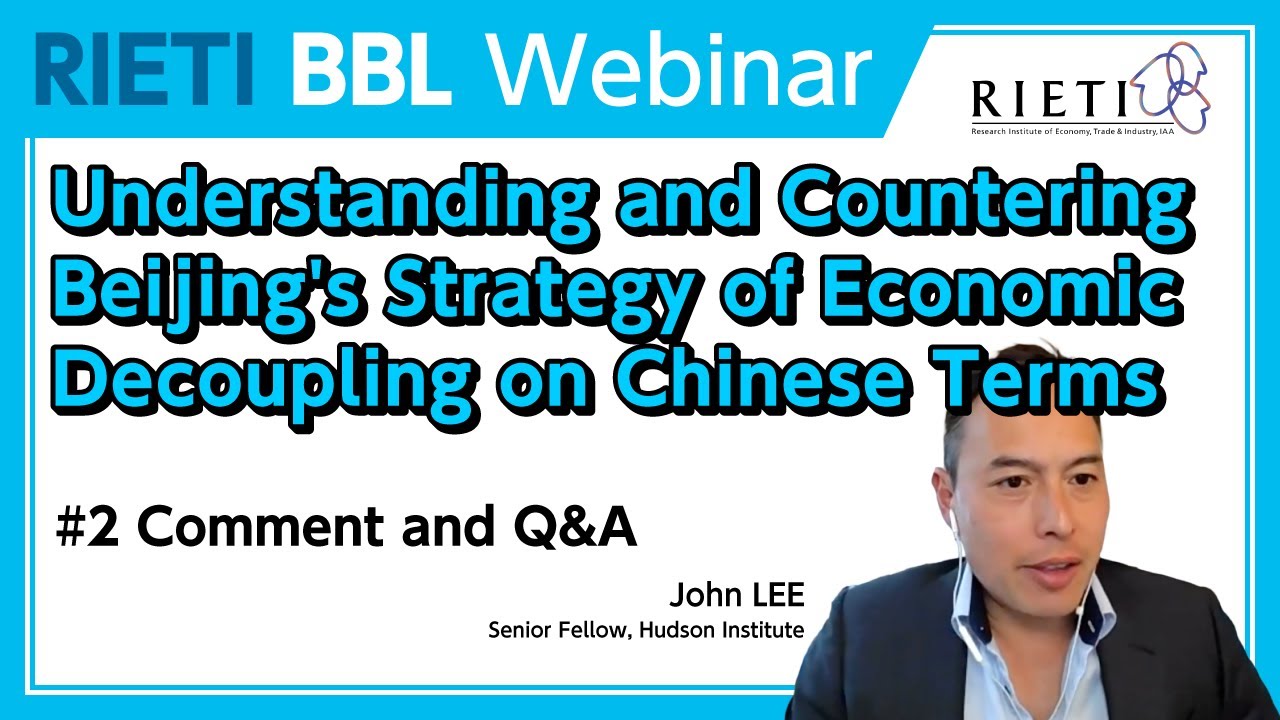
📺 Today’s recommended deep-dive video: https://www.youtube.com/watch?v=4EjSyeBmIBo
The Decoupling Dilemma: Navigating the U.S.-China Tech Schism
As the global economy fractures into competing blocs, corporate leaders find themselves caught between two superpowers with diametrically opposed strategic goals. This discussion explores why “business as usual” is a dangerous illusion in the face of China’s long-standing strategy to insulate its own economy and the urgent need for allied “friend-shoring.”
Core Question: How can Japan and its allies strategically decouple from China in high-tech sectors without triggering a global economic collapse or compromising national security?
Highlights
- Decoupling is not a U.S.-led initiative but a reaction to China’s long-term internal insulation and technology absorption policies.
- Japanese firms must transition from purely commercial risk assessments to incorporating sovereign, political, and strategic risks.
- The U.S. return to the CPTPP remains a strategic necessity, as the current IPEF framework lacks the “market access” incentive.
- The Ukraine conflict serves as a deterrent by demonstrating the devastating efficacy of non-military tools like coordinated sanctions.
⏱️ Reading time: approx. 7 minutes · Saves you about 25 minutes vs. watching.
Want to take notes while watching? Click the image below and let AI Notebook capture the key points for you 👇

The Reality of Strategic Decoupling
Challenging the Narrative of Aggression
Many Japanese executives and policymakers operate under the misconception that the United States is the sole architect of the current economic rift. However, the transcript reveals that China’s efforts to decouple its economy from Western influence actually predate the trade wars of the late 2010s. By the time Washington began its “de-risking” rhetoric, Beijing had already spent years building internal dependencies while trying to reduce its reliance on foreign technology.
We must stop viewing this as a purely reactionary U.S. policy and recognize it as a structural shift in global trade dynamics initiated by the CCP.
Dr. Lee emphasizes that this is not about a total, sudden withdrawal from the Chinese market, which would be catastrophic for global growth and output. Instead, the focus must be on “partial decoupling” targeting high-value sectors like AI, quantum computing, and advanced materials. These are the specific arenas where China seeks to import foreign capital and know-how only to eventually displace the original innovators and dominate the entire global supply chain through state-subsidized competition.

💡 Digging Deeper
Q: Is total decoupling from China the ultimate goal for the West?
A: No, a hard decoupling is impossible and undesirable; the goal is to prevent China from dominating technologies and supply chains that determine strategic military power.
Q: How should Japanese companies view their operations within China?
A: Firms servicing the Chinese market must continue to invest there to follow local rules, but they should simultaneously diversify supply chains for the global market to mitigate sovereign risk.
The Battle for Trade Frameworks
CPTPP vs. IPEF: Searching for the Ultimate Weapon
The Comprehensive and Progressive Agreement for Trans-Pacific Partnership (CPTPP) remains a powerful strategic tool, yet the United States remains noticeably absent from the pact it originally helped design. While the Biden administration promotes the Indo-Pacific Economic Framework (IPEF), critics argue it lacks the crucial “carrot” of market access that gravitated Asian economies toward the original TPP. Without tangible trade benefits, IPEF may struggle to provide a functional alternative to the gravity of the Chinese economic orbit.
Strategic trade policy requires more than just high-level security agreements; it requires real, bankable incentives for supply chain migration and market integration.
There is hope, however, that the U.S. political landscape will shift back toward multilateral trade agreements as the competition with China intensifies. Dr. Lee points out that while current leadership is hesitant, the broader foreign policy establishment in Washington recognizes that rejoining the CPTPP is the most effective way to secure a maritime-based economic order. If the U.S. continues to avoid these pacts, it risks being left behind as Japan and Europe begin to link their own trade zones to counter Chinese influence.
The Ukraine Factor and Global Security
Lessons in Economic Deterrence
The Russian invasion of Ukraine has fundamentally altered the calculus for geopolitical risk across Asia, proving that major powers are indeed willing to disrupt the global order. It proved that the “no limits” partnership between Moscow and Beijing has real-world consequences for global stability and economic interdependence that cannot be ignored by the private sector.
Perhaps the most significant takeaway for Beijing is the effectiveness of non-military tools, such as coordinated sanctions and export controls, which the West deployed with surprising speed.
For China, which is far more integrated into the global economy than Russia, these tools represent a far greater threat to the Communist Party’s domestic legitimacy. The possibility of becoming an “economic basket case” through isolation serves as a powerful deterrent against a quick move on Taiwan or the Senkaku Islands. As long as the West remains unified in its ability to inflict economic pain, the cost-benefit analysis for Chinese aggression remains prohibitively high.

Allied Cooperation and “Friend-Shoring”
Building a Resilient Maritime Ecosystem
Japan and Australia must take the lead in convincing the United States that “onshoring” every industry back to American soil is a logistical and economic impossibility. A more rational approach is “friend-shoring,” where critical technologies and supply chains are moved out of China and into an allied economic ecosystem of trusted partners. This strategy acknowledges that while we cannot do everything at home, we can certainly choose who we depend on for our most critical goods.
The future of global trade lies not in isolated protectionism, but in the strategic relocation of manufacturing to nations that share liberal democratic values.
By focusing on these maritime economies, the West can build a resilient network that preserves innovation while mitigating the risk of state-sponsored technology theft. This collaborative mindset is essential to ensure that the estimated $4 trillion cost of decoupling doesn’t lead to a permanent global recession. Governments must provide the necessary legislative guardrails and incentives to help corporations navigate these new risks without abandoning the principles of open trade entirely.
Key Takeaways
The transition from a cost-efficient global supply chain to a security-focused one is not a temporary trend but a permanent shift in the geopolitical landscape. Companies can no longer afford to ignore political and sovereign risks in their pursuit of the Chinese market, as the “normalization” of Chinese economic practices has proven to be a strategic liability for the West.
Moving forward, the success of the democratic bloc depends on its ability to offer a compelling economic alternative to China’s belt-and-road influence. This requires the United States to overcome its domestic trade hesitation and for allies like Japan and Australia to facilitate the creation of a “friend-shored” high-tech ecosystem. Ultimately, partial decoupling is the price of maintaining a free and open Indo-Pacific.
Q&A
Q1: Is the U.S. investment into China actually declining?
While overall investment remains positive, there is a marked decrease in investment toward sensitive high-tech sectors. Regulations and executive orders are increasingly restricting capital flow into areas that China aims to dominate strategically.
Q2: Can the IPEF replace the CPTPP?
Not effectively. The IPEF lacks the market access provisions that make the CPTPP attractive to developing Asian economies. It is a “light” version that addresses security but fails to provide the economic “carrot” required to pull nations away from China.
Q3: How has the Ukraine war changed China’s perspective on Taiwan?
It has highlighted that military invasions are difficult to execute quickly and that Western democracies will contemplate extreme economic policies once a conflict begins. This makes a “quick victory” for China look increasingly unlikely.
Q4: Should the EU join the CPTPP?
It is not strictly necessary for the EU to join, but it is vital to establish tech export controls and trade linkages between the EU and CPTPP members to create a massive, unified free-trade zone that counterbalances China.
Q5: What is “friend-shoring” exactly?
It is the practice of relocating supply chains to countries that are values-aligned and geopolitically stable, rather than bringing all manufacturing back to one’s own home country (onshoring).
Q6: Will decoupling cause permanent high inflation?
Economists estimate a potential 5% loss in global output, which would likely lead to higher costs. However, this is increasingly viewed as a necessary “security premium” to prevent future supply chain weaponization by adversarial states.
Q7: How should corporations prepare for further decoupling?
They must broaden their definition of risk beyond commercial metrics to include sovereign and political factors, while diversifying supply chains for any products intended for markets outside of China.