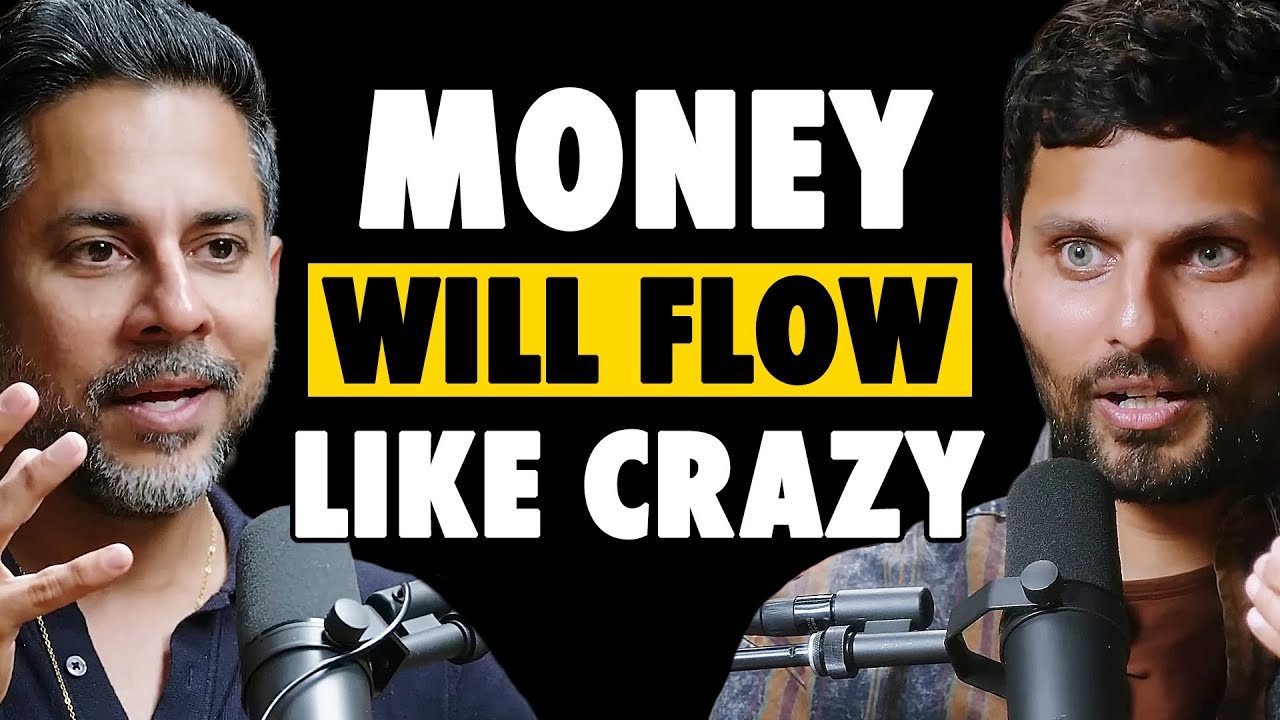
📺 Today’s recommended deep-dive video: https://www.youtube.com/watch?v=-d1dvrj_fMk
Beyond Stillness: Mastering the High-Performance Mind with Vishen Lakhiani
Meditation is often marketed as a passive escape into silence, but for Mindvalley founder Vishen Lakhiani, it is a high-octane tool for engineering a better reality. In this conversation with Jay Shetty, Lakhiani breaks down why he moved away from traditional “breath-work” to create a structured six-phase system that treats mental optimization like a biological software update.
Core Question: How can we shift from passive meditation to an active, structured protocol that solves real-world problems and aligns our daily habits with our soul’s destiny?
Highlights
- The crucial distinction between “passive” meditation (stillness) and “active” meditation (problem-solving).
- Why compassion is a physiological health biomarker that changes heart resonance and cellular function.
- Forgiveness as a high-performance “biohack” to achieve the brainwave coherence of long-term monks.
- The “What and Why” rule: How focusing on intentions while ignoring the “How” reduces resistance to manifestation.
⏱️ Reading time: approx. 6 minutes · Saves you about 48 minutes vs. watching.
Want to take notes while watching? Click the image below and let AI Notebook capture the key points for you 👇

The Evolution of Active Meditation
From Skin Healing to High-Performance
Most people view meditation as an escape from the world, a moment of silence to drown out the noise of modern life.
Vishen Lakhiani’s journey began not with a quest for Zen, but with a desperate need to heal a severe skin condition that had shattered his confidence as a teenager. By applying the Silva Method—an active form of visualization—he managed to clear five years of skin disease in just five weeks, proving that the mind is a functional tool for biological and environmental change rather than just a witness to it. He realized that the brain can be directed toward specific “projects,” such as healing the body or qualifying for athletic championships, rather than just being calmed.
This realization led to the vital distinction between “passive” meditation, like focusing on the breath, and “active” meditation, where the practitioner treats their problems as tactical projects to be solved through specific mental protocols.

💡 Digging Deeper
Q: What is the primary difference between the Silva Method and traditional Eastern meditation?
A: The Silva Method focuses on “active meditation” to solve problems, whereas Eastern styles often emphasize “passive meditation” to achieve stillness and detachment.
Q: How did Vishen transition from a skeptic to a meditation teacher?
A: After realizing his $250,000 university degree taught him less about success than a $20 book on meditation, he quit his Silicon Valley job to share these tools.
Q: What is the “Tea Kettle” analogy for daily practice?
A: Active meditation for a specific crisis is like an electric drill (a power tool), but the Six-Phase method is like a tea kettle—a daily ritual to put you in a peak state.
Engineering Compassion and Gratitude
The Daily Mental “Tea Kettle”
The Six-Phase Meditation Method is designed to be your daily mental preparation, much like a tea kettle that gets you ready for the day, rather than a heavy-duty power tool reserved only for major crises.
Phase one centers on compassion, using techniques from Zen Buddhism and the HeartMath Institute to alter heart resonance and improve physiological health. By seeing the world through a lens of empathy—illustrated by Vishen’s story of tipping a “poor” waitress during the pandemic—we move from a state of criticism and comparison to one of awe and connection, which naturally lowers stress levels. Compassion is not a favor you do for others; it is a physiological gift you give your own nervous system to improve your heart’s health biomarkers.
It layers six distinct psychological techniques to optimize your human state for bliss and productivity.

💡 Digging Deeper
Q: How does compassion affect the heart?
A: Visualizing someone you love changes your heart resonance, which the HeartMath Institute identifies as a key biomarker for overall physical health.
Q: Why is gratitude for oneself included in the protocol?
A: Most people are conditioned to see their flaws; focusing on what you love about yourself counters self-loathing and builds the character necessary for growth.
Q: What is “Blissipline”?
A: It is the discipline to nurture positive emotions and maintain a high “Positivity Quotient” (PQ) regardless of external circumstances, such as melancholy or sadness.
The Biohack of Forgiveness
Clearing the Slate for the Future
Phase three involves a rigorous eight-step forgiveness protocol because guilt and shame are the lowest vibrational states a human can experience.
Scientifically, forgiveness is the primary “hack” for achieving the high-alpha brainwave amplitude and left-right brain coherence typically found in monks who have meditated for decades. It doesn’t just clear the mind; studies show it can improve physical endurance and even the vertical jump height in athletes by removing mental “weight.” By forgiving others and ourselves, we remove the internal friction that prevents us from manifesting our higher goals and intentions.
Letting go isn’t about condoning bad behavior; it’s about reclaiming your energy to fuel your future.
Once the slate is cleared, phase four focuses on a vision for the future, differentiating between “immature wanting”—based on social pressure—and “mature wanting,” which aligns with your soul’s true destiny. Vishen suggests focusing on the “What and Why” of your desires, while deliberately parking the “How, When, and Who” to avoid creating resistance.

💡 Digging Deeper
Q: Can forgiveness really improve physical athletic performance?
A: Yes, research in Israel and other institutes suggests that the emotional release of forgiveness correlates with improved endurance and physical power.
Q: What is the “Highway of Destiny” analogy?
A: Life is a highway (Destiny) where you can change lanes or speeds (Intention), but trying to take an “exit ramp” away from your soul’s purpose causes unnecessary struggle.
Q: What are the “What and Why” vs. the “How”?
A: Focusing on what you want and why you want it adds momentum; worrying about how it will happen adds resistance to the manifestation process.
Designing the 12 Buckets of Life
Beyond Career and Finance
Vishen advocates for the “Lifebook” protocol, which breaks down existence into twelve distinct categories, including emotional mastery, character, and quality of life, rather than just focusing on career or finance.
By getting hyper-clear on the quality of life one desires—the friends, the travel, the daily feelings—the specific “how” of a career often manifests as a byproduct. Vishen notes that when he focused on wanting to lead a life of global speaking and five-star travel, a documentary he produced won an Emmy despite him never having targeted that specific accolade directly. The vehicle (the job) appeared because the destination (the quality of life) was clearly defined in his meditation.
Your career is simply a vehicle for your growth, not the destination itself.

💡 Digging Deeper
Q: Why focus on “Quality of Life” instead of a job title?
A: A job is just a vehicle; if you define the lifestyle first, the ideal career path will often present itself as a way to fulfill that lifestyle.
Q: What is “Mimetic Wanting”?
A: It is the trap of wanting what everyone else wants (like becoming a lawyer for prestige) rather than what actually resonates with your soul.
Q: How do you evaluate a “good” meditation?
A: Instead of judging the session, ask six questions at the end of the day: Who did I help? What made me come alive? What did I learn? What new desire did I see? What was my favorite part? Did I feel connected?
Key Takeaways
The transition from passive to active meditation marks the difference between someone who simply watches their life and someone who engineers it. By using structured phases—Compassion, Gratitude, Forgiveness, Future Vision, Commanding the Day, and The Blessing—we address the core psychological barriers that hold us back. This isn’t just about feeling better; it is about physiological optimization, brainwave coherence, and aligning with a destiny that transcends simple ego-driven desires.
Forgiveness remains perhaps the most potent “hidden” tool in the high-performance toolkit. By clearing the emotional debris of guilt and shame, we unlock physical and mental capabilities that are otherwise suppressed. When this is combined with a clear focus on the “What and Why” of our future, we reduce the resistance between where we are and where our soul is meant to go.
Ultimately, meditation is not the goal—life is the goal. A successful practice is one that manifests as kindness in a restaurant, resilience in the face of sadness, and a career that feels like a “long happy holiday” rather than a grueling climb. By breaking life into twelve buckets and meditating on the quality of experience rather than just financial output, we reclaim our autonomy from a society that often tells us what to want.
Q&A
Q1: Is the Six-Phase method meant for experts or beginners?
A1: It is designed for everyone; each phase takes about two minutes and uses guided techniques that don’t require previous years of practice to be effective.
Q2: How do you handle sadness if the goal is “Blissipline”?
A2: Blissipline isn’t about fake happiness; it’s about observing emotions like melancholy or grief without letting them turn into the low-vibration states of guilt or shame.
Q3: What if I don’t know my “destiny”?
A3: Focus on what you would do if you weren’t being paid; that “joy-centered” activity is usually the stepping stone to your true career path.
Q4: How does meditation help with professional leadership?
A4: Studies show that the highest correlation with revenue growth is employees feeling that their supervisor cares about them—a direct result of practicing the compassion phase.
Q5: Why is the “How” less important than the “What” in visioning?
A5: Focusing on the “How” creates mental resistance and limits the universe to only the paths your current ego can imagine, which are often too small.
Q6: How does narcissism differ from the self-love taught in Phase 2?
A6: Narcissism is self-love without love for others. The Six-Phase method prevents this by always starting with the Circle of Compassion for others first.
Q7: What is the Hawkins Scale?
A7: It is a scale of consciousness vibration where guilt and shame are at the bottom, and enlightenment is at the top; Phase 3 (Forgiveness) is designed to move you up this scale.