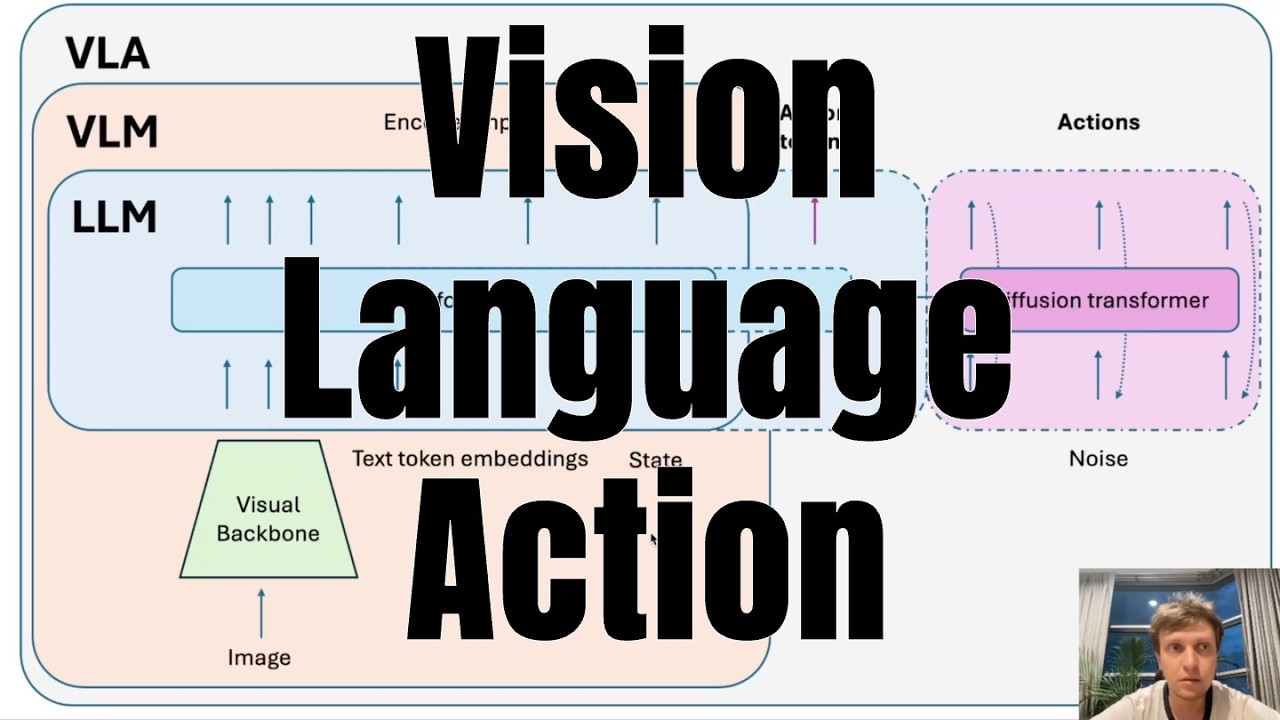
📺 Today’s recommended deep-dive video: https://www.youtube.com/watch?v=8dZUOo5xWFw
The Brains Behind the Bot: Understanding Vision-Language-Action (VLA) Models
For years, training robots required rigid, task-specific programming that broke the moment an environment changed or a new object was introduced. Vision-Language-Action (VLA) models are changing the game by repurposing the vast reasoning power of Large Language Models to give robots visual understanding and physical agency. This technology represents a critical shift from building specialized tools to developing general-purpose robotic minds that can learn from the internet and adapt to our homes.
Core Question: How do VLA models bridge the gap between abstract linguistic reasoning and precise physical control to enable multi-task robotic generalization?
Highlights
- LLM Foundation: VLAs utilize pre-trained Transformer backbones to inherit world knowledge from billions of pages of internet text.
- Multimodal Integration: These models process text instructions and camera feeds simultaneously, treating robot actions as just another “language” to be predicted.
- Action Heads: Modern architectures use specialized “action experts” or diffusion processes to turn noisy neural signals into smooth, continuous robotic movements.
- Evolutionary Shift: Robotics is moving away from rigid, modular pipelines toward a “fine-tuning” paradigm similar to how we adapt GPT models for specific industries.
⏱️ Reading time: approx. 7 minutes · Saves you about 28 minutes vs. watching.
Want to take notes while watching? Click the image below and let AI Notebook capture the key points for you 👇

The Evolution from Text to Physical Action
Defining the VLA Hierarchy
To understand a VLA, you must first trace its lineage through the landscape of modern AI. It starts with the Large Language Model (LLM), which takes text and predicts the next text token. If you add a visual backbone—a neural network that “sees”—you get a Vision Language Model (VLM) like GPT-4 or Gemini, capable of describing images.
A VLA is the final evolutionary step where we add “Action” to the output layer.
Instead of just responding with words, the model receives a text command, a current image of its environment, and its own joint states, then predicts the exact motor movements required to complete a task. It essentially treats the physical world as a sequence of tokens to be solved, just like a sentence.

💡 Digging Deeper
Q: Is a VLA just a chatbot connected to a robot arm?
A: Not quite. While it uses a chatbot’s “brain” (the Transformer), the output layers are specifically trained on robotic data to understand physics, torque, and spatial geometry that standard LLMs lack.
Q: Why not just use traditional programming?
A: Traditional code is deterministic; it fails if a cup is two inches to the left of its expected position. VLAs are probabilistic, allowing them to “reason” through visual changes and unexpected obstacles in real-time.
The Architecture of a Robot Mind
The Transformer Core and Action Heads
The heart of a VLA is a massive Transformer decoder, the same architecture powering the world’s most advanced AI. This core is pre-trained on massive internet datasets, giving it a baseline understanding of what a “hammer” is or how “laundry” should look. However, the real magic happens at the output stage, where the model must decide how to move.
There are two primary ways to handle these outputs: action tokens or diffusion heads.
In a token-based system, robot movements are squeezed into a “dictionary” of discrete steps, effectively teaching the model to “speak” in motor commands. Alternatively, models like Pi Zero use an “action expert”—a separate Diffusion Transformer that takes the high-level thoughts from the LLM and refines them into smooth, continuous paths. This prevents the robot from moving in the jerky, staccato fashion common in older AI experiments.

💡 Digging Deeper
Q: What is the “Visual Backbone” mentioned in these models?
A: It is usually a Vision Transformer (ViT) or a CNN that compresses a high-resolution camera image into a series of mathematical vectors that the LLM can digest.
Q: How does the model know its own position?
A: The “State” input provides the model with “proprioception”—data from sensors in the robot’s joints that tell the model exactly where its hand is in 3D space at every millisecond.
The Four Eras of Robotic Policy
From Modular Pipelines to Plug-and-Play
The robotics industry is currently transitioning between four distinct patterns of development. The earliest era relied on “Non-End-to-End” policies, where developers manually coded separate modules for perception, planning, and control. This was followed by the “End-to-End” era, where models like ACT or Diffusion Policy were trained from scratch to perform a single, specific task like folding one particular shirt.
We are currently in the “Fine-tuning” era.
This is where VLAs shine: we take a massive model already trained on thousands of different tasks and “fine-tune” it on a small amount of data for a specific robot. This is significantly faster than starting from scratch. The ultimate goal, which we haven’t fully reached yet, is the “Plug-and-Play” era—a future where you can buy a new robot, plug it in, and it immediately knows how to clean your kitchen because it has already seen millions of other kitchens via its pre-training.

Key Takeaways
The transition to Vision-Language-Action models represents the “ChatGPT moment” for robotics. By leveraging the pre-existing knowledge embedded in Large Language Models, researchers are finally moving away from robots that can only do one thing in one specific room. The architecture of these models allows them to understand natural language commands and visual context, making them far more versatile than the rigid industrial bots of the past decade.
However, the field is still in its infancy. While fine-tuning open-source models like SmolVLA or Pi Zero is becoming accessible to hobbyists with basic hardware, true “zero-shot” generalization—where a robot handles a new task perfectly the first time—remains the frontier. The quality of data collected via teleoperation remains the biggest bottleneck, as the model is only as good as the human demonstrations it learns from.
Ultimately, the goal is a unified policy: one brain for many bodies. Whether the robot is a two-armed kitchen assistant or a simple mobile base, the underlying VLA logic remains the same. As datasets grow and architectures like Diffusion Transformers mature, we will see robots move from controlled laboratory settings into the messy, unpredictable environments of our daily lives.
Q&A
Q1: Do I need a supercomputer to fine-tune a VLA for my own robot?
A: Not necessarily. While initial training requires massive clusters, fine-tuning models like SmolVLA can be done on consumer-grade GPUs, making it possible for developers to train their own home robots.
Q2: How much data is needed for a simple task like picking up a ball?
A: For a simple, single-task experiment, about 50 to 60 episodes (roughly 15 minutes of teleoperated data) is often enough to see the model begin to succeed, though more is always better for reliability.
Q3: Can these models recover if they make a mistake, like dropping an object?
A: Yes, if the training dataset includes “recovery” episodes. If the model sees examples of a human missing a grab and trying again, it will learn that same corrective behavior.
Q4: What is the difference between an action token and a continuous action?
A: Action tokens turn movements into “words” (discrete steps), which is easier for the LLM to process but can be jerky. Continuous actions use math to create smooth, fluid motions, which is better for delicate tasks.
Q5: Are open-source VLAs as good as the ones from Google or Physical Intelligence?
A: Frontier labs still have a lead in scale and private data, but open-source models like SmolVLA and Gr00t are catching up quickly, providing a robust starting point for the global research community.
Q6: Why is natural language so important for these robots?
A: Language allows for “zero-shot” task switching. Instead of rewriting code to change a task, you simply tell the robot “pick up the red cup instead of the blue one,” and the model uses its linguistic understanding to adapt.