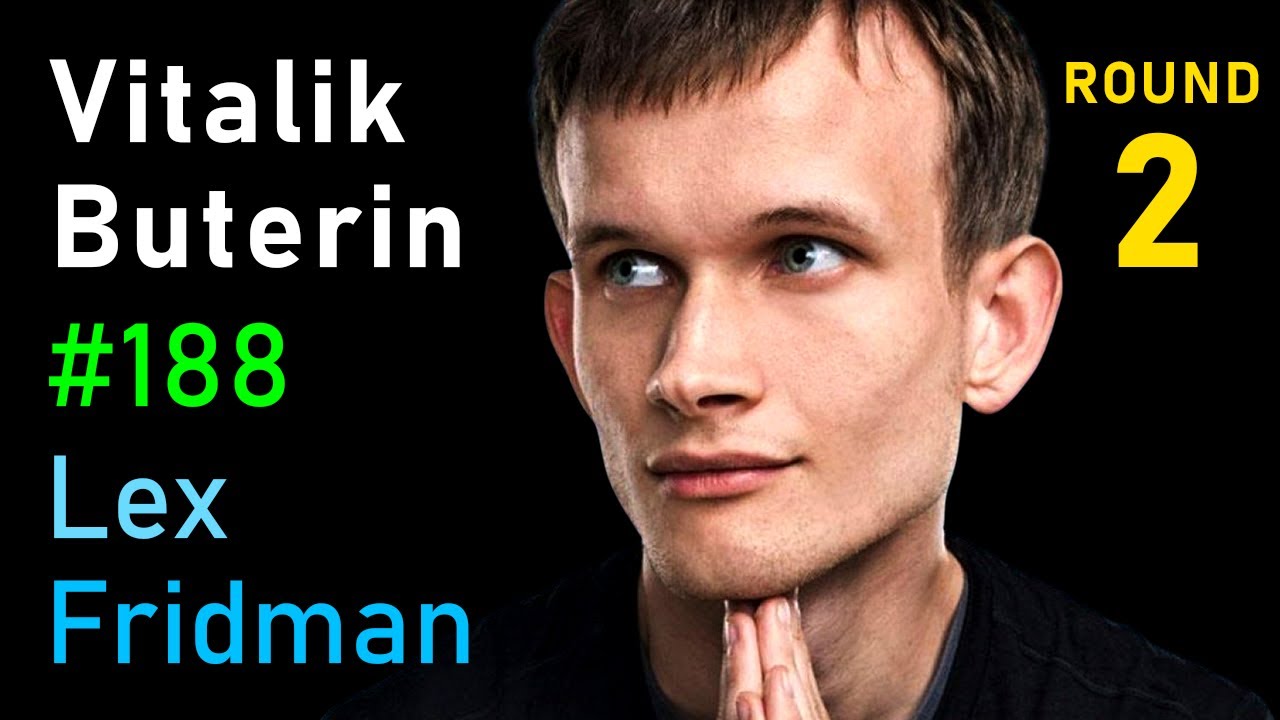
📺 Today’s recommended deep-dive video: https://www.youtube.com/watch?v=XW0QZmtbjvs
The Ethereum Evolution: Vitalik Buterin on Scaling, Sovereignty, and Longevity
Ethereum co-founder Vitalik Buterin joins Lex Fridman to explore the technical and philosophical boundaries of the decentralized world. From the high-stakes burn of billions in Shiba Inu tokens to the roadmap for Proof of Stake, this conversation delves into how code becomes a digital institution.
Core Question: How can decentralized technology scale to empower global populations while maintaining the human values of privacy and open participation?
Highlights
- The technical stress of handling $7 billion in Shiba Inu tokens and the logic behind the “burn.”
- Why Proof of Stake and Sharding are the twin pillars of Ethereum’s scalable future.
- The “soft fork” vs. “hard fork” debate and why explicit consensus is more ethical than stealthy upgrades.
- A deep dive into longevity research and treating aging as an engineering problem rather than an inevitability.
⏱️ Reading time: approx. 12 minutes · Saves you about 170 minutes vs. watching.
Want to take notes while watching? Click the image below and let AI Notebook capture the key points for you 👇

The Dog Coin Saga and the Ethics of Power
Turning Memes into Public Goods
Cryptocurrency is often seen through the lens of pure finance, but Vitalik Buterin views it as a laboratory for social engineering.
When the creators of the Shiba Inu (SHIB) token “gifted” Vitalik half of the total supply, they unintentionally placed a $7 billion burden on a single individual. Buterin explains that the stress wasn’t just about the money, but the security of moving 325,000 ETH out of an old cold wallet while the world watched his every move on the blockchain.
To solve this, he bought a fresh laptop from Target, combined fragments of private keys held by his family in Canada, and performed a digital “heist” on himself. He ultimately burned 90% of the SHIB tokens and donated the rest to an Indian COVID-19 relief fund. This move wasn’t just charitable; it was a deliberate refusal to be a central point of failure or a locus of massive, unearned power within a community that valued decentralization.

💡 Digging Deeper
Q: Why did you burn 90% instead of donating it all?
A: A massive dump of $7 billion would have instantly crashed the market, making the tokens worthless for the charity and creating chaos for retail investors.
Q: What is the difference between a hot and cold wallet?
A: A hot wallet is connected to the internet for easy access, while a cold wallet stores private keys offline—often on paper or air-gapped hardware—to prevent remote hacking.
Q: How did the “dog coin” community react to the burn?
A: While some were upset, many were inspired by the idea that their “meme gambling” accidentally contributed to a massive global humanitarian effort.
Scaling the Decentralized World
Proof of Stake and the End of Mining
The transition from Proof of Work to Proof of Stake is the most significant upgrade in Ethereum’s history.
Proof of Stake replaces energy-hungry mining hardware with “staked” coins, allowing the network to secure itself with roughly 99% less electricity. Vitalik argues that this isn’t just an environmental win; it’s a security upgrade. By using coins as the economic resource, the protocol can “slash” or burn the funds of malicious actors automatically, something that is impossible to do with physical mining rigs.
Rollups and Sharding: The 10,000x Leap
Ethereum’s current capacity is limited, but a two-pronged approach aims to fix this.
First, Sharding splits the blockchain into 64 separate pieces, allowing nodes to process only a fraction of total data rather than the whole chain. Second, Layer 2 “Rollups” perform the actual computation off-chain, compressing thousands of transactions into a single tiny proof that is posted back to Ethereum. By combining these two technologies, Vitalik believes the network can eventually handle hundreds of thousands of transactions per second, rivaling traditional payment processors like Visa.
💡 Digging Deeper
Q: What is MEV (Miner Extractable Value)?
A: It is the profit miners or validators make by reordering or front-running transactions within a block, which can potentially lead to centralization if not firewalled.
Q: Why are ZK-Rollups better than Optimistic Rollups?
A: ZK-Rollups use cryptographic proofs (SNARKs) to prove validity instantly, whereas Optimistic Rollups require a one-week waiting period for “fraud challenges.”
Q: Does Vitalik “fear the Doge” as Elon Musk claimed?
A: No; he actually enjoys Dogecoin and suggests that a secure bridge between Doge and Ethereum would allow the meme coin to scale using Ethereum’s Layer 2 tools.
The Human Dimension: Longevity and History
Aging as an Engineering Problem
Vitalik’s interest extends far beyond code; he is a major supporter of the SENS Foundation and longevity research.
He argues that the 20th-century mindset romanticizes nature and views death as an inevitable, even meaningful, conclusion. However, the COVID-19 pandemic shifted public consciousness toward treating biology as something we can—and must—fix through human ingenuity and vaccines. If we can extend the human lifespan by even 30 years, we might reach “escape velocity,” where medical progress outpaces aging, allowing us to live for centuries.
Lessons from the Darkest Moments
Reflecting on 20th-century history, Vitalik notes that evil rarely stems from pure greed.
Instead, atrocities often arise from fear—the fear that if a group doesn’t act ruthlessly, their world will collapse. He saw a microcosm of this during the DAO fork in 2016, where internal community fear led to an abandonment of principles and calls for government intervention. He believes the only way to avoid these pitfalls is to build systems that prioritize compassion and logic over reactive, fear-based tribalism.

💡 Digging Deeper
Q: Does death give life meaning through scarcity?
A: Vitalik suggests that we can find meaning through finite relationships and creative challenges without the literal “dragon” of death eating our grandparents.
Q: How does Vitalik’s Russian heritage influence him?
A: He notes that speaking different languages changes his mindset; Russian makes him feel more pragmatic, while Chinese makes him feel “cute” or more social.
Q: What is the “Hardcore History” connection?
A: Vitalik is a fan of Dan Carlin’s podcast, using it to understand the sociology of historical conflicts and how to prevent them in digital ecosystems.
Key Takeaways
Ethereum is evolving from a simple platform for tokens into a foundational layer for “digital institutions.” The move to Proof of Stake and the integration of Rollups represent a shift toward a sustainable, hyper-scalable future where transaction fees no longer bar the global poor from participating in the economy.
Vitalik Buterin’s philosophy is rooted in the belief that technology should minimize human suffering. Whether by donating billions to fight a pandemic or funding research to end the “disease” of aging, he views decentralization as a tool to bypass the flaws of centralized power.
Ultimately, the goal of the Ethereum project is to create an open, permissionless system that remains neutral. By focusing on technical rigor and resisting the urge to take political sides, Ethereum aims to provide the world with a reliable, digital “public good” that belongs to everyone and no one simultaneously.
Q&A
Q1: Is Bitcoin cash a scam?
It’s complicated. Vitalik views it as an earnest attempt at “Big Block” scaling that unfortunately suffered from internal political fractures and the influence of controversial figures like Craig Wright.
Q2: What is a “Soft Fork” versus a “Hard Fork”?
A soft fork is a backwards-compatible upgrade that can be “sneaked in,” whereas a hard fork requires everyone to consciously upgrade their software, which Vitalik finds more honest and democratic.
Q3: Can we reach “Longevity Escape Velocity”?
If we can extend lives enough to buy time for the next medical breakthrough, we may eventually reach a point where humans live long enough to explore the stars as digital or biological entities.
Q4: Will AI destroy the world?
The risk is real, but the solution lies in “legibility”—making AI systems understandable and formalizing their goals so they don’t optimize for the wrong things, like the “paperclip” problem.
Q5: What is the “Merge” timeline?
The “Merge” of the Ethereum mainnet and the Proof of Stake beacon chain is realistically expected in early 2022, marking the official end of Ethereum mining.
Q6: Why are NFTs so popular?
Though Vitalik originally thought they were overrated, he now appreciates them as a decentralized way to fund artists and public goods that were previously ignored by traditional markets.
Q7: What does money mean to Vitalik?
He views money subtractively—it’s not for buying more “stuff,” but for removing “hassle” and worry from life, allowing him to focus on meaningful, self-directed work.