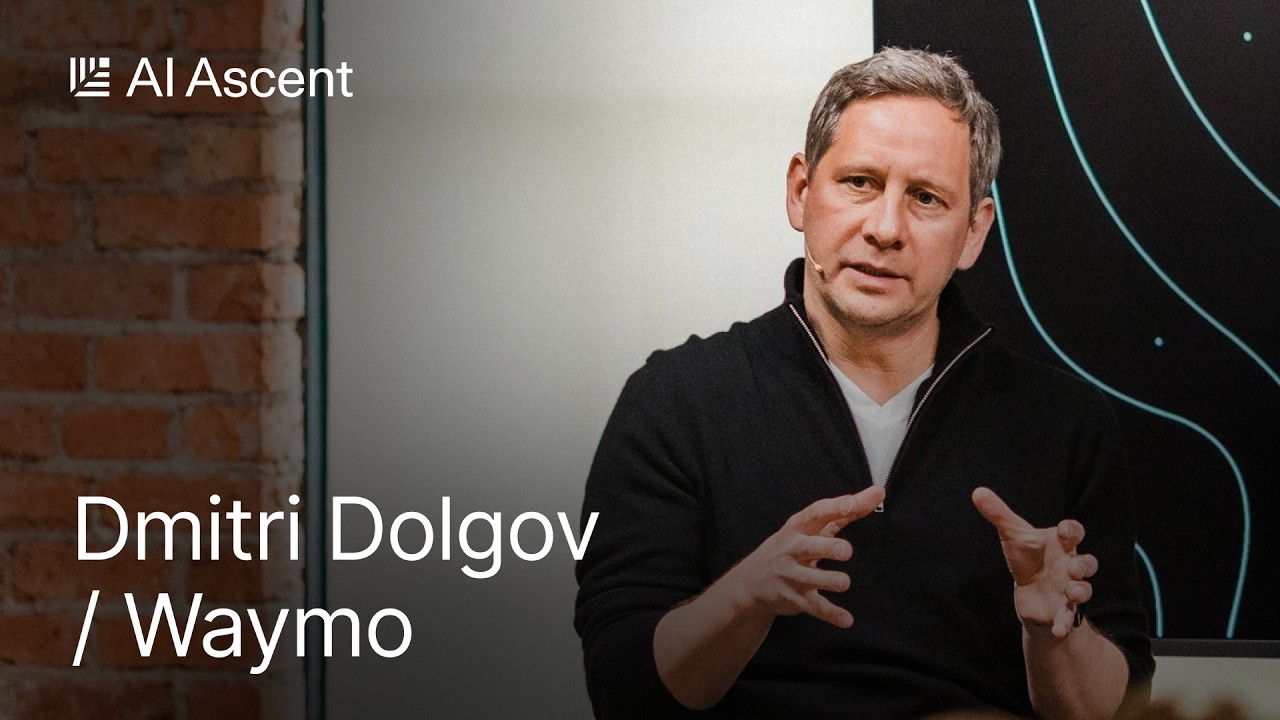
📺 Today’s recommended deep-dive video: https://www.youtube.com/watch?v=I_0Kuf6Aa2c
The 20-Year Overnight Success: How Waymo Mastered the Long Tail of Autonomy
For two decades, Dmitri Dolgov has chased a singular dream: replacing human error with machine precision. From the dusty tracks of the DARPA Grand Challenge to the bustling streets of San Francisco, his journey reveals the grit required to move past tech demos and into a global commercial reality.
Core Question: How does a leader navigate twenty years of AI hype to build a superhuman driver that is currently scaling exponentially across the globe?
Highlights
- The transition from “Project Chauffeur” to a service providing over one million rides every few weeks.
- Waymo’s unique AI architecture: A multimodal foundation model combining Driver, Simulator, and Critic.
- Why “pure” end-to-end AI is insufficient for the safety requirements of Level 4 autonomy.
- The launch of the 6th Generation Waymo Driver, designed for mass production and international expansion to London and Tokyo.
⏱️ Reading time: approx. 6 minutes · Saves you about 21 minutes vs. watching.
Want to take notes while watching? Click the image below and let AI Notebook capture the key points for you 👇

The Long Game of Autonomy
From DARPA to Daily Rides
Dmitri Dolgov didn’t just join the AI revolution in 2022; he has been building for the autonomous future since the original DARPA Urban Challenge twenty years ago.
In the early days of Google’s “Project Chauffeur,” the mission was defined by audacious, manual benchmarks like driving 100,000 miles across ten specific, high-difficulty routes in the Bay Area. This was an era of intense, 24/7 labor where the team of twelve performed every task—from calibrating sensors by hand at midnight to writing the core planning algorithms that would eventually evolve into the world’s most advanced driver.
This relentless pace eventually convinced the early team that the problem was solvable, leading them to double down on a fully autonomous product. Instead of settling for simple driver-assist tools, they committed to the arduous path of full Level 4 autonomy, even when others began to doubt the timeline.

💡 Digging Deeper
Q: How did Dolgov’s education in the Soviet Union shape his approach?
A: He attended an elite physics and math program in Moscow, which he credits with fostering the ability to learn independently and explore complex systems from first principles.
Q: Why was the 100,000-mile goal significant?
A: At the time, such a distance was unheard of for autonomous systems; completing it across ten distinct, difficult routes proved the technology wasn’t just a “demo” but a robust system.
Q: What kept the team going during the AI “slump” of 2017?
A: A deep belief in the mission—specifically the fact that a person dies in a car crash every 26 seconds—provided the stamina to ignore hype cycles.
The Waymo Foundation Model
Beyond Vanilla End-to-End AI
Waymo’s AI ecosystem is built upon a massive multimodal world-action-language model that synthesizes inputs from lidars, radars, and cameras into a cohesive understanding of 3D spatial dynamics. This “Foundation Model” doesn’t just predict where a car might move; it deeply reasons about the social semantics of driving, such as understanding the subtle intentions of a cyclist or the physics of a pedestrian tripping in the road.
While many competitors chase a “pure” end-to-end approach, Waymo uses an augmented architecture that adds structured validation layers to the learned neural representations.
These materialized intermediate representations are critical because they allow for richer training recipes and reinforcement learning via a closed-loop simulator. By having a “Critic” evaluate the “Driver” within a simulated world, the system can achieve superhuman safety benchmarks that a black-box model simply cannot guarantee at scale. This allows the system to incorporate human feedback and “social” rules of the road that are often lost in purely statistical models.

💡 Digging Deeper
Q: What is a “World-Action-Language” model?
A: It is a multimodal system that combines physical world data (lidar/radar) with language model knowledge to help the AI understand deep social context.
Q: How does the “Simulator” pillar work?
A: It uses the foundation model to instantiate a digital twin of the world where the driver can be tested against millions of edge cases before hitting the street.
Q: Can the Waymo driver see through objects?
A: Not exactly, but it uses “superhuman” perception, such as detecting the sparse lidar returns of a person’s feet moving under a parked bus to predict their emergence.
Scaling the Magic
13x Safer and Globally Bound
The transition from R&D to commercial scaling is now occurring at a blistering pace, with Waymo providing over one million rides every few weeks across eleven different cities. This exponential growth marks a phase transition for the company as they move from sequential de-risking to parallel global commercialization in cities like London and Tokyo.
Data from 170 million miles of autonomous driving shows that the Waymo Driver is now 13 times safer than a human at avoiding serious injury-causing collisions.
Scaling to new geographies involves more than just software; it requires deep engagement with local communities to earn trust and navigate complex operational components like unique environmental characteristics. The new 6th Generation hardware suite is designed specifically for this high-volume future, drastically reducing costs while simplifying the sensor package to make global deployment economically viable for the first time in the company’s history.

💡 Digging Deeper
Q: What characterizes the 6th Generation hardware?
A: A focus on cost reduction and high-volume production, while maintaining the high-fidelity sensor suite needed for Level 4 safety.
Q: How long did it take to reach 100 million miles?
A: It took roughly 16 years to hit the first 100 million miles, but only six months to hit the second 100 million, illustrating the exponential curve.
Q: How does Dolgov use the product personally?
A: He is a daily user, often commuting from Palo Alto to San Francisco via freeway, and notes that his children now find human-driven cars “annoying” by comparison.
Key Takeaways
Building a truly autonomous system is a marathon that requires resisting the temptation of “quick wins.” While it is relatively easy to get an AI driver to 90% capability using basic end-to-end models, reaching the final “nines” of safety requires a sophisticated architecture that combines deep learning with structured, verifiable representations. Waymo’s success stems from this “End-to-End Plus” approach.
Safety is not just a feature; it is the non-negotiable foundation of the business model. By proving a 13x reduction in serious injuries compared to human drivers, Waymo has moved the conversation from “is it possible?” to “how fast can we deploy?” This shift is supported by the 6th Generation hardware, which moves the company into a phase of global, parallel commercialization.
Q&A
Q1: How does Waymo handle the “long tail” of weird events on the road?
A1: Through a foundation model that generalizes from massive amounts of data and a closed-loop simulator that allows the AI to “practice” rare edge cases millions of times.
Q2: What is the main difference between Waymo and a standard driver-assist system?
A2: Waymo is Level 4 autonomy, meaning the “driver” is the system itself, designed to operate without any human intervention in specific geographies.
Q3: Why did Waymo expand to 11 cities recently?
A3: The driver has reached a level of generalization where it can be deployed in new environments with minimal localized tuning, allowing for rapid parallel expansion.
Q4: What is the “Critic” in the Waymo architecture?
A4: It is an AI component that evaluates the performance of the driver, providing rich reward functions that help the system learn what “good” driving looks like.
Q5: How does the new 6th Gen car feel for the rider?
A5: It is designed around the passenger, featuring a “living room” feel with more space, automated sliding doors, and internal screens for a better UX.
Q6: Are there plans for international expansion?
A6: Yes, Waymo recently announced plans to bring their autonomous driving service to London and Tokyo.
Q7: How often does Waymo prevent a serious injury?
A7: Based on current mileage and safety data, the Waymo driver prevents a serious injury approximately every eight days.