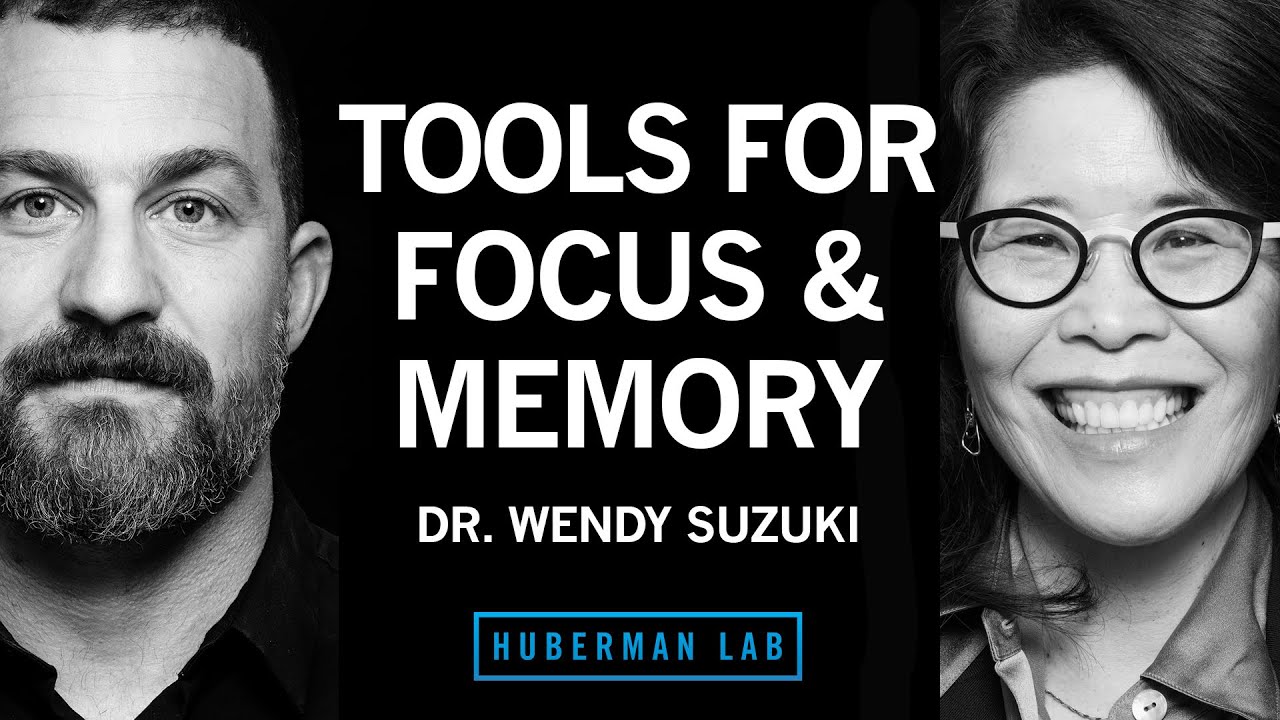
📺 Today’s recommended deep-dive video: https://www.youtube.com/watch?v=099hgtRoUZw
The Neurochemistry of Memory: How Exercise and Mindset Rebuild Your Brain
Dr. Wendy Suzuki, a world-renowned neuroscientist and Dean of Arts and Sciences at NYU, reveals the transformative power of physical activity on cognitive function. By understanding how the hippocampus stores our life stories, we can leverage movement and meditation to literally grow a more resilient, higher-performing brain.
Core Question: How can specific behavioral tools like exercise and meditation structurally and functionally enhance our memory and protect against cognitive decline?
Highlights
- The “Big Four” of memory: Novelty, Repetition, Association, and Emotional Resonance.
- Why exercise acts as a neurochemical “bubble bath” that triggers the birth of new neurons.
- The “minimum dose” of movement: How 10 minutes of walking can shift your neurochemistry.
- Why your morning routine—including cold exposure and meditation—is a non-negotiable for brain health.
⏱️ Reading time: approx. 8 minutes · Saves you about 99 minutes vs. watching.
Want to take notes while watching? Click the image below and let AI Notebook capture the key points for you 👇

The Anatomy of Remembering
The Four Pillars and the Seahorse
Your memories are the essential threads that weave together the story of your life, defining who you are and how you perceive the future. Without the ability to encode what we have done and who we have met, our sense of self dissolves into a perpetual, disconnected present.
To make information stick, the brain relies on four specific triggers: novelty, repetition, association, and emotional resonance. While a mundane white cup is easily forgotten, if that cup is presented in a surprising way or linked to a traumatic or joyous event, the brain’s “attention system” locks it into permanent storage. This occurs through a critical dialogue between the amygdala, which processes emotion, and the hippocampus, the brain’s primary engine for long-term memory.
The hippocampus is a stunning, seahorse-shaped structure tucked deep within the brain that functions as much more than just a filing cabinet for facts. Recent research suggests it is the seat of the imagination; without it, we cannot envision future scenarios because we lack the “memory blocks” required to build them. When this area is damaged—as seen in the famous case of Patient HM—individuals lose the ability to form any new memories of facts or events, effectively freezing their identity in time.

💡 Digging Deeper
Q: Why do we remember negative events more vividly than positive ones?
A: This is an evolutionary survival mechanism; the brain prioritizes “single-trial learning” for threats to ensure we avoid dangerous locations or behaviors in the future.
Q: Is the hippocampus the only place memories are stored?
A: No, while it is essential for encoding and intermediate storage, long-term memories are eventually distributed across the neocortex, though the hippocampus remains active in the retrieval process for years.
Q: Does “imagining” the future use the same brain regions as remembering the past?
A: Yes, the hippocampus assembles past experiences into novel combinations to allow us to simulate future events, a process known as prospection.
The Neurochemical “Bubble Bath” of Exercise
Growing a Fat, Spongy Hippocampus
Every time you move your body, you are essentially giving your brain a luxurious, chemical-rich soak in a cocktail of growth factors. This isn’t just about weight loss or heart health; it is about the structural integrity of your nervous system.
Physical activity, particularly aerobic exercise, triggers the release of Brain-Derived Neurotrophic Factor (BDNF), a protein that acts like high-grade fertilizer for neurons. This factor is responsible for neurogenesis—the birth of brand-new brain cells—in the adult hippocampus. While most areas of the adult brain do not grow new neurons, the hippocampus remains remarkably plastic, capable of expanding even into our 90s if given the right stimulus.
This biological upgrade is powered by two main pathways: the muscles and the liver. When we exercise, our striated muscles release “myokines,” proteins that cross the blood-brain barrier to stimulate BDNF production. Simultaneously, the liver responds to the stress of movement by releasing a ketone called beta-hydroxybutyrate, which provides an additional signal for the brain to increase its growth factor levels. The result is a larger, more efficient hippocampus that acts as a “buffer” against the eventual onset of age-related dementia.

💡 Digging Deeper
Q: How much exercise is needed to see these brain-building effects?
A: Studies show that even 10 minutes of walking improves mood, but 30-45 minutes of daily cardio is the gold standard for structural hippocampal growth.
Q: Is the benefit of exercise only for the elderly?
A: Absolutely not; Wendy Suzuki’s research shows that even young adults with low fitness levels see immediate memory and attention gains from just two or three spinning classes per week.
Q: Does intensity matter?
A: Yes, “every drop of sweat counts.” Higher-intensity cardio that significantly raises the heart rate correlates with greater improvements in both mood and hippocampal memory tasks.
Daily Protocols for Peak Cognition
Beyond the Gym: Meditation and Mindset
Consistency is the most powerful tool in the neuroscientist’s kit because the brain thrives on the non-negotiable repetition of healthy signals. To optimize cognitive performance, one must bridge the gap between physical vitality and mental stillness through a structured morning routine.
Dr. Suzuki advocates for a “science-based” morning that begins with an intentional 45-minute tea meditation, followed by a 30-minute cardio session and a final cold-water blast in the shower. This combination addresses the three pillars of high performance: focus, neuroplasticity, and alertness. Cold exposure, specifically, triggers a massive release of adrenaline and dopamine that can keep the brain in a state of heightened awareness for several hours after the shock.
Mindset also plays a physiological role, as seen in “IntenSati”—a workout that combines high-intensity movement with spoken affirmations. By shouting “I am strong” or “I am inspired” during a workout, you are using your own voice to override the “chatter” of negative self-talk. This isn’t just “feel-good” psychology; it is a method of utilizing the brain’s predictive coding to reshape your self-image and reduce cortisol-driven anxiety.

💡 Digging Deeper
Q: Why perform these protocols in the morning?
A: Exercise and meditation provide a “cognitive spike” that lasts for at least two hours; doing them early ensures your brain is at its peak when you begin your most demanding work.
Q: What if I don’t have an hour for meditation?
A: Dr. Suzuki’s research proves that even 12 minutes of daily “body scan” meditation significantly reduces stress and improves memory scores in as little as eight weeks.
Q: Is sleep more important than exercise?
A: Sleep is the most fundamental physiological requirement; you can survive without meditation, but chronic sleep deprivation will negate the benefits of any exercise or supplement.
Key Takeaways
The most profound realization from modern neuroscience is that we are the architects of our own brain structure. By engaging in regular aerobic exercise, we aren’t just improving our physique; we are actively cultivating a “fat, spongy” hippocampus that can withstand the ravages of time and disease. The release of BDNF through muscle and liver pathways provides the raw materials for new neurons, but it is the consistency of our daily habits—the morning walk, the cold shower, and the focused meditation—that cements these gains.
Furthermore, we must treat our attention as a finite and precious resource. In an age of digital distraction, the ability to anchor oneself in the present moment through “body scan” meditations or intentional movement is the differentiator between those who simply react to life and those who thrive. Whether you are a student facing exams or an adult looking to preserve your history, the prescription is simple: move your body, quiet your mind, and prioritize your sleep.
Q&A
Q1: What is the most famous case study in memory research?
A: Patient HM, who had his hippocampus removed in 1954 to treat epilepsy. While it cured his seizures, he lost the ability to form any new memories of facts or events for the rest of his life.
Q2: How does cold exposure actually help the brain?
A: The “cold shock” causes a sharp increase in adrenaline and noradrenaline from the locus coeruleus, providing a long-lasting arc of dopamine that improves mood and alertness for up to four or five hours.
Q3: Can 10 minutes of walking really make a difference?
A: Yes. Even a short 10-minute walk has been clinically shown to boost mood and reduce hostililty by triggering a “bubble bath” of dopamine and serotonin.
Q4: What is “Good Anxiety”?
A: It is the concept of leveraging the energy of anxiety as a tool for warning or preparation, rather than letting it become a paralyzing force, by using behavioral tools to regulate the nervous system.
Q5: What is the relationship between the liver and the brain during exercise?
A: During exercise, the liver releases the ketone beta-hydroxybutyrate, which crosses the blood-brain barrier and serves as a precursor/stimulant for the growth factor BDNF.
Q6: Why is the “tea meditation” effective?
A: It combines interoception (internal focus) with a ritualistic, present-moment activity, which trains the brain to move away from future-tripping or past-ruminating.
Q7: Do these benefits apply to people who are already fit?
A: Yes. Wendy Suzuki’s “unpublished” data shows that “medium-fitness” individuals who increased their exercise frequency saw linear improvements in mood and hippocampal memory.