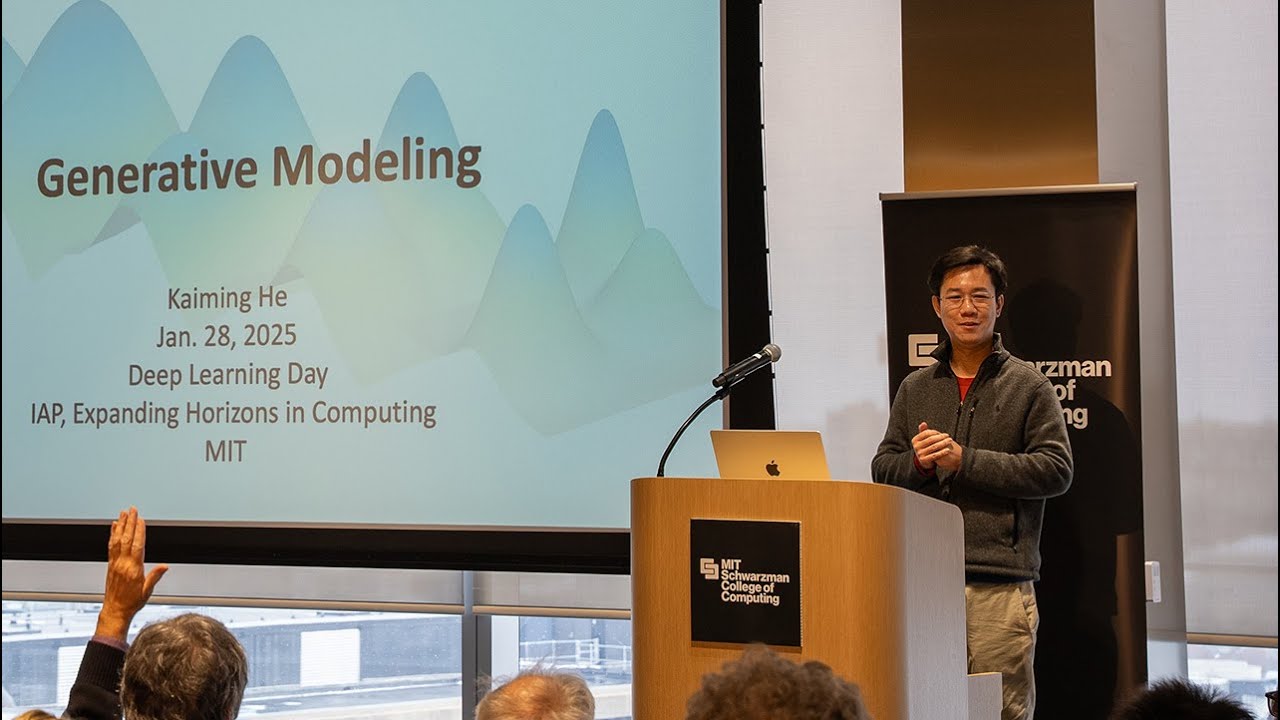
📺 Today’s recommended deep-dive video: https://www.youtube.com/watch?v=2yJSoaGU2i4
The Next Level of Abstraction: Mastering Generative Modeling
We are currently living through the “GenAI” era, a transformative moment where computers have transitioned from simple calculators to creative agents capable of synthesizing human-like text, images, and even protein structures. This shift is fundamentally rooted in a move from discriminative models that merely label the world to generative models that learn to replicate its underlying distributions.
Core Question: How do generative models transform the complex, high-dimensional probability of the real world into actionable, creative outputs across science and industry?
Highlights
- The fundamental distinction between discriminative models (finding boundaries) and generative models (mapping distributions).
- An overview of the “Big Four” architectures: VAEs, GANs, Auto-regressive models, and Diffusion/Flow Matching.
- How generative modeling solves “out-of-distribution” problems where the computer creates something it has never explicitly seen.
- The evolution of AI as a stack of abstractions, moving from layers to neural networks to generative agents.
⏱️ Reading time: approx. 7 minutes · Saves you about 47 minutes vs. watching.
Want to take notes while watching? Click the image below and let AI Notebook capture the key points for you 👇

The Philosophy of “Creating” vs. “Categorizing”
From Boundaries to Distributions
In classical machine learning, we mostly deal with discriminative models, which act like filters or judges. If you give a discriminative model an image of a dog, its entire job is to find a mathematical boundary that separates “dog” from “not dog” so it can assign a label. It cares about the conditional probability of a label given an image, essentially simplifying the world into a series of binary or categorical decisions.
Generative modeling reverses this entire logic.
Instead of asking “Is this a dog?”, a generative model asks “What are the characteristics that make up the ‘dog-ness’ of an image?” It attempts to model the actual probability distribution of the data itself. This is significantly more difficult because the output space is high-dimensional; while a label is just one word, a generated image contains millions of pixels that must all harmonize to look plausible to the human eye.

💡 Digging Deeper
Q: Why is generative modeling considered “unsupervised”?
A: Unlike supervised learning where every input has a fixed “correct” output label, generative models often have to figure out the relationship between random noise and structured data without a 1:1 map provided in the training set.
Q: Can a generative model create something it has never seen before?
A: Yes, this is known as out-of-distribution generation. By learning the “rules” of a distribution—like how light hits a surface—it can combine concepts (e.g., a “teddy bear teaching calculus”) that don’t exist in its training data.
The Modern Architectures of AI
The Evolution of the Generative Stack
The history of this field didn’t start with ChatGPT; it began decades ago with simple texture synthesis and “patch match” algorithms used in Photoshop. However, the real breakthrough came with Deep Neural Networks, which allowed us to represent probability distributions as layers of mathematical transformations.
Variational Autoencoders (VAEs) were among the first to treat distributions as objects that could be compressed and then reconstructed. Shortly after, Generative Adversarial Networks (GANs) introduced a “game theory” approach where two networks—a Generator and a Discriminator—competed against each other. The Generator would try to create a fake image, and the Discriminator would try to catch it, forcing the Generator to become increasingly realistic until the two distributions became indistinguishable.
Today, we have moved toward Diffusion and Flow Matching.
Diffusion models are inspired by thermodynamics; they take a clean image, slowly destroy it with Gaussian noise until it is unrecognizable, and then learn to reverse that process. It is like watching a drop of ink disperse in water and then training an AI to pull the ink back into its original shape. Flow Matching is the latest evolution of this, treating the transformation of noise into data as a smooth “flow” between geometric shapes, such as turning a simple sphere into a complex 3D bunny.

Real-World Applications Beyond Art
From Weather to Robotics
While image generation gets the most headlines, the true power of generative modeling lies in its ability to handle “chaotic” or “multi-modal” problems where there isn’t just one right answer. In weather forecasting, for instance, traditional physics-based models struggle with the chaotic nature of the atmosphere. Generative models can predict qualitative behaviors—like whether it will be rainy or windy—by sampling from a distribution of possible weather states, providing a more robust “best guess” than rigid classical algorithms.
In robotics, we use generative modeling for “policy learning.”
Imagine a robot trying to move an object; there are infinite paths its arm could take to reach the goal. A discriminative model might get confused by all the “correct” options, but a generative model can represent all those plausible trajectories as a distribution, allowing the robot to choose the most efficient path based on the current context. This is also how we are revolutionizing protein design—generating new molecular structures that have the “plausible” property of curing a specific disease, even if those proteins have never existed in nature.

💡 Digging Deeper
Q: How does “next-token prediction” relate to this?
A: Large Language Models use auto-regressive generation, which is just a specific type of generative modeling. It breaks a complex sentence into a chain of smaller, conditional probability problems—predicting one word at a time based on everything that came before.
Q: Is image classification now a “solved” problem using generation?
A: Not necessarily “solved,” but “expanded.” By treating classification as a generative task (Open Vocabulary Recognition), we can move beyond a fixed list of labels (e.g., “Cat” or “Dog”) to descriptive, nuanced answers (e.g., “A ginger tabby sitting on a sunlit windowsill”).
Key Takeaways
Generative modeling represents a paradigm shift in computer science where we no longer just program computers to follow rules, but rather to understand the “latent factors” of our world. By mastering the mapping between simple noise and complex data, we have unlocked the ability to generate everything from realistic videos to life-saving medicines.
We are building a massive stack of abstractions.
Ten years ago, AI research was about “layers” like convolutions and activations. Today, those layers have been bundled into “generative models,” which are themselves becoming the building blocks for even higher-level “reasoning agents.” Just as we moved from assembly language to Python, we are moving from pixel-manipulation to agentic AI that uses these generative distributions to navigate the real world.
Q&A
Q1: What is the main difference between a discriminative and a generative model?
A: A discriminative model learns the boundary between classes ($P(Y|X)$), while a generative model learns the actual distribution of the data ($P(X|Y)$ or $P(X)$), allowing it to create new examples.
Q2: Why is the “Teddy Bear teaching” example important?
A: It demonstrates “out-of-distribution” capabilities. The model hasn’t seen that specific image, but it understands the distribution of “teddy bears,” “blackboards,” and “teaching,” and can synthesize them into a coherent new reality.
Q3: How do Auto-regressive models work in simple terms?
A: They break a huge, complicated problem (like writing a paragraph) into many tiny problems. They predict the very next “token” or element based on the previous ones, creating a chain of conditional probabilities.
Q4: What is “Flow Matching”?
A: It is a cutting-edge technique that treats generative modeling as a geometric problem. It learns a “flow field” that smoothly morphs a simple distribution (like a sphere) into a complex one (like the shape of a human face).
Q5: Can generative models be used for standard tasks like image classification?
A: Yes. By treating the image as the “condition” and the label as the “data,” you can perform open-vocabulary recognition, where the AI provides descriptive captions instead of just picking from a pre-set list of tags.
Q6: Why is generative modeling useful for robotics?
A: In robotics, there are often many “right” ways to complete a task. Generative models allow the robot to represent all these possible “trajectories” and choose the best one, rather than trying to find a single mathematical “average” path that might not work.
Q7: What is the “next level” after generative models?
A: The speaker suggests that generative models are becoming the new “building blocks” for agentic machine learning and reasoning, where AI doesn’t just create content but acts as an autonomous agent solving multi-step problems.