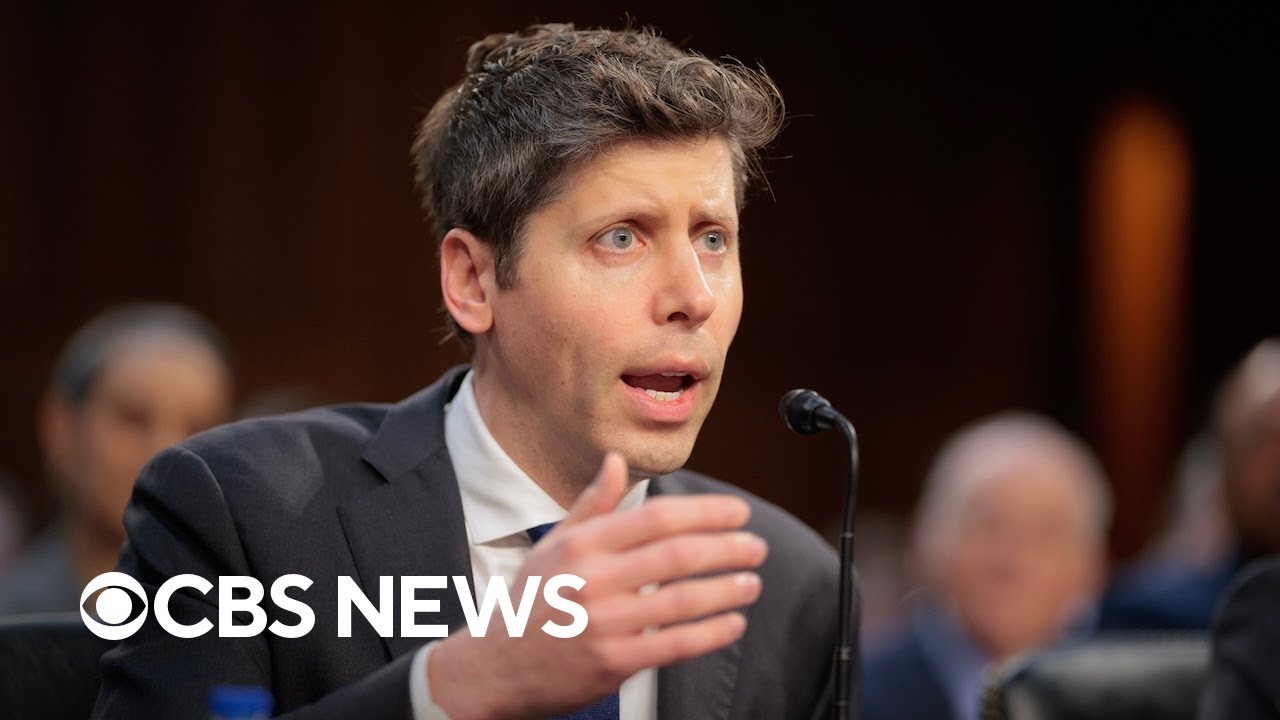
📺 Today’s recommended deep-dive video: https://www.youtube.com/watch?v=pxGE41V04fs
Silicon, Steel, and Sovereignty: The Senate’s Blueprint for AI Dominance
Artificial Intelligence has reached a transformative inflection point, sparking a global industrial revolution that will redefine the 21st-century order. This high-stakes Senate hearing explores how the United States can outpace China by leveraging “light-touch” regulation, massive infrastructure investment, and rapid technology adoption.
Core Question: How can the U.S. maintain its global lead in AI while balancing the need for massive energy expansion and sensible safety guardrails?
Highlights
- The Global Race: The U.S. must beat China’s 2030 goal by prioritizing innovation and avoiding the restrictive “command and control” regulatory models seen in Europe.
- The Infrastructure Bottleneck: AI leadership depends on “abundant intelligence and abundant energy,” requiring a massive overhaul of federal permitting for power and data centers.
- The AI Stack: Success requires a “string of pearls” strategy—unifying hardware (chips), software (models), and infrastructure (cloud) into a cohesive American ecosystem.
- Diffusion as Power: Global influence is secured when the world adopts American AI standards and software, effectively exporting democratic values through technology.
⏱️ Reading time: approx. 9 minutes · Saves you about 182 minutes vs. watching.
Want to take notes while watching? Click the image below and let AI Notebook capture the key points for you 👇

The Geopolitical Sprint: USA vs. China
Learning from the Internet Era
The United States currently stands at a critical fork in the road regarding technological governance and global economic leadership. Chairman Ted Cruz argues that the nation must draw on the success of the 1990s, where a decisively “light-touch” regulatory environment allowed the internet to flourish and eventually grow the American economy to be 50% larger than Europe’s.
The nation that secures the absolute lead in artificial intelligence today will effectively dictate the terms of the global economic and security order for the next century.
Critics of heavy regulation point to the European Union’s “failed policies,” where only 6% of global AI startup funding currently flows to EU firms. Industry leaders like Sam Altman and Brad Smith suggest that burdensome audits and risk assessments could stifle the “itinerant deployment” necessary to improve models. They believe the U.S. must remain an “innovation sandbox” to ensure that the brightest researchers and most ambitious projects, like the $500 billion “Project Stargate” in Texas, remain on American soil.

💡 Digging Deeper
Q: Why is the “diffusion” of AI technology considered a matter of national security?
A: If American AI is the global standard, our values of privacy and transparency are exported; if China leads, their “backdoor” surveillance and censorship become the global norm.
Q: What was the primary criticism of the Biden administration’s AI Executive Order?
A: Witnesses argued it cast AI as “dangerous and opaque,” potentially creating a “bureaucracy of busybodies” that would slow down American engineers compared to their Chinese counterparts.
Q: How far ahead is the U.S. compared to China in the current AI race?
A: Estimates vary, but leaders suggest a lead of roughly six months to two years, though this lead is “tentative” and requires constant acceleration to maintain.
Electrons and Silicon: The Physical Backbone
The Energy Crisis and Permitting Reform
To win the AI race, the U.S. must solve a looming physical crisis: the staggering demand for electricity. Michael Intrator of Coreweave noted that we cannot run a 21st-century economy on 20th-century infrastructure, especially as AI computing needs have multiplied 100,000-fold since 2018. The panel reached a unanimous consensus that “abundant energy” is the limiting reagent for American prosperity.
Permitting for federal wetlands and energy interconnections currently takes 18 to 24 months, a timeline that Microsoft’s Brad Smith describes as “excruciating” and unsustainable for rapid scaling.
To maintain a competitive edge, the U.S. must pursue an “all-of-the-above” energy strategy that includes natural gas, advanced nuclear (SMRs), and renewables. This expansion must be handled carefully to ensure that residential ratepayers do not see their bills skyrocket. By investing in private-public partnerships for grid improvements, AI hyperscalers hope to bring new generation online that actually lowers the overall cost of energy for the surrounding communities.

💡 Digging Deeper
Q: What is the most significant hurdle in building new data centers in the U.S.?
A: Federal permitting, specifically the Army Corps of Engineers’ wetlands permits, often takes twice as long as state or local approvals.
Q: How are companies addressing the massive water consumption of AI data centers?
A: Companies like Microsoft use “closed-loop” liquid cooling systems that recycle water and have committed to “water replenishment” projects to return more water than they consume.
Q: What is the significance of the CHIPS and Science Act for AI?
A: It provides the foundation for bringing the semiconductor supply chain back to the U.S., ensuring we don’t rely on adversaries for the physical “brain” of AI.
Guardrails, Safety, and the Global Market
Standards Without Stagnation
While industry leaders oppose European-style pre-approval, they do acknowledge the need for “sensible guardrails” to prevent social harm. This includes technical standards for identifying deepfakes, protecting intellectual property, and ensuring that AI does not “accelerate inequality.” The consensus suggests that standards should be developed by industry experts first and then adopted by federal bodies like NIST to ensure they are technically sound.
Never underestimate the ability of a human with a better tool to change the world; we are building machines to help people become better, not to replace them.
Export controls remain a contentious but vital part of the strategy. The panel argued that while we must keep advanced chips out of the hands of the Chinese military, we must not let “quantitative caps” prevent our allies from buying American technology. If the U.S. restricts its exports too tightly, it creates a market vacuum that China will eagerly fill with its own hardware and software, potentially leading to another “Huawei-style” security crisis where the world is built on adversarial infrastructure.

💡 Digging Deeper
Q: How can we protect children from AI-generated harms or “hallucinations”?
A: Leaders suggest stricter rules for juvenile accounts, including limited personas, while allowing adult users more “permissive” freedom to use the tools as powerful assistants.
Q: What is “iterative deployment” and why is it important for safety?
A: It is the practice of releasing models gradually so society can “co-evolve” with the technology, allowing developers to catch and fix bias or errors in a real-world setting.
Q: Will AI replace jobs on a massive scale?
A: While some disruption is expected, history shows technology creates new roles; the goal is to enhance productivity so a single programmer or scientist can do the work of ten.
Key Takeaways
The overarching message of the hearing is one of “urgent optimism.” To lead the world, the United States must treat AI not just as a software upgrade, but as a national infrastructure project on the scale of the Interstate Highway System. This requires a tri-partisan alignment between industry, the executive branch, and Congress to streamline the physical construction of data centers and power plants.
The competitive advantage of the U.S. lies in its “open ecosystem” and its ability to attract global talent. By maintaining a light-touch regulatory framework, the U.S. can ensure that the “next Sam Altman” is staying up late in an American attic, rather than a lab in Beijing. The success of this era will be defined by “abundant intelligence and abundant energy,” provided the government stays out of the way of innovation while providing the strategic support necessary to build the world’s most powerful “AI factories.”
Ultimately, the goal is to create a “virtuous positive cycle” where American AI is the most adopted, most trusted, and most innovative in the world. By winning the “diffusion race,” the U.S. can ensure that the global digital future is built on a foundation of democratic values, entrepreneurial freedom, and unprecedented human productivity.
Q&A
Q1: How does the U.S. plan to address the threat of Chinese models like DeepSeek?
A1: By continuing to out-innovate them. While DeepSeek showed that China can be efficient with limited hardware, American models remain the global gold standard in reasoning and safety.
Q2: What are “AI Hallucinations” and are they being fixed?
A2: Hallucinations are incorrect outputs. OpenAI reports that while not yet 0%, accuracy is improving rapidly as models learn to cite sources and utilize better “scientific reasoning” during training.
Q3: Why is “Project Stargate” significant?
A3: It represents a $500 billion private investment in U.S. infrastructure, signaling that the private sector is ready to spend massive capital if the regulatory environment remains stable.
Q4: Can AI be used for better government services?
A4: Yes. Leaders envision “AI agents” in every citizen’s pocket that can instantly handle tax filings, permit applications, and medical advice, eliminating bureaucratic “wait times.”
Q5: What is the industry’s stance on AI and copyright?
A5: There is a push for balance; creators must be rewarded for their “expression,” but the “ideas” within data must be accessible for models to learn and evolve, similar to how humans learn from reading.
Q6: What is a “Public Benefit Corporation” (PBC) in the context of OpenAI?
A6: It is a corporate structure that allows a company to pursue a mission—like “AI for all”—while still raising the massive private capital required to build world-class infrastructure.
Q7: How important are National Labs to the AI race?
A7: They are “crown jewels” that conduct foundational, “blue-sky” research that private companies might not pursue, creating a pipeline of discovery that industry then scales for the public.