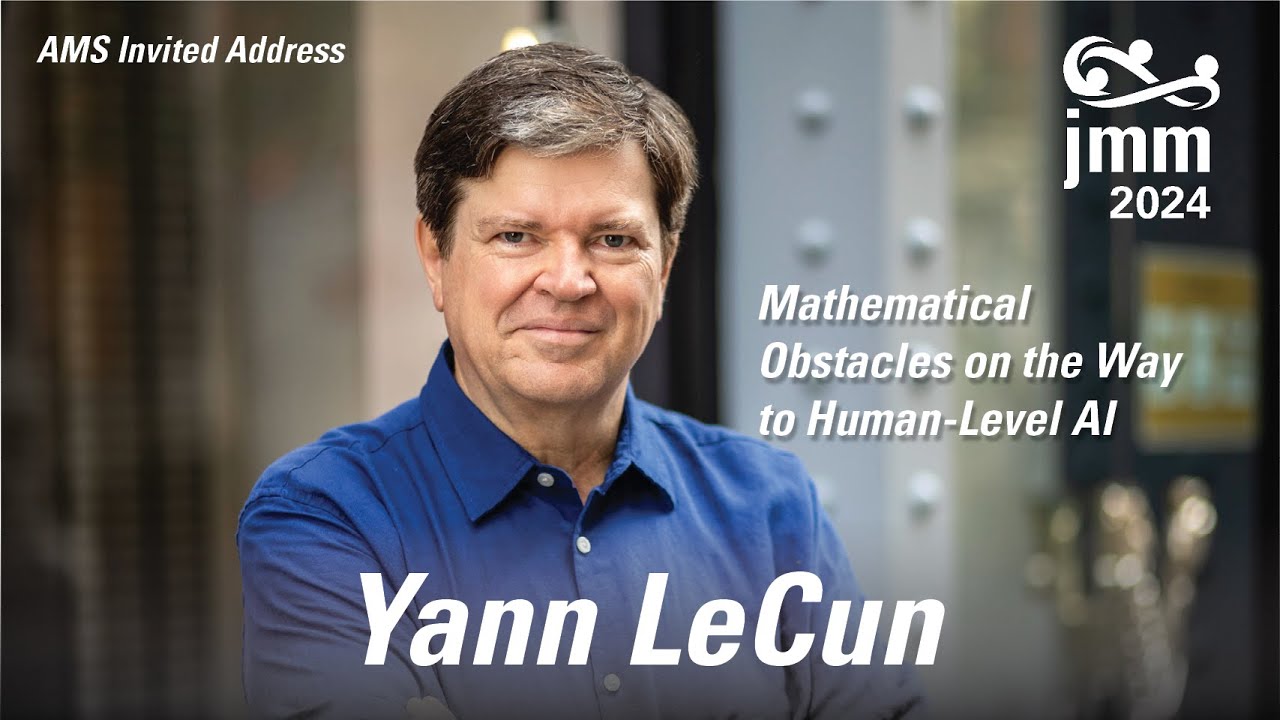
📺 Today’s recommended deep-dive video: https://www.youtube.com/watch?v=ETZfkkv6V7Y
Escaping the LLM Trap: Yann LeCun’s Blueprint for Truly Intelligent Machines
Large language models might seem magical, but they are fundamentally incapable of reaching human-level intelligence because they lack a physical understanding of the world. Turing Award winner Yann LeCun argues that we must move past simple next-token prediction toward “world models” that can reason, plan, and understand cause-and-effect. This shift requires a total rejection of current generative trends in favor of objective-driven architectures that mimic the way biological brains actually learn.
Core Question: How can we move from auto-regressive text predictors to AI systems that possess common sense and the ability to plan in the physical world?
Highlights
- Why auto-regressive LLMs are mathematically “doomed” due to exponential error divergence.
- The sensory data gap: Why a 4-year-old sees more data than all the text on the internet.
- JEPA (Joint Embedding Predictive Architecture) as the replacement for Generative AI.
- The transition from probabilistic inference to “System 2” inference via energy minimization.
⏱️ Reading time: approx. 8 minutes · Saves you about 48 minutes vs. watching.
Want to take notes while watching? Click the image below and let AI Notebook capture the key points for you 👇

The Ceiling of Large Language Models
The Mathematical Divergence Problem
Current AI is dominated by auto-regressive models that predict the next token in a sequence. While this works for generating text, it is a fundamentally divergent process where the probability of a sequence remaining “correct” vanishes exponentially as the length increases. In a tree of possible continuations with a branching factor of 100,000, even a tiny error rate per token eventually pushes the model out of the “set of correct answers” into the realm of hallucination.
This is why LLMs seem to “lose the plot” or produce nonsense over long horizons.
Because they lack a persistent internal state or a true understanding of the underlying reality described by the text, they are essentially sophisticated “statistical parrots” that cannot be fixed by simply adding more data.
The Sensory Data Gap
We often marvel at the trillions of tokens used to train models like Llama or GPT-4, but this pales in comparison to biological learning. A typical four-year-old child has been awake for 16,000 hours, and through the optic nerve, they ingest approximately 10^14 bytes of data—orders of magnitude more information than all the text ever produced by humanity. This visual and tactile data provides a “world model” that includes intuitive physics, gravity, and object permanence, which text alone cannot convey.
Language is a very low-bandwidth medium compared to the high-bandwidth sensory input of the physical world.
If we want machines to reach the level of a house cat, let alone a human, they must learn from video and sensory observation rather than just reading Wikipedia. A cat understands that if it jumps on a table, the table will support it; current AI does not “know” this—it only knows that the word “table” frequently follows the word “on.”

💡 Digging Deeper
Q: Why can’t we just scale LLMs to fix hallucinations?
A: Because the error is cumulative; scaling only delays the inevitable divergence without addressing the lack of a ground-truth world model.
Q: Is “Chain of Thought” a valid fix for reasoning?
A: It is a “hack” to force a fixed-computation model to spend more tokens on a problem, but it doesn’t represent true internal optimization or planning.
The JEPA Revolution: Moving Beyond Generative AI
Predicting Representations, Not Pixels
LeCun proposes a move away from Generative AI (GenAI) toward the Joint Embedding Predictive Architecture (JEPA). In a generative model, the system tries to predict every pixel in a future video frame, which is a waste of resources because most details—like the exact movement of leaves on a tree—are unpredictable and irrelevant. JEPA instead encodes the input and the target into an abstract representation space and makes its prediction there.
By ignoring the “noise” and focusing on the underlying structure, the model learns the “gestalt” of the scene rather than the texture.
This approach mimics human perception; when you see a person walking, your brain predicts their future location, not the exact pattern of the fabric on their shirt. Abandoning generative models prevents the “blurry prediction” problem that plagues current video-prediction systems.
Energy-Based Models (EBMs)
Instead of traditional probabilistic models that are often mathematically intractable, LeCun advocates for Energy-Based Models. In this framework, an “energy” scalar measures the compatibility between an input and a hypothesized output; inference then becomes the process of finding the output that minimizes this energy. This allows the system to handle “one-to-many” mappings, such as the multiple valid ways a person might choose to walk around an obstacle.
Inference by optimization is the key to what psychologists call “System 2” thinking—conscious, deliberate planning.

💡 Digging Deeper
Q: What is “collapse” in a JEPA model?
A: Collapse happens when the encoders decide to output a constant value for everything, making the prediction error zero but the information content also zero.
Q: How does the “World Model” differ from a standard neural net?
A: It is a specific module within a larger architecture that simulates the environment, allowing the “Actor” to test actions internally before performing them.
Designing the Cognitive Architecture
Hierarchical Planning and Objectives
Truly intelligent systems must be “objective-driven,” meaning they act to minimize a cost function that represents a goal or a guardrail. This requires hierarchical planning: I don’t plan a trip to Paris by calculating every muscle twitch; I plan at a high level (go to airport), then a medium level (get a taxi), and finally a low level (open the door). Current AI cannot do this; it operates at a single, flat level of token prediction.
Artificial Machine Intelligence (AMI) must be able to break down long-term goals into sub-goals across different time scales.
Without this hierarchy, AI will remain confined to digital screens, unable to navigate the messy, non-deterministic physical world of robotics or autonomous driving.
The Role of VicReg
To train these systems without labels, LeCun uses “VicReg” (Variance, Invariance, Covariance Regularization). This method prevents the model from collapsing by forcing the representations to maintain high variance and de-correlating the variables. It ensures that the model uses its full capacity to represent the richness of the world rather than taking the “easy path” of redundant outputs.
By maximizing the information content of the embeddings, the system discovers the true “features” of reality.

Key Takeaways
We are currently at a plateau where adding more text and more GPUs to auto-regressive models will yield diminishing returns. The path to human-level AI requires a fundamental shift in architecture—moving from “predicting the next word” to “predicting the state of the world.” This transition will involve replacing generative decoders with joint embeddings and replacing probabilistic sampling with energy-based optimization.
Ultimately, intelligence is the ability to plan and reason toward an objective. By building “World Models” that learn from the high-bandwidth data of the physical world, we can create AI assistants that aren’t just clever conversationalists, but capable agents that understand our reality, respect our guardrails, and solve complex, multi-step problems in the real world.
Q&A
Q1: Why does LeCun suggest abandoning Generative AI?
A1: Generative models waste too much computational energy on irrelevant details. Predicting in “representation space” (JEPA) allows a model to focus on the causal structure of the world rather than the textures of pixels.
Q2: What is “System 2” thinking in the context of AI?
A2: It is deliberate reasoning where the AI performs an internal optimization to find a sequence of actions that satisfies a goal, rather than just reacting with a pre-trained “System 1” response.
Q3: How do babies learn physics without being told?
A3: They use self-supervised learning, observing the world to build a mental model. By 9 months, they have learned that objects don’t float; they learn this by “filling in the blanks” of their observations.
Q4: What is the “Moravec Paradox” mentioned in the lecture?
A4: It is the observation that things humans find hard (like math or chess) are easy for computers, while things humans find easy (like folding laundry or walking) are incredibly difficult for AI.
Q5: Why is open source important for the future of AI?
A5: LeCun believes that for AI to be a safe and useful “amplifier of human intelligence,” the underlying platforms must be transparent and available for global contribution, rather than locked behind proprietary walls.
Q6: Can LLMs ever achieve “Common Sense”?
A6: No. Common sense is built on an understanding of the physical world’s constraints, which cannot be fully captured by language alone.
Q7: What is the main mathematical obstacle to Energy-Based Models?
A7: The “partition function” (the normalizing constant) is often intractable to compute, which is why LeCun suggests using regularized methods rather than trying to turn every energy function into a probability distribution.