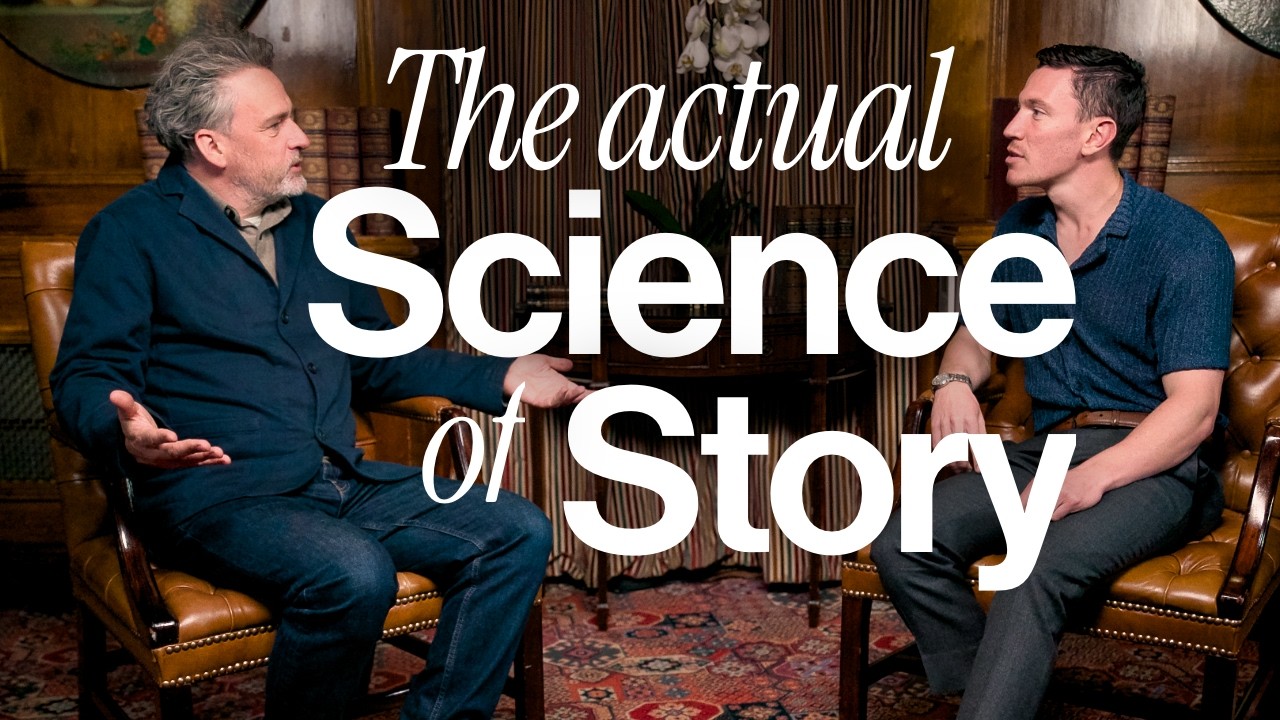
📺 Today’s recommended deep-dive video: https://www.youtube.com/watch?v=kDrsYMW_EYg
The Architecture of the Human Soul: Why Character Beats Plot Every Time
Most writers get trapped in the “Hero’s Journey” plot points, but the real magic of storytelling lies in the psychology of character. Will Storr argues that every great story is actually a laboratory for testing a character’s flawed “theory of control.” By shifting focus from what happens to who it happens to, you can create narratives that resonate on a primal, evolutionary level.
Core Question: How does our psychological drive for survival, connection, and status shape the stories we tell and the characters we love?
Highlights
- Character is a “theory of control”—a flawed mental model for navigating the world that the plot exists solely to challenge.
- Human brains process reality as a story to simplify chaotic information and facilitate social cooperation.
- Every enduring narrative is built on three primary human drivers: Survival, Connection, and Status.
- True suspense is generated by the “threat of change” rather than the explosive action of the “bang” itself.
⏱️ Reading time: approx. 8 minutes · Saves you about 60 minutes vs. watching.
Want to take notes while watching? Click the image below and let AI Notebook capture the key points for you 👇

The Psychology of the “Theory of Control”
The Flawed Lens of the Protagonist
We don’t see the world as it is; we see it as we need it to be to survive.
Will Storr posits that every character enters a story with a specific “theory of control”—a set of internal rules that dictates their behavior to get what they want. This theory is almost always a one-sentence belief system, such as “I am only safe if I have all the money” or “Men and women can’t be friends because sex gets in the way.” Because these theories are inherently flawed, the story acts as a pressure cooker that forces the character to confront the disconnect between their mental model and reality.
Take Ebenezer Scrooge as the quintessential example: his theory is that isolation and wealth equal safety, yet the “plot” (the three ghosts) serves only to dismantle that specific psychological defense. By the end of the narrative, the character must either update their theory to survive or double down and face a tragic end. This internal battle is far more gripping to the human brain than a series of disconnected explosions or chase scenes because it mirrors our own daily struggle to maintain a coherent sense of self in a changing world.
It is the specific “origin damage”—the past trauma that created the flawed theory—that gives a character their profound depth.

💡 Digging Deeper
Q: Does a writer need to explicitly state the “origin damage” in the text?
A: Not necessarily; Shakespeare often removed the “why” behind his characters’ actions to make them more mysterious and allow the audience to project their own theories onto the character.
Q: How do you distill a character into one sentence?
A: Complete the prompt: “I am only safe/successful if I…” The answer defines their entire trajectory.
Q: Can a plot exist without a character change?
A: In commercial fiction, it’s rare, but in high-quality literary fiction, the change might only be a tiny, realistic hint of a shift rather than a total Hollywood transformation.
The Three Drivers and the Five-Act Structure
The Engine of Human Desire
Storytelling is a biological necessity that allows us to function as a “collaborative super-organism” by aligning our individual goals.
Storr identifies three fundamental buckets that encompass all human motivation: survival, connection, and status. Our brains are evolutionary machines designed to scan for threats to these pillars; Alien is a survival story, while Whiplash is a status story. The most enduring tales, such as The Godfather, hit all three simultaneously, creating a rich tapestry of human anxiety and aspiration that feels universally authentic because it triggers our ancient tribal instincts.
Status, in particular, is the silent engine of the modern ego, driving us to be valuable to our groups to avoid the death sentence of social ostracization.

The Five Acts of Transformation
To map this psychological change, Storr utilizes a five-act structure that focuses entirely on the character’s internal state. Act One is “This is me and it’s not working,” where we see the flawed theory in action. Act Two asks “Is there another way?” as the character begins to experiment with a new version of themselves after a major disruption.
The midpoint, or Act Three, is the transformation point where the character fully embraces the new theory—like the protagonist in Jaws finally deciding to go into the water. Act Four, “Can I face the pain of change?”, tests the character with the ramifications of their choice. Finally, Act Five is the showdown where they decide if this transformation is permanent. This structure ensures the plot is always a servant to the character’s evolution.
Pacing, Suspense, and the Threat of Change
The Information Density of Moments
Hitchcock famously noted that there is no terror in the “bang,” only in the anticipation of it.
This “threat of change” is the secret weapon of the expert storyteller because it mirrors how our brains process high-stakes reality. When you meet someone who was in a car accident, they don’t describe the whole day; they describe the four seconds of the crash in extreme, high-density detail. In writing, you must slow down the fast bits of life—the moments of psychological change—by increasing sensory information.
By describing the smell of the air or the specific breakfast a character ate during a crisis, you signal to the reader’s brain that this moment is critical for their survival intelligence.

💡 Digging Deeper
Q: Why does “causality” matter so much in a story?
A: The human brain is a cause-and-effect machine; we see patterns even in random dots, so a story without clear causal links feels like “hard work” and loses the reader.
Q: What is the difference between a tragedy and a hero’s journey in this model?
A: In a hero’s journey, the character fixes their flaw; in a tragedy, they double down on their flawed theory and are destroyed by it.
Q: How does this apply to business leadership?
A: Groups are bound by shared stories; a leader’s job is to create a story that wires individual brains together to overcome obstacles in pursuit of a common goal.
Key Takeaways
Great storytelling isn’t about following a mechanical recipe of plot points like “The Hero’s Journey.” Instead, it is about understanding the evolutionary psychology of the human brain, which uses stories to navigate social status, form connections, and ensure survival. By identifying a character’s flawed “theory of control” and the “origin damage” that created it, you can build a narrative that feels both inevitable and profoundly moving.
The technical craft of writing involves manipulating information density—slowing down the most important moments of change to signal their significance. Whether you are writing a blockbuster movie, a literary novel, or a corporate mission statement, the goal is the same: to replace the listener’s consciousness with a new reality that teaches them how to be a more successful human being.
Q&A
Q1: Why does Will Storr prioritize character over plot?
A1: Because plot points are just external stressors; the real story is how those stressors force a character to confront and change their flawed internal model of the world.
Q2: What is the “Theory of Control”?
A2: It is a character’s specific strategy for navigating life, usually born from past trauma, which the story eventually proves to be incorrect or incomplete.
Q3: How does the brain process a car accident similarly to a good story?
A3: In both cases, the brain increases information density and slows down perceived time to focus on a critical “moment of change” that affects survival.
Q4: What are the three fundamental human drives in storytelling?
A4: Survival (staying alive), Connection (finding love/community), and Status (being valuable to the tribe).
Q5: What is the difference between commercial and literary character endings?
A5: Commercial stories usually feature a total character transformation, whereas literary stories often end with just a realistic hint or possibility of change.
Q6: How does “causality” affect the reader’s experience?
A6: The brain naturally seeks causes for every effect; when a story lacks a “domino effect” of causal events, it feels disjointed and requires too much conscious effort to follow.
Q7: What is “Origin Damage”?
A7: It is the foundational event in a character’s past that convinced them to adopt a specific, albeit flawed, theory of control to keep themselves safe.