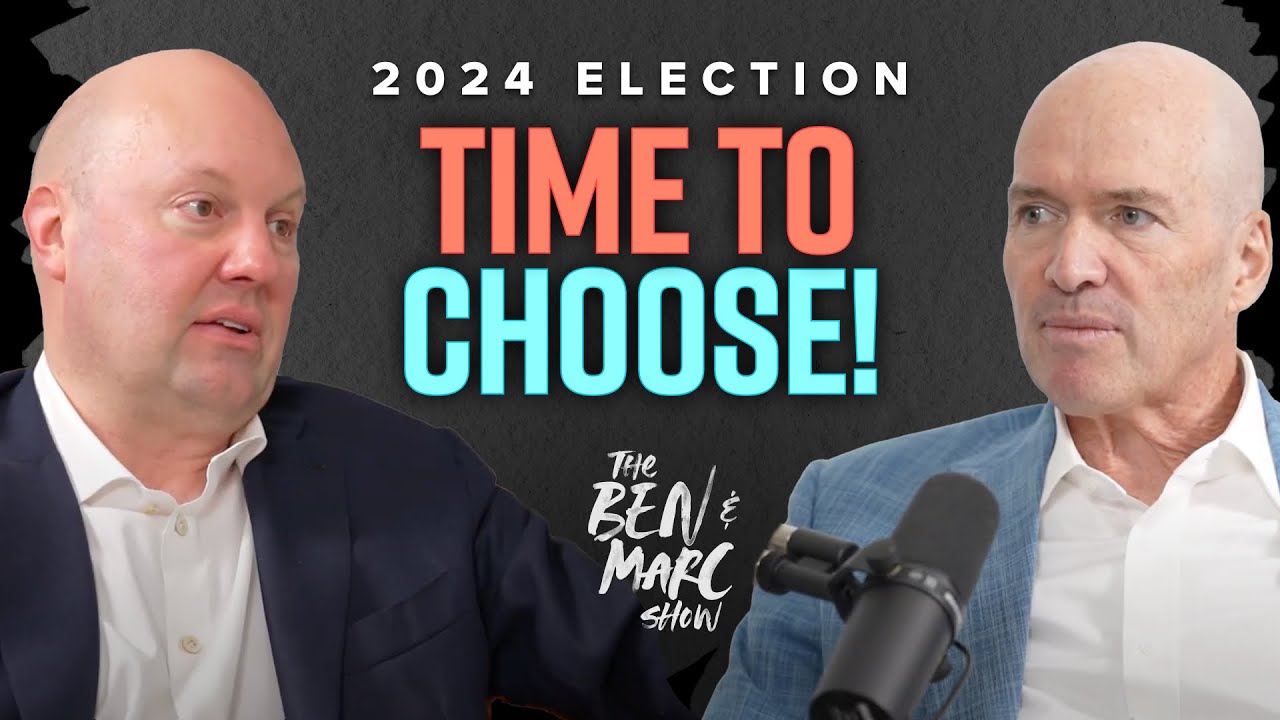
📺 Today’s recommended deep-dive video: https://www.youtube.com/watch?v=n_sNclEgQZQ
The “Little Tech” Agenda: Why Silicon Valley’s Elite are Crossing the Political Aisle
Silicon Valley legends Ben Horowitz and Marc Andreessen break decades of Democratic support to endorse Donald Trump, arguing that “Little Tech” startups face an existential threat. They contend that the future of American innovation, from AI to Blockchain, is being stifled by an aggressive administrative state and radical new tax proposals.
Core Question: Is the current administration’s regulatory and tax trajectory leading to the permanent dismantling of the American startup ecosystem?
Highlights
- The “Triangle of Power”: Why technological dominance is the prerequisite for both economic prosperity and military security.
- The Crypto “Chokepoint”: How the SEC and FDIC are allegedly using extra-legal means to debank and sue the blockchain industry into submission.
- The 10^26 Flop Limit: Why Ben and Marc view Biden’s AI Executive Order as a “math-regulating” maneuver that enshrines big-tech monopolies.
- The Argentina Warning: A breakdown of how the proposed tax on unrealized gains could systematically strip founders of their companies.
⏱️ Reading time: approx. 8 minutes · Saves you about 83 minutes vs. watching.
Want to take notes while watching? Click the image below and let AI Notebook capture the key points for you 👇

The Foundation of Global Stability
The American Triangle: Tech, Economy, and Military
Since World War I, the United States has maintained its position as the preeminent global power through a self-reinforcing triangle of dominance. This cycle begins with technological preeminence, which drives the economic growth necessary to fund the world’s most advanced military. Without the “Tech” corner of this triangle, the other two inevitably collapse.
America’s best days are not necessarily behind it, but the balance is currently precarious.
Technological dominance is not a historical accident; it was built by “Little Tech” entrepreneurs like Thomas Edison and Henry Ford who created the manufacturing base that won World War II. The speakers argue that monopolies, by their very nature, stop innovating because they simply don’t have to. Real breakthroughs come from startups that either succeed directly or force incumbents to react, as seen with OpenAI’s impact on Google’s AI strategy.
The defeat of Soviet communism in 1989 was essentially a surrender triggered by falling behind in this specific triangle. The Soviets realized they could no longer compete technologically or economically, rendering their military strength moot.

💡 Digging Deeper
Q: Why do startups matter more than established monopolies for national security?
A: Monopolies are risk-averse and focus on lobbying; startups are the primary source of unpredictable, “permissionless” innovation that creates strategic advantages.
Q: Is the American lead in technology guaranteed?
A: No. It is an inherited advantage that can be lost through “top-down” government control, similar to how Argentina’s talent was stifled by bad policy.
Q: What is the disagreement with Peter Thiel?
A: Marc disagrees with Thiel’s “Monopoly is Good” thesis, arguing that monopolies are “death to innovation” and must be provoked by startup competition.
Regulation as a Weapon
The War on Blockchain and AI
The speakers describe a “brutal assault” on the crypto industry, which they view as a transformative technology for “stakeholder capitalism” and digital truth. They allege that the Biden administration has bypassed the legislative process to “nuke” the industry through “Chokepoint 2.0″—a coordinated effort to prevent crypto companies from accessing basic banking services.
This is not a failure of law, but a deliberate use of the administrative state to bypass the will of Congress.
The concern extends to Artificial Intelligence, where the current administration’s Executive Order sets a “flop limit” (computational power limit) for models. Ben and Marc argue this is a misguided attempt to “regulate math” that will only serve to create an “OPEC of AI” dominated by three or four big companies. This approach ignores Moore’s Law, which will soon make today’s “exotic” supercomputing power available on a common laptop.
By contrast, they highlight the 2024 Republican platform, which explicitly promises to end the “un-American crypto crackdown” and repeal the AI Executive Order. Trump’s view, as described by the duo, is simpler and more pragmatic: AI is scary, but America must win the race against China at all costs.

💡 Digging Deeper
Q: What is “Chokepoint 2.0”?
A: A tactic where the FDIC pressures banks to drop crypto clients, effectively outlawing the industry without passing a single law.
Q: Why is the “flop limit” in the AI Executive Order criticized?
A: It treats computational power like a controlled substance, failing to account for the rapid deflationary cost of technology and software efficiency.
Q: How does Worldcoin illustrate the problem?
A: It is a product that proves “humanness” in an AI world, yet it is launched everywhere except the US due to regulatory hostility.
The Existential Threat of New Tax Structures
The End of the Startup Dream
The final straw for the a16z founders is the proposal to tax unrealized capital gains. Currently, capital gains are taxed only when an asset (like a house or company stock) is sold; the new proposal would require individuals with a high net worth to pay a 25% annual tax on the “paper” increase of their assets.
This is an “anarcho-tyranny” where laws are applied to the law-abiding while the system itself becomes chaotic.
For a startup founder, this means being forced to sell 25% of their ownership every year to pay taxes on a valuation that might not even be “real” yet. Because the IRS only accepts US dollars—not private stock—founders would be forced to liquidate their holdings or take on massive debt. Over a decade, this would systematically strip founders of their companies and make venture capital a mathematical impossibility.
While marketed as a “billionaire tax,” the speakers warn of a historical pattern where taxes start at the top and “walk down” the income ladder as the tax base shrinks. They predict this would eventually hit every tech employee and California homeowner, turning the US economy into a cautionary tale similar to Argentina.

💡 Digging Deeper
Q: Why is a tax on “unrealized” gains different from a normal tax?
A: It taxes money you haven’t actually received yet, forcing you to sell illiquid assets (like a company you are still building) to pay the bill.
Q: How would this affect the state of California?
A: Up to 50% of California’s tax receipts come from the top 1,000 taxpayers; destroying the tech sector would effectively bankrupt the state’s school and social systems.
Q: What is the “Kulak” analogy?
A: It refers to how the Bolsheviks eventually targeted anyone with “two cows” after they ran out of rich people to tax/eliminate.
Key Takeaways
The endorsement of Donald Trump by Ben Horowitz and Marc Andreessen is rooted in a “one-issue” focus: the survival of the Little Tech agenda. They characterize the Biden administration’s policies—ranging from the SEC’s litigation-first approach to crypto to the Treasury’s proposal for unrealized gains taxes—as a radical departure from the pro-business Democratic eras of Clinton and Obama. These policies are seen as “optional” choices that prioritize administrative control over technological progress.
The duo emphasizes that technological leadership is the only way to ensure American security in a world where China is aggressively harnessing AI for its military. They argue that the US cannot afford to “classify math” or put “flaming hoops” in front of its entrepreneurs while its adversaries move at full speed.
Ultimately, their message is a plea for “adult, sober conversations” in Washington. They believe that by supporting a platform that champions innovation and deregulates emerging sectors, they are protecting the fundamental engine of the American dream: the ability for any talented individual to build something new without seeking permission from a calcified bureaucracy.
Q&A
Q1: Why are you coming out publicly with this endorsement now?
A1: Because the future of technology and America is literally at stake. The “Little Tech” agenda has become a partisan issue, and the current administration’s policies have become too destructive to ignore.
Q2: What is your personal relationship with the candidates?
A2: We have met with Trump and many top White House officials (like Jake Sullivan and Gina Raimondo), but we have been unable to secure a meeting with President Biden or Senator Elizabeth Warren.
Q3: How did the assassination attempt on Trump affect your perspective?
A3: It showcased a level of “physical courage” that is rare. Seeing a 78-year-old man get shot and immediately stand up to fire up a crowd is a remarkable display of resilience, regardless of your politics.
Q4: Is your support for Trump just about lower taxes?
A4: No. It’s about tax structure. We aren’t arguing about rates; we are arguing against a “realization” change that would make starting a company mathematically impossible.
Q5: What do you think of the “Precautionary Principle” in Europe?
A5: It’s a warning sign. Europe has essentially eliminated its own tech industry by trying to “stop the future” before it happens. We don’t want America to follow that path.
Q6: Are there any Democrats you still support?
A6: Yes, we remain bipartisan in our donations and support “heroic” Democrats like Ritchie Torres and Chuck Schumer who have fought for common-sense tech legislation.
Q7: What happens if China wins the AI race?
A7: We live in a very “dark world” characterized by top-down surveillance and a loss of American economic and military leverage. Winning is the only viable option.