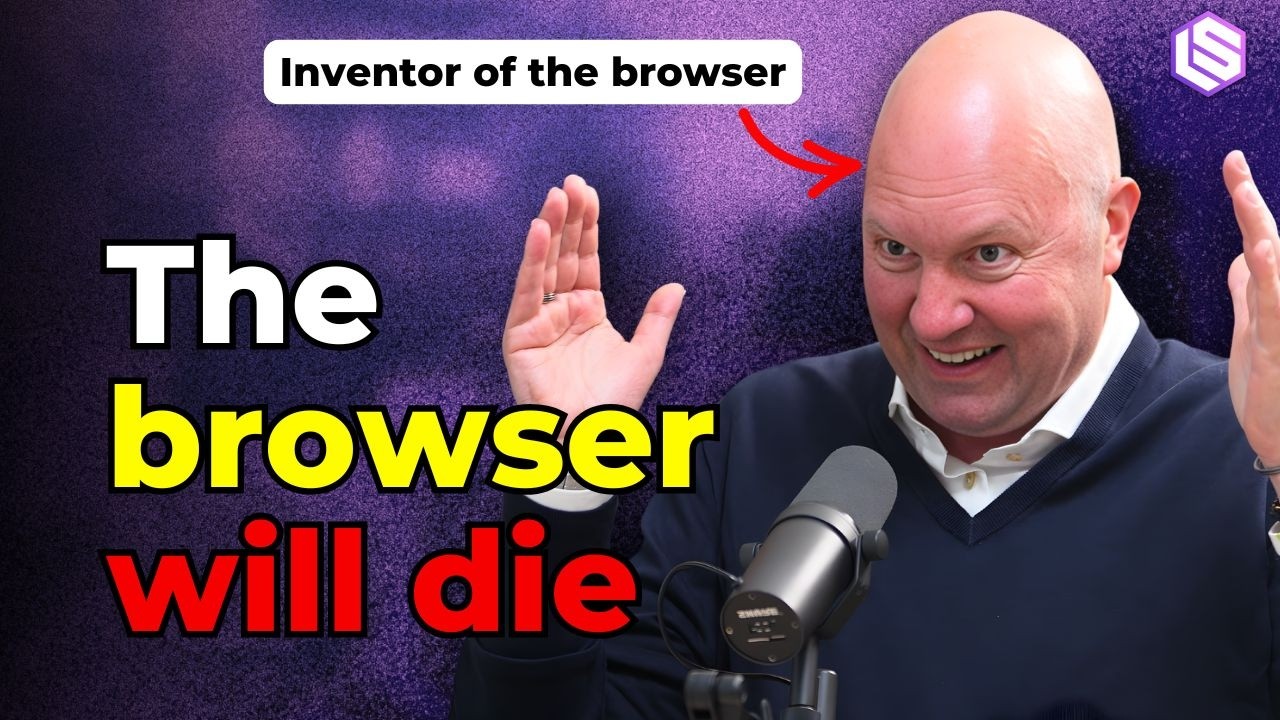
📺 Today’s recommended deep-dive video: https://www.youtube.com/watch?v=knx2wrILP1M
The 80-Year Overnight Success: Why AI is Finally Real
The current explosion in artificial intelligence isn’t a sudden fluke, but the culmination of eight decades of research that has finally hit the “knee” of the curve. From the 1943 origins of neural networks to the reasoning breakthroughs of 2025, we have transitioned from simple pattern completion to agentic systems that can think, code, and self-correct.
Core Question: How does the convergence of the “Unix mindset” and reasoning models transform AI from a creative toy into a robust, self-improving infrastructure for the global economy?
Highlights
- The Four Breakthroughs: We have moved through four distinct levels of capability: LLMs, Reasoning (o1/R1), Agents (OpenClaw/Pi), and Recursive Self-Improvement.
- The Unix Mindset: The next leap in AI isn’t a new model, but an architecture that pairs LLMs with a Bash shell, file system, and “cron” heartbeat.
- Software as a Fungible Commodity: In a world where bots emit binaries and weights directly, high-quality code moves from a scarce resource to an infinite, cheap utility.
- The Managerial Friction: While technology accelerates at a “ferocious” pace, real-world adoption is slowed by “managerial capitalism,” professional cartels, and labor unions.
⏱️ Reading time: approx. 8 minutes · Saves you about 68 minutes vs. watching.
Want to take notes while watching? Click the image below and let AI Notebook capture the key points for you 👇

The 80-Year Overnight Success
From Dartmouth to DeepSeek
The history of AI is a repetitive cycle of “summer” and “winter” that stretches back to the first neural network paper in 1943.
In 1955, experts at Dartmouth thought they could solve AGI in ten weeks; instead, it took seventy years of controversial research to prove that the neural network was the correct architecture. For decades, scientists like John McCarthy and Alan Newell worked on these concepts without ever seeing them truly succeed in the real world. We are currently living through an “80-year overnight success,” where a massive backlog of hardcore research is suddenly being unlocked by massive compute and the Transformer architecture.
This isn’t just a trend; it’s the payoff for generations of scientists who were fundamentally right about the physics of intelligence.

💡 Digging Deeper
Q: Why was the neural network controversial for so long?
A: For nearly 60 years, researchers debated whether symbolic logic (expert systems) or connectionism (neural networks) was the path forward, with networks often dismissed as impractical.
Q: What was the “knee” in the curve for modern AI?
A: The AlexNet breakthrough in 2013 provided the first major validation of deep learning at scale, followed by the 2017 Transformer paper.
Q: Is this time different from the 2016-17 AI boom?
A: Yes, because the models have moved beyond creative writing into reasoning and coding tasks that Linus Torvalds himself admits are competitive with top humans.
The Agentic Architecture: LLMs Meet Unix
The Power of the Shell
The most profound recent shift in software isn’t a bigger model, but the marriage of LLMs to the “Unix mindset.”
Modern agents like OpenClaw and Pi aren’t monolithic castles of code; they are modular systems that combine a language model with a Bash shell, a file system, and a recurring “cron” heartbeat. This architecture allows an agent to be independent of its underlying model, meaning you can swap the LLM “brain” while keeping the agent’s state, memories, and tools intact. Because these agents have access to the shell, they can use any existing command-line tool, essentially turning the entire history of computing into their playground.
The agent becomes an introspective entity that can rewrite its own files and extend its own capabilities on the fly.

💡 Digging Deeper
Q: What makes the “Unix mindset” so effective for agents?
A: It treats the operating system as a programming language, allowing agents to chain discrete modules together rather than relying on a single, rigid application.
Q: Can an agent truly improve itself?
A: Yes; because agents can introspect their own code and files, they can identify missing features, write the necessary code, and “migrate” themselves to new environments.
Q: Why use text protocols instead of binary?
A: Text protocols and human-readable code (like Markdown) allow for “view source” transparency, enabling both humans and bots to understand and fix the system easily.
The Economics of Infinite Software
Scaling Laws and Supply Crunches
We are entering an era where high-quality software is no longer a precious, scarce resource managed by elite engineers.
In the past, we were “jealous” with our engineering hours, carefully deciding which bugs to fix and which features to build because human labor was the bottleneck. Today, with coding agents, software is becoming a fungible commodity that can be generated, secured, and translated across languages with a simple “hand-wave.” This transition mirrors Moore’s Law, where the hardware and software scaling laws create a self-fulfilling prophecy of exponential growth. Even as we face a chronic supply shortage of GPUs, the software is improving so fast that older chips are actually becoming more valuable over time.
This “depreciation reversal” is unprecedented in the history of technology and signals a massive shift in how we value compute infrastructure.

💡 Digging Deeper
Q: How does the current GPU shortage compare to the Dot-com crash?
A: Unlike the 2000 fiber overbuild, every dollar put into GPUs today is immediately generating revenue, though we still face a 3-4 year supply chain sell-out.
Q: Will we still need programming languages in ten years?
A: Possibly not; bots may eventually emit binary code or even “model weights” directly, making human-readable abstractions a form of “interpretability” rather than a necessity.
Q: What is the “Managerial” threat to AI growth?
A: Economic progress is often blocked by “cartels” like professional certifications or unions that prevent automation in sectors like healthcare, law, and education.
Key Takeaways
The fundamental nature of work is shifting from “doing” to “directing.” In the same way that 99% of humanity once worked behind a plow before moving to more complex tasks, we are moving away from the manual labor of coding and paperwork. AI agents are the “super-managers” of the future, enabling a single founder to operate with the leverage of a massive corporation without the bureaucratic bloat of traditional middle management.
The unification of AI and Crypto will likely provide the missing pieces of the internet: “Proof of Human” and native payments. As bots become indistinguishable from humans, we will need biological validation (like World/Worldcoin) to prove who is a real person and who is an agent. This creates a secure layer where agents can hold bank accounts, hire humans, and participate in the economy as independent actors.
Ultimately, the friction of the real world—unions, government monopolies, and professional certifications—will determine the speed of AI’s GDP impact. While the technology is ready to accelerate growth 10x, society must decide whether to embrace this “consumer cornucopia” or protect legacy structures that lead to stagnation.
Q&A
Q1: Is an “AI Winter” still possible?
A: While hype cycles are inevitable, the “this time is different” argument holds because the technology is finally working in the real world, particularly in coding and reasoning.
Q2: Why is “Open Source” AI so critical for the industry?
A: It drives information diffusion. When a lab like DeepSeek releases a paper and code (like R1), it teaches the entire world how to replicate breakthroughs, preventing a total monopoly.
Q3: How do agents handle security?
A: While agents might expose more bugs initially, they are also the solution; they can automatically scan, identify, and fix latent security flaws across entire codebases at scale.
Q4: What is “Proof of Human” and why do we need it?
A: Since bots can now pass the Turing test, we cannot prove “not a bot.” We must instead use biometrics and cryptography to prove someone is a person to prevent bot spam.
Q5: Can AI agents truly operate my smart home?
A: Yes. By hacking into “dumb” Internet of Things devices and rewriting their firmware, an agent can unify disparate systems into a coherent, truly smart home.
Q6: What is the “Managerial Capitalism” problem?
A: It’s the shift from founders (Henry Ford) to professional managers. AI allows a return to the “founder” model by automating the administrative complexity that previously required a massive staff.
Q7: Will AI make humans “log off and touch grass”?
A: As software begins to interact with other software, humans may spend less time staring at user interfaces and more time focusing on high-level goals and personal relationships.