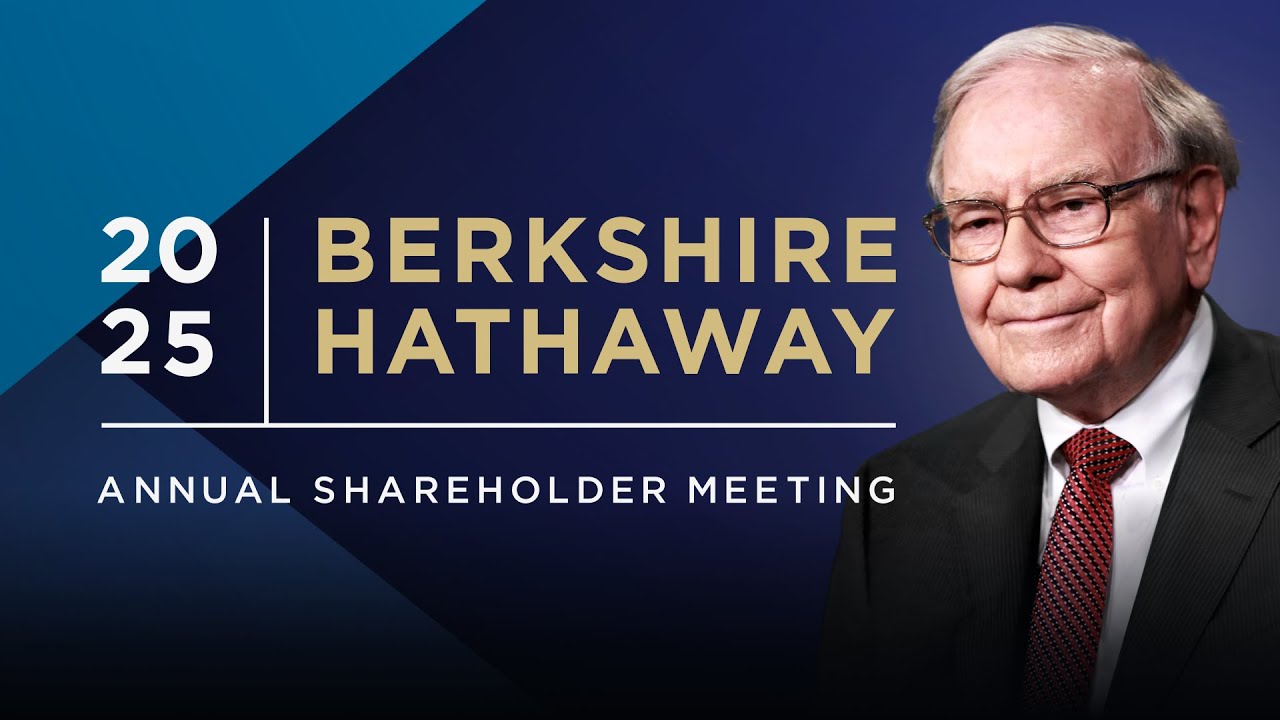
📺 Today’s recommended deep-dive video: https://www.youtube.com/watch?v=1LWBphTImy4
The End of an Era: Buffett Hands the Baton to Greg Abel
After sixty years of guiding the world’s most famous investment conglomerate, Warren Buffett used the 2025 Berkshire Hathaway annual meeting to deliver the definitive word on the company’s future. The “Oracle of Omaha” signaled a major structural shift by recommending that Greg Abel take over the CEO role by the end of the year.
Core Question: How will Berkshire Hathaway preserve its unique culture and manage its record $348 billion cash pile as it transitions to a post-Buffett leadership era?
Highlights
- Greg Abel is named CEO effective January 1, 2026, with Howard Buffett slated as future non-executive Chairman.
- Buffett warns that aggressive trade tariffs are a “big mistake” and represent an act of “economic war.”
- Berkshire’s cash hoard reaches a staggering $347.7 billion, surpassing the combined cash of Apple, Microsoft, Google, and Amazon.
- GEICO completes a historic turnaround, reducing its workforce by 20,000 to achieve a market-leading 80% combined ratio.
⏱️ Reading time: approx. 15 minutes · Saves you about 368 minutes vs. watching.
Want to take notes while watching? Click the image below and let AI Notebook capture the key points for you 👇

The Succession Shockwave
A Surprise recommendation for Greg Abel
The transition from a founder-led cult of personality to a professionally managed institution is no longer a theoretical exercise; it is an imminent reality.
Greg Abel has spent the last seven years deeply embedded in Berkshire’s non-insurance operations, learning the distinct DNA of over sixty subsidiaries. Buffett’s decision to name him CEO at year-end reflects a profound trust in Abel’s strategic ability to allocate capital and manage diverse managerial personalities without the “Oracle” looking over his shoulder.
While Howard Buffett will eventually take on the role of non-executive chairman to protect the corporate culture, the day-to-day tickets now belong to Abel. This move, delivered as a surprise recommendation to the board, formalizes the hierarchy of the post-Buffett era. Buffett intends to remain a sounding board, coming into the Omaha office daily, but the final word on acquisitions, share repurchases, and operational pivots will now rest squarely with the man from Edmonton.

💡 Digging Deeper
Q: Will the corporate headquarters move out of Omaha?
A: No, Greg Abel confirmed that the office remains in Omaha to maintain its historical roots.
Q: Who will have the final say on capital allocation?
A: Buffett explicitly stated that Greg Abel will have the final word on capital deployment and acquisitions.
Q: What role does Howard Buffett play?
A: He is the “guardian of the culture,” serving as non-executive chairman to ensure the company doesn’t drift into traditional corporate behavior.
Macro Policy and the “Economic War”
The Perils of Global Tariffs
Buffett did not mince words regarding the current geopolitical climate, describing punitive tariffs as a regression into a more dangerous era of international relations.
He believes the United States has already “won the game” of global capitalism and that aggressive protectionism risks alienating 7.5 billion people for the sake of 300 million.
The Oracle argued that trade should be a bridge to prosperity rather than a weapon of mass destruction. He specifically referenced his 2003 “Import Certificate” proposal as a more balanced way to manage trade deficits without declaring economic war on allies. For a company like Berkshire, which owns everything from Fruit of the Loom to massive energy grids, the uncertainty of trade policy creates a “FOMO” (fear of missing out) surge in demand followed by painful inflationary troughs.
The Japanese Connection
Berkshire’s massive stake in the five largest Japanese trading houses—Itōchū, Marubeni, Mitsubishi, Mitsui, and Sumitomo—remains a cornerstone of its international strategy.
Buffett views these companies as permanent fixtures in the portfolio.
The strategy is unique: Berkshire borrows in Japanese Yen at incredibly low interest rates to fund equity purchases in the same currency, effectively hedging the currency risk while capturing a significant yield spread. Greg Abel has taken the lead on these relationships, visiting Japan to meet with executives who operate with a multi-decade mindset that perfectly mirrors Berkshire’s own philosophy.

💡 Digging Deeper
Q: Why borrow in Yen to buy Japanese stocks?
A: It creates a natural hedge; if the Yen devalues, the debt becomes cheaper to repay, protecting the dollar-denominated value of the investment.
Q: What is the long-term plan for the Japan holdings?
A: Buffett stated Berkshire has no intention of selling these stocks for at least 50 years.
Q: Does Berkshire worry about the US Dollar losing reserve status?
A: While concerned about fiscal deficits, Buffett believes the US Dollar remains the only viable global reserve currency for the foreseeable future.
The $348 Billion Fortress
Why Berkshire is Sitting on the Sidelines
The most striking figure in the Q1 2025 report was the cash hoard, which has swelled to $347.7 billion.
This “dry powder” is not a sign of fear, but a reflection of a market that Buffett believes lacks “fat pitches.”
He explained that deploying $100 billion is a five-second decision if the right opportunity exists, but he refuses to “swing” at mediocre deals just to stay fully invested. The record cash level actually gives the company a competitive advantage during periods of market “hair curlers,” where panicked sellers look for a reliable buyer of last resort. For now, the money sits in short-term Treasuries, earning a respectable return while waiting for the next great American business to go on sale.
The GEICO Turnaround and AI
Ajit Jain and Todd Combs have successfully navigated GEICO through a period of intense technological lag.
By slashing the workforce by 20,000 and aggressively adopting telematics, GEICO has caught up to competitors like Progressive.
Jain noted that the shift from human-error-based insurance to product-liability-based insurance—driven by autonomous vehicles—is the next great hurdle. While AI is viewed as a potential game-changer for underwriting, Buffett remains cautious, comparing the technology to the atomic bomb: a “genie” that cannot be put back in the bottle once released.

💡 Digging Deeper
Q: Why did Berkshire stop buying back its own shares?
A: Buffett believes the stock is currently trading at a “rich” valuation, and he only repurchases shares when they are significantly underpriced.
Q: How did GEICO save $2 billion annually?
A: Through a massive staff reduction and a pivot toward automated systems and telematics-based pricing.
Q: Is AI a threat to Berkshire’s insurance dominance?
A: Ajit Jain believes it will drastically reduce accident frequency but increase the cost of technology-heavy repairs.
Key Takeaways
The 2025 meeting was a masterclass in institutional continuity. While the headlines focused on Greg Abel’s promotion, the underlying message was that Berkshire’s “Cathedral”—its culture of trust, long-term thinking, and capital discipline—is built to survive the transition from its architect. Buffett’s refusal to chase the “Casino” of high-valuation tech or speculative AI underscores his belief that rationality is the ultimate competitive advantage.
The company is positioning itself not just as an investment vehicle, but as a strategic asset for the United States. With more cash than the largest tech giants combined, Berkshire is ready to act as the lender of last resort when the next crisis hits. Whether it is stabilizing the energy grid or acquiring iconic brands during a recession, the “Abel Era” begins with a balance sheet that is arguably the strongest in corporate history.
Q&A
Q1: Why did Berkshire sell a significant portion of its Apple stake?
A: Buffett hinted that the decision was partly driven by the current tax environment and a high valuation, though he noted that Tim Cook has made more money for Berkshire than Buffett himself.
Q2: What is the biggest risk to Berkshire’s energy business?
A: Wildfire liabilities in the West. Greg Abel noted that the company must work with regulators to ensure they are not the “insurer of last resort” for climate-driven disasters.
Q3: Will Berkshire ever pay a dividend?
A: Not as long as the leadership believes they can create more than one dollar of value for every dollar retained, though this remains a perennial debate as the cash pile grows.
Q4: How does Buffett view the current US deficit?
A: He described the 7% GDP deficit as unsustainable and warned that fiscal policy is the primary threat to the long-term value of the US Dollar.
Q5: Why is Berkshire so bullish on Japan?
A: The trading companies are diversified, well-managed, and were trading at “ridiculously low” prices when Berkshire first started buying six years ago.
Q6: What is the “Tapeworm” of the US economy?
A: Healthcare costs. Buffett noted that the failed “Haven” venture with JP Morgan and Amazon showed that the $4 trillion industry is too entrenched to be changed by private enterprise alone.
Q7: Will Warren Buffett still be involved after Greg Abel becomes CEO?
A: Yes. He plans to come into the office daily and serve as a “Charlie Munger-style” sounding board, though Greg Abel will hold the final decision-making power.