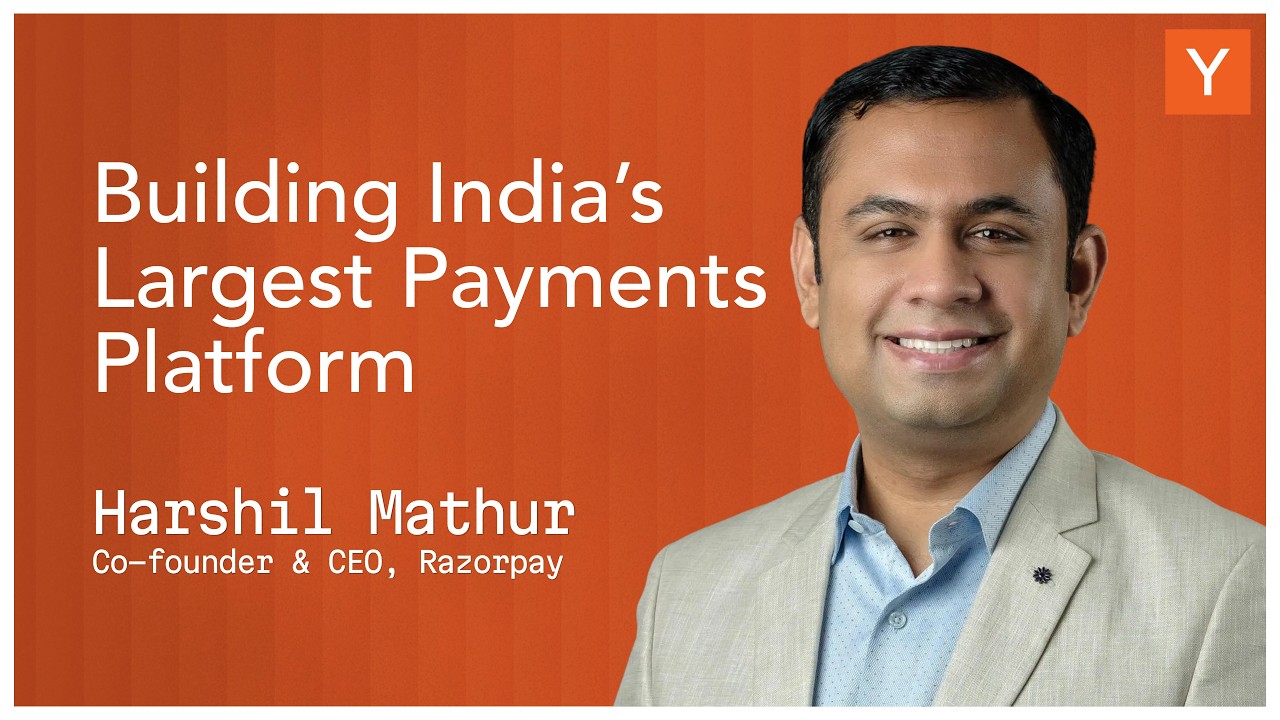
📺 Today’s recommended deep-dive video: https://www.youtube.com/watch?v=X5bABLCuIHA
The Razorpay Playbook: Building Trust and Moats in Complex Markets
Razorpay’s journey from a Y Combinator-backed startup to a global payments titan highlights the power of persistence in regulated environments. Harshil Mathur shares how early failures in the education sector and a near-death banking crisis forged a culture of radical honesty. By betting on UPI before it was a certainty, the company proved that speed and conviction are the ultimate advantages for a small player.
Core Question: How can founders build a generational B2B company by transforming regulatory hurdles and market crises into permanent competitive moats?
Highlights
- Regulation as a Moat: A one-year wait for licensing became a barrier that prevented less patient competitors from entering the space.
- Radical Crisis Honesty: When a bank partner pulled the plug, the founders called every customer personally to preserve trust.
- Capital Efficiency: Growing 40x while remaining profitable through interest on deposits, despite investor pressure to burn more capital.
- The “Founder Mode” Pivot: Why AI requires founders to move from “manager mode” back to the trenches to out-pace incumbents.
⏱️ Reading time: approx. 7 minutes · Saves you about 25 minutes vs. watching.
Want to take notes while watching? Click the image below and let AI Notebook capture the key points for you 👇

From Side Projects to Regulatory Moats
Navigating the Hurdles of Indian Finance
Harshil Mathur began as a “techie” with no background in finance, driven purely by the desire to build things that worked.
While working at an oil company in the Middle East, Mathur spent his weekends coding a social crowdfunding platform. He quickly realized that in India, it was significantly easier to accept physical cash than digital payments. This friction felt like the antithesis of democratization, prompting him to pivot from his side project to solving the underlying infrastructure problem for everyone.
His initial go-to-market strategy focused on educational institutes, assuming the massive volume of tuition fees represented a low-hanging fruit for digital conversion.
The strategy failed because the universities had a monopoly; they didn’t care about user experience because students had no choice but to pay. This realization forced a pivot toward fellow startups who were desperate for better technology. By embedding themselves in co-working spaces, Razorpay found its true north: building for developers who prioritized ease of integration over legacy bank relationships.
The company spent its entire YC tenure without a single live transaction because of regulatory delays.
Instead of seeing this as a failure, Mathur framed the one-year gestation period as a long-term advantage for the business. Because the license was so difficult to obtain, any future competitor would have to face the same grueling wait times. This perspective turned a frustrating bureaucratic bottleneck into a “regulatory moat” that protected the company from a saturated market of copycats.

💡 Digging Deeper
Q: Why did the education sector fail as an initial GTM?
A: Universities held all the power; they had no incentive to pay a 1% fee for convenience when they could force students to pay in cash or via bank counters.
Q: How did Razorpay survive a year without a product launch?
A: They focused on deep technical integration and building conviction through customer conversations, realizing that the wait time was a barrier to entry for others.
Q: What was the primary motivator for starting Razorpay?
A: It was the frustration that technology, which should democratize access, was creating silos in the Indian payment landscape.
Crisis Management and the Architecture of Trust
Surviving the Near-Death Banking Pull-out
Trust is the only currency that matters in B2B, particularly when you are handling other people’s money and livelihoods.
Two weeks after their YC Demo Day, Razorpay’s primary bank partner suddenly pulled the plug, leaving fifty live merchants unable to accept payments. This was a terminal event for a payments company. Mathur and his co-founder faced a choice: hide behind support tickets or face the music directly. They chose the latter, establishing a rule that would define their culture: pick up the phone.
The team spent days calling every single merchant to explain the situation, enduring verbal abuse and intense frustration from their users.
They refused to automate these interactions or use AI to hide from the problem. This “human touchpoint” saved the company. Merchants who shouted at them on the phone eventually stayed with the platform for a decade because they respected the transparency. It proved that even in a technical business, a person saying “I am managing this” provides more security than any software.
Today, Razorpay uses AI for almost everything except replacing the human element of customer support for high-stakes issues.
Mathur believes that when a crisis occurs, a human spending time to solve a problem is a signal of commitment that machines cannot replicate. The efficiency of AI is discarded in favor of the trust-building potential of a real conversation. This philosophy ensures that even as the company scales to billions in volume, the core relationship with the merchant remains personal and unbreakable.

💡 Digging Deeper
Q: How did the team handle the verbal abuse from angry customers?
A: They viewed it as a necessary venting process, listening through the frustration to show they were present and accountable.
Q: Why does Razorpay limit AI in customer support?
A: Support is viewed as a trust-building channel, not just a problem-solving channel; humans signal care in a way AI currently cannot.
Q: How long did it take to get a new bank partner live after the crisis?
A: It took roughly four to five days of intense work, during which they kept every merchant updated on their progress.
The India Opportunity and Capital Efficiency
Growth Without the Burn
In 2015, the Indian payment market was estimated at $60 billion; today, Razorpay alone processes over $180 billion in GMV.
Mathur recalls receiving acquisition offers from global giants early in the YC cycle. He turned them down because he felt global players didn’t understand the sheer scale of the Indian opportunity or the investment required to win. While others saw a medium-sized market, Mathur saw a trillion-dollar future that required a long-term, local perspective that no external partner could match.
The company’s growth was famously capital efficient, a trait that actually frustrated their early Series A investors.
Razorpay raised $11 million but only burned $200,000 a month, eventually becoming profitable simply by collecting interest on their venture capital deposits. Investors, accustomed to the high-burn models of B2C delivery apps, were confused by this restraint. Mathur argued that in B2B, burning money doesn’t create engagement; only adding tangible value to the business customer creates a sustainable and logical growth path.
B2B is a logical business where you either add value or you are replaced by someone who does.
Unlike consumer apps that spend to “buy” users, Razorpay focused on compounding product depth. This logic allowed them to survive the skepticism surrounding UPI’s launch in 2016. While major banks and legacy gateways ignored the technology, Razorpay became the first to integrate it. When demonetization hit, they were the only ones ready to scale, landing giants like Zomato and Swiggy overnight.

Founder Mode in the Age of AI
Moving Faster Than the Market
AI has fundamentally compressed the “build” phase of software development, making execution speed the only remaining sustainable competitive advantage.
Mathur admits that as the company grew, he drifted into “manager mode,” hiring executives and stepping back from the trenches. He now views this as a mistake for a product-driven company. The “founder mode” essay resonated with him because it highlighted that no leader will ever care about the company’s vision as much as the person who started it.
To combat incumbent inertia, Razorpay recently reinvented its entire platform from the ground up using an AI-first approach.
He believes that if a founder waits to respond to market changes, they are already dead. You must bring the disruption yourself before a new startup does. By spending hours personally coding with tools like Claude, Mathur ensures he understands the technology’s power well enough to make radical pivots. This prevents the company from falling into the “incumbent fallacy” of protecting what already exists.
Aspiring founders must pick a problem they are willing to dedicate the next ten years of their lives to solving.
While AI makes it easy to build a project, it does not make it easier to build a company. The core of entrepreneurship remains the deep connection to a problem statement. If you are only building because a tool made the code easy to write, you will lack the conviction to survive the inevitable cycles of regulation and crisis.

Key Takeaways
Building a B2B empire in a regulated market requires a psychological shift: viewing barriers not as obstacles, but as filters that remove your competition. Razorpay’s success was not just about better code, but about the patience to wait for licenses and the courage to be radically honest with customers during systemic failures. This architecture of trust creates a moat that even the best AI cannot easily disrupt.
The transition from “manager mode” back to “founder mode” is essential in the age of AI. As the time required to build software collapses toward zero, the only differentiation left is the speed of decision-making and the depth of the founder’s conviction. To win, one must be willing to cannibalize their own successful products to stay ahead of the next wave of innovation.
Q&A
Q1: How did Razorpay land big clients like Zomato and Swiggy?
A1: They integrated UPI before anyone else. When the market shifted suddenly due to demonetization, they were the only gateway that could handle the scale of the new payment method.
Q2: What is the “incumbent fallacy” Mathur mentions?
A2: It is the belief that because you are currently the largest player, you have time to respond to market changes. In reality, the market moves faster than a large organization can react.
Q3: Why was the Series A investor unhappy with Razorpay’s profitability?
A3: They wanted the company to burn capital to capture more market share faster, whereas the founders preferred a logical, value-added growth path.
Q4: What role does Mathur think AI plays in building a company today?
A4: AI compresses the “build” time of a product, but it doesn’t shorten the “company building” time, which still requires a ten-year commitment to a problem.
Q5: Why did Razorpay reject early acquisition offers?
A5: The founders believed the Indian market was going to be much larger than global players realized and didn’t want to compromise their long-term vision for India.
Q6: What is the main difference between B2B and B2C growth?
A6: B2B is logical and value-driven; customers pay because you solve a problem. B2C often requires spending money to build engagement before monetization can occur.
Q7: How should a founder decide what to delegate?
A7: Delegate the day-to-day management but stay deeply involved in the core things that matter to the vision, such as product direction and customer trust.