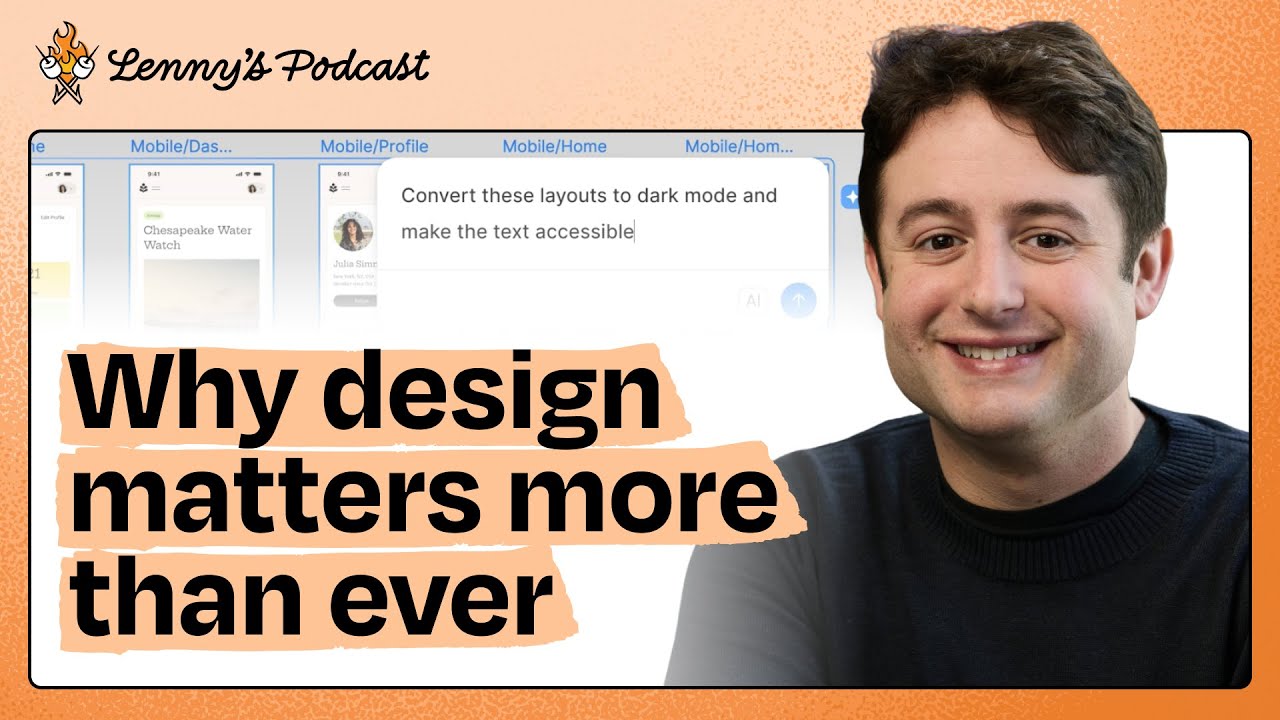
📺 Today’s recommended deep-dive video: https://www.youtube.com/watch?v=WyJV6VwEGA8
Designing the Future: Dylan Field on Figma’s Evolution, AI Craft, and the Power of Fun
Figma’s journey from a browser-based design tool to an AI-powered product platform has been defined by a relentless focus on craft, especially following the collapse of the $20 billion Adobe merger. CEO Dylan Field shares how he maintained team momentum through radical transparency, why “fun” became a core product strategy for FigJam, and why design is the ultimate differentiator in the modern software landscape.
Core Question: How can companies maintain a startup pace and high-quality craft while scaling into a multi-product platform in the age of AI?
Highlights
- The “Detach” program allowed employees to leave with severance after the Adobe deal fell through, ensuring the remaining team was fully “bought-in.”
- Moving from one product to two (Figma to FigJam) is significantly harder than moving from two to many.
- Design has become the primary differentiator in software because technical barriers like cloud hosting and code generation have been commoditized.
- Product “taste” is not an innate gift but a developed framework for judgment built through curiosity and cross-disciplinary exposure.
⏱️ Reading time: approx. 8 minutes · Saves you about 79 minutes vs. watching.
Want to take notes while watching? Click the image below and let AI Notebook capture the key points for you 👇

Post-Adobe Momentum and the “Detach” Strategy
Keeping the Gas Pedal Down
Most companies would have spiraled into a period of mourning after a $20 billion acquisition fell through, but Figma chose a different path by immediately accelerating their roadmap. Field attributes this to constant communication during the 16-month regulatory process, which narrowed the “path of uncertainty” for employees before the final decision.
To ensure the team remained focused on a “hard-charging startup” mission rather than the stability of a corporate giant, Field introduced the “Detach” program. This initiative offered any employee who felt misaligned with the new reality three months of severance to leave on good terms, a move that resulted in about 4% of the workforce exiting.
It served as a necessary reset for the organization’s culture.
By removing those who were no longer “all-in” on the startup journey, Figma was able to launch Dev Mode and expand their platform with a unified, high-energy team that was ready to compete rather than settle.

💡 Digging Deeper
Q: How did you find “padding” in project timelines?
A: By coming from a place of curiosity and digging into the underlying work; if a project is dragging, I ask what constraints or missing resources are causing the delay rather than just accepting the estimate.
Q: Why is a “flatter” organization helpful for pace?
A: It reduces the number of assumptions made about requirements and prevents information from being distorted as it moves through management layers.
Q: What is the risk of moving too fast?
A: Systematic “tech debt” can accumulate, which eventually grinds everything to a halt if you don’t balance new features with infrastructure quality.
The Pivot to Multi-Product Success
The FigJam Experiment
The transition from a single-product company to a multi-product platform is a notorious graveyard for startups, yet Figma successfully navigated this by following the natural user workflow. Field noticed users were already using Figma for messy brainstorming and realized they needed a dedicated, simpler surface for whiteboarding and diagramming.
FigJam was born from the realization that designers weren’t the only ones who needed to collaborate early in the process.
However, a month before the official launch, the product felt “soulless” and lacked a clear differentiator against established competitors. In a high-stakes board meeting, Field and his team made a controversial decision to pivot the product’s identity entirely.
They decided to make “fun” their primary differentiator.
The Design Sprint for “Soul”
This pivot led to a rapid design sprint that produced features like cursor chat and “high-fives,” which transformed the product from a utility into a social experience. This “playful” approach was perfectly timed for the remote-work era of the pandemic, where teams were craving human connection in their digital tools.
Field argues that while “fun” works for FigJam, it might be an annoying distraction in a high-precision tool like Figma Design. This highlights a key lesson in product leadership: context dictates where you should apply quirkiness versus where you should maintain invisible utility.

AI, Make, and the Future of the “Product Builder”
Prototyping as the New PRD
Figma Make is the company’s ambitious foray into AI-augmented design, allowing users to move from a text prompt to a functional prototype in seconds. Field believes this shift will fundamentally change the roles of PMs and engineers by allowing them to “speak” in the language of design rather than just writing static requirement documents.
When anyone can generate a prototype, the barrier to entering the design conversation disappears.
This doesn’t replace designers; instead, it frees them from mundane tasks like “drawing out a basic screen” and allows them to focus on the high-level logic and unique craft that differentiates a product. Field views AI as a way to “uproot” ideas that would otherwise die on the vine due to a lack of visual polish or technical friction.
The Role of Taste in the AI Era
As AI lowers the floor for creating software, the ceiling is raised for those who possess “taste”—the ability to judge what is actually excellent versus what is merely “good enough.” Field defines taste as a point of view backed by a framework, often developed by looking at the “canon” of a field and understanding where you agree or disagree with established paths.
He notes that many great product builders are former musicians or artists because they understand the iterative loop of “I like this/I don’t like this/Why?”
In a world of infinite, AI-generated options, the winner is the person who can curate the best possible outcome from a sea of averages.
Key Takeaways
Figma’s success is rooted in the belief that design is the only way to win in a saturated software market. By focusing on “Time to Value” and relentlessly removing blockers that prevent users from experiencing “magic moments,” the company has managed to expand its Total Addressable Market (TAM) far beyond what skeptics originally predicted. Field emphasizes that founders shouldn’t be obsessed with current market sizes but should instead bet on trends—like the rising global expectation for high-quality user experiences.
The future of the industry belongs to the “Product Builder,” a generalist who uses AI to bridge the gaps between design, engineering, and management. As roles continue to merge, the primary skill for any leader will be the ability to unpack context and create clarity within their teams. Whether it’s through “fun” cursors or AI-generated mocks, the goal remains the same: getting ideas into the world as quickly and beautifully as possible.
Q&A
Q1: Why did the Adobe deal fall through?
A1: Regulators in various regions had arguments against the deal and ultimately blocked it; Field chose to move forward rather than drag out the legal battle further.
Q2: What was the most controversial decision during the development of FigJam?
A2: Choosing “fun” as the primary differentiator, which led to features like cursor chat and playful animations that weren’t standard in enterprise software.
Q3: How does Dylan Field define product “taste”?
A3: It is an articulated point of view and a framework for judgment developed through curiosity, exposure to different mediums, and the ability to reflect on why you like or dislike something.
Q4: What happened with the initial launch of “Make Design”?
A4: It suffered a “QA failure” where it generated designs too similar to existing apps (like Apple Weather); Field pulled the feature to improve the rigorous “evals” and ensure visual originality.
Q5: Will AI lead to engineering headcount reductions at Figma?
A5: No; while productivity has increased, the demand for new development is not yet satiated, and Figma continues to hire aggressively for engineering roles.
Q6: What is Dylan’s advice to founders on market size?
A6: Don’t be constrained by the current TAM of a category; Figma’s market grew because the world started caring more about design as a differentiator.
Q7: What is Dylan’s most unusual personal preference?
A7: He finds chocolate “repulsive” and “disgusting,” speculating it may be a rare genetic trait similar to the “Truman Show” vibes where he can’t believe everyone else actually likes it.