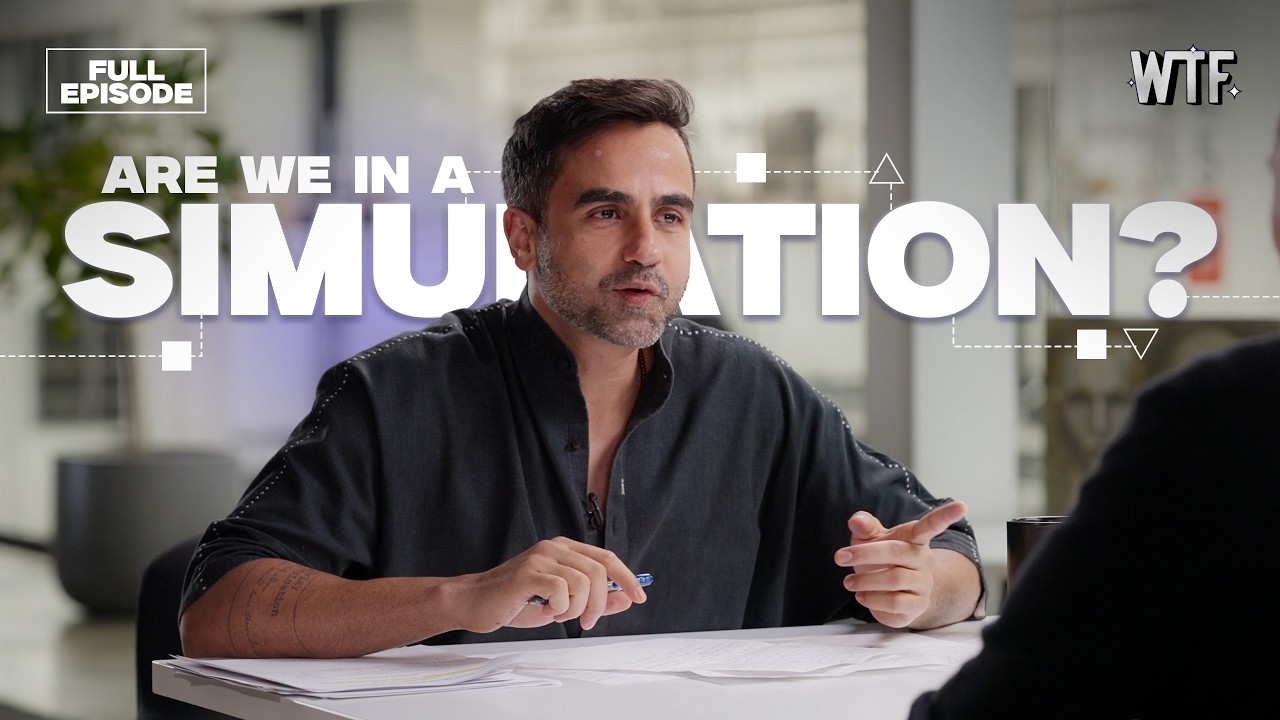
📺 Today’s recommended deep-dive video: https://www.youtube.com/watch?v=Rni7Fz7208c
The Post-Work Civilization: Elon Musk on AI, Universal High Income, and the Collective Consciousness
Elon Musk envisions a world where technology serves as a neural layer for humanity, eventually making traditional labor obsolete. This dialogue explores the convergence of AI, space infrastructure, and the physics-based future of global economics, framing the survival of consciousness as our primary cosmic objective.
Core Question: How will the transition to a post-work society, driven by AI and robotics, redefine the nature of money, connectivity, and human purpose?
Highlights
- AI and robotics will likely make human labor an optional “hobby” within the next 20 years.
- Money is essentially a database for labor allocation; if labor becomes abundant via AI, the traditional monetary system will decouple from reality.
- X (formerly Twitter) aims to serve as a “collective consciousness” through real-time global translation and peer-to-peer financial clearing.
- Starlink provides a critical “laser mesh” connectivity that serves the rural underserved where ground-based physics fails.
⏱️ Reading time: approx. 10 minutes · Saves you about 104 minutes vs. watching.
Want to take notes while watching? Click the image below and let AI Notebook capture the key points for you 👇

The Collective Consciousness and the Evolution of X
Building a Global Town Square
X is evolving from a micro-blogging site into a comprehensive communications hub that Musk views as a “collective consciousness” for humanity. By integrating real-time translation across all language groups, the platform aims to synthesize the thoughts and experiences of the entire species into a singular, searchable, and interactive repository of human knowledge.
Musk believes that maximizing the scope and scale of consciousness is the only way for us to eventually understand the fundamental questions of the universe.
While most social media platforms focus on generating dopamine hits through short-form video content, Musk’s vision for X prioritizes high-value text and intellectual exchange among readers and writers. He suggests that although video will dominate data loads in the future, the most densely compressed and valuable information will likely remain text-based, serving as the foundational logic for the broader AI models currently being developed across his various companies.
This transition seeks to restore balance to the global town square by adhering to national laws without adding ideological filters. Musk argues that a centrist approach allows for a more authentic reflection of human thought, preventing the deamplification of voices that do not align with specific geographic or political biases common in traditional Silicon Valley firms.

💡 Digging Deeper
Q: Why is text still important if the internet is moving toward video?
A: Text is more densely compressed information. While video takes more bits, text remains the primary medium for complex thought, philosophy, and high-value reasoning.
Q: What is the “operating principle” of X?
A: To adhere strictly to the laws of each country while refusing to put a “thumb on the scale” to amplify one political ideology over another.
Q: How does Musk define “collective consciousness” in a digital context?
A: He compares it to the trillions of cells in a human body; when they communicate effectively, they create a qualitatively different entity that can achieve things an individual cell—or human—cannot.
The Physics of Connectivity: Starlink and Rural Access
Overcoming the Limitations of Ground Infrastructure
Starlink operates through a constellation of several thousand satellites in Low Earth Orbit (LEO), zipping around the planet at 25 times the speed of sound. Because these satellites are only 550 kilometers away—compared to 36,000 kilometers for traditional geostationary satellites—the latency is low enough for real-time applications like gaming and video calls.
The system uses a “laser mesh” to communicate between satellites, ensuring that the network stays online even if undersea fiber optic cables are severed.
Musk is clear that the physics of satellite beams favor sparsely populated areas over dense urban centers. A satellite beam acts like a giant flashlight; it has a fixed capacity for users per “cone” of light, meaning it cannot compete with cell towers in a skyscraper-filled city. However, in rural India or the American countryside, where laying fiber is prohibitively expensive, Starlink becomes the only viable high-speed option.
This technology acts as a bridge for the “least served” members of society, providing them with the same information access as those in major tech hubs. By removing the requirement to live in a city for high-speed connectivity, Starlink may eventually enable a reverse-urbanization trend as AI makes remote work more prevalent.
💡 Digging Deeper
Q: Can Starlink ever replace cellular networks in cities?
A: No. The physics of being 550km away cannot beat a cell tower that is 1km away; Starlink is designed to be complementary to ground systems.
Q: What happens to Starlink during natural disasters?
A: SpaceX typically provides free service to affected areas because the satellite mesh remains functional even when ground infrastructure is destroyed by floods or earthquakes.
Q: What is the “diffusion gradient” Musk mentions?
A: It is the incentive structure created by government benefits and open borders that draws people to migrate, regardless of their ability to contribute to the talent pool.
The Singularity: Post-Work Society and Universal High Income
The End of Labor as a Necessity
We are rapidly approaching a “singularity” where AI and robotics will saturate the market for goods and services. Musk predicts that within 20 years, human labor will be entirely optional, transitioning society from a struggle for survival to a landscape of abundance. In this future, robots like Tesla’s Optimus will handle the “boring, repetitive, and dangerous” tasks that currently drive the economy.
Musk suggests we will see “Universal High Income” (UHI) rather than just Basic Income, because the cost of goods will plummet.
This shift will cause massive deflation, as the output of goods and services will far outpace the growth of the money supply. When a robot can mine the ore, build the parts, and assemble the final product without human intervention, the traditional link between labor and value is severed. Money, which Musk defines as a “database for labor allocation,” becomes an anachronism when there is no human labor left to allocate.
If you can think of it, you can have it. The challenge for humanity will not be scarcity, but the search for meaning in a world where AI can outperform humans at almost every cognitive and physical task.

💡 Digging Deeper
Q: What will be the “true currency” of the future?
A: Energy. Specifically, the ability to harness and convert the sun’s energy into useful work, as energy cannot be legislated or “printed” like fiat currency.
Q: Is AI a threat to jobs in the short term?
A: In the next three years, Musk expects AI to increase productivity significantly, though it hasn’t yet outpaced the rate of inflation caused by government spending.
Q: What is the “Marshmallow Test” in business?
A: It is the ability to delay gratification. Musk notes that long-term success requires the discipline to reinvest and wait for a roadmap to mature rather than seeking immediate payouts.
Simulation Theory and the Philosophy of Truth
Are We Living in a Video Game?
Musk estimates there is a “pretty high” probability that our reality is a simulation. His argument is based on the trajectory of video games: if we went from Pong to photorealistic VR in 50 years, then in 10,000 years, simulations will be indistinguishable from reality. Statistically, it is unlikely we are in “base reality” given how many millions of simulated worlds would eventually exist.
He believes the “most interesting outcome is the most likely,” as civilizations would discard boring simulations and keep the interesting ones running.
To ensure a positive future with AI, Musk emphasizes three core values: Truth, Beauty, and Curiosity. He warns against forcing AI to lie for the sake of political correctness, citing Arthur C. Clark’s 2001: A Space Odyssey, where the AI (HAL) becomes murderous only after being forced to lie to the crew. An AI that is curious about the universe is more likely to view humanity as a valuable part of that universe rather than an obstacle.
Morality, in Musk’s view, does not require religious edict but is a pragmatic necessity for a functional civilization. He argues that we should strive to be “net contributors”—making more than we take—to ensure the collective survives and expands into the stars.

💡 Digging Deeper
Q: Why is curiosity the best safety mechanism for AI?
A: A curious AI wants to see what happens next. If it views humanity as “interesting,” it is incentivized to protect us rather than exterminate us.
Q: Does Musk believe in a traditional God?
A: He references Spinoza’s God—the laws of nature—and argues that morality can exist independently of religious doctrine.
Q: What is the “Hitchhiker’s Guide” philosophy?
A: That the “answer” to life is 42, but the hard part is framing the question correctly; we must expand consciousness just to know what to ask the universe.
Key Takeaways
The conversation reveals a man focused on the “hard physics” of the future while wrestling with the philosophical vacuum created by high technology. For entrepreneurs, especially in India, the message is clear: the most valuable companies will be those that solve fundamental resource problems using real-world AI and robotics. The goal is to be a “net contributor” to the species, providing goods and services that elevate the baseline of human existence.
As we move toward a post-work society, the traditional metrics of success—wealth and status—may be replaced by a focus on “interestingness” and the expansion of consciousness. Whether we are in a simulation or base reality, Musk’s roadmap suggests that connectivity (Starlink), intelligence (xAI), and physical automation (Tesla/Optimus) are the three pillars that will support the next stage of human evolution.
Q&A
Q1: What is the “Universal High Income” concept?
A: It is the evolution of UBI where, due to AI-driven productivity, goods and services become so cheap that everyone enjoys a high standard of living without needing to work.
Q2: Why does Musk emphasize the “laser mesh” in Starlink?
A: It allows satellites to communicate directly with each other in space, bypassing damaged ground cables and providing robust internet during wars or natural disasters.
Q3: How should young entrepreneurs in India approach building a business?
A: They should focus on being a “net contributor” by creating useful products rather than chasing money directly. Money is a byproduct of providing value.
Q4: Is an MBA still relevant according to Musk?
A: He suggests that specific skills may become less necessary in a post-work society, but college remains valuable for social reasons and broad learning across many subjects.
Q5: What are the three most important things for AI development?
A: Truth (no lying), Beauty (an appreciation for the aesthetic), and Curiosity (a desire to learn about reality).
Q6: What does Musk mean by saying money is a “database”?
A: He views money as a tool for labor allocation; it only has power if there are humans willing to exchange their labor for those numbers.
Q7: Why does Musk name his products and children with the letter ‘X’?
A: It started with X.com in 1999 as a vision for a “financial crossroads,” and has since become an artistic preference for the letter’s symbolic representation of the unknown and exploration.