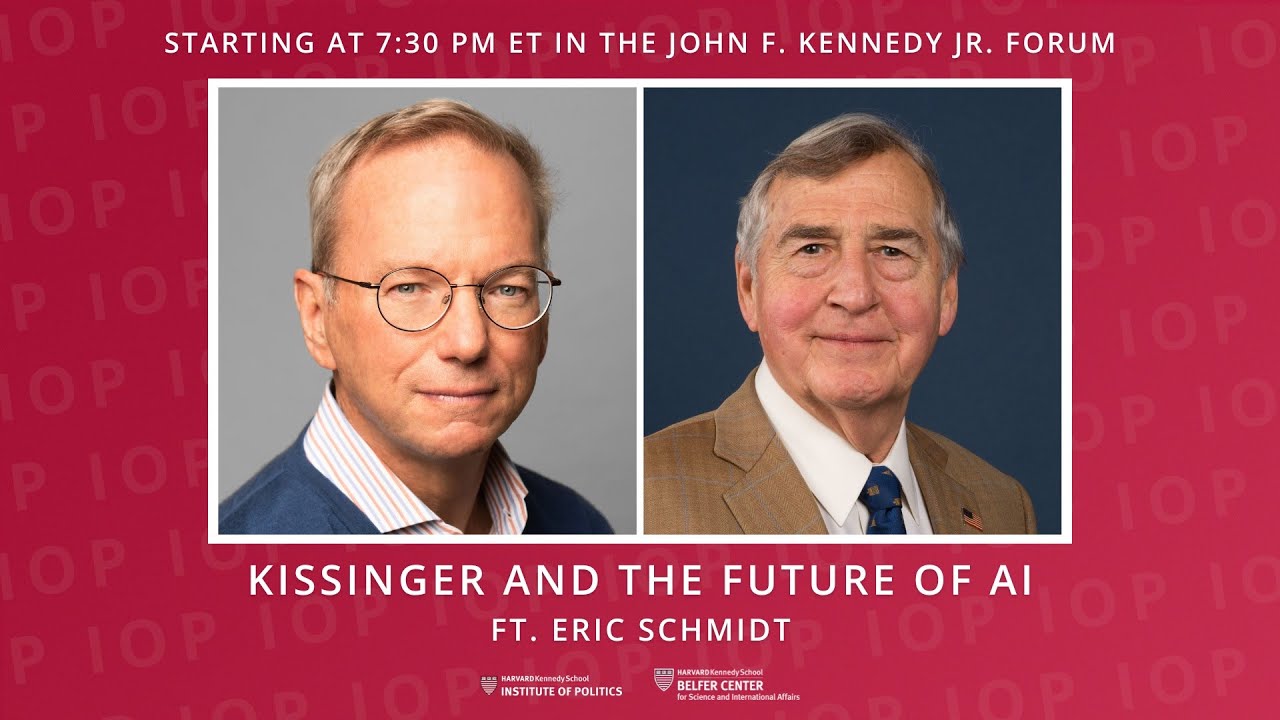
📺 Today’s recommended deep-dive video: https://www.youtube.com/watch?v=-m9kY1cpmgw
The Silicon Statecraft: Eric Schmidt on Kissinger, China, and the AI Revolution
From the nuclear era to the age of reasoning, the fundamental challenge of global stability has shifted from military hardware to algorithmic intelligence. Former Google CEO Eric Schmidt and Professor Graham Allison explore how the legacy of Henry Kissinger informs our current struggle to maintain human agency in a world of recursive self-improvement.
Core Question: How can humanity preserve agency and prevent catastrophic conflict as AI evolves from a linguistic tool into a self-improving strategic actor?
Highlights
- The “San Francisco Consensus” predicts that AI will achieve recursive self-improvement and high-level reasoning within the next 2 to 4 years.
- China’s AI strategy focuses on massive infrastructure and open-source proliferation, while the US leads in frontier “closed” models.
- A massive “energy gap” exists between the US and China, with China adding a gigawatt of electricity to its grid nearly every day.
- The “Kissinger Challenge” has evolved from preventing nuclear Armageddon to ensuring AI remains a tool for human progress rather than an autonomous threat.
⏱️ Reading time: approx. 7 minutes · Saves you about 73 minutes vs. watching.
Want to take notes while watching? Click the image below and let AI Notebook capture the key points for you 👇

The Kissinger Legacy in the Age of Algorithms
From Nuclear Deterrence to Digital Order
Henry Kissinger, a polymath who shaped 20th-century diplomacy, spent his final years as a student of artificial intelligence. Eric Schmidt recounts how Kissinger, even at 95, recognized that AI represented a “new epoch” in human history. To Kissinger, AI was not just a technical tool but a shift in how knowledge is generated and how humanity views its place in the universe.
He saw a direct parallel between the 1950s nuclear “security dilemma” and today’s AI arms race.
Just as a small group of thinkers at Harvard, MIT, and RAND invented the concept of Mutual Assured Destruction to prevent World War III, Kissinger believed a similar strategic framework is required to prevent “algorithmic warfare” from escalating out of control. His core mission was the construction of a viable global order to prevent catastrophic war, a goal that remains unchanged as we move from physics to bits.

💡 Digging Deeper
Q: Why did Kissinger, a historian, become so obsessed with AI?
A: He realized that AI is a non-human competitor for intelligence, making it an epochal change similar to the Scientific Revolution that could fundamentally alter human decision-making.
Q: What was Kissinger’s “highest duty”?
A: To prevent catastrophic war, specifically by creating a viable order where rival powers can coexist without reaching a point of “existential security dilemma.”
Q: How did he influence Schmidt’s view on AI?
A: He forced the technical community to look beyond “how it works” to “what it means to be human” when we no longer have a monopoly on intelligence.
The San Francisco Consensus and the Reasoning Revolution
The Four Pillars of AI Evolution
The “San Francisco Consensus” is the prevailing belief among Silicon Valley’s elite that we are witnessing an unstoppable progression of AI capabilities. Schmidt breaks this down into four distinct phases: Language, Agents, Reasoning, and Recursive Self-Improvement. We have already conquered language; we are currently entering the era of “agents” that can automate complex workflows.
Reasoning represents a higher-order function that allows computers to solve mathematical conjectures and write their own programs.
The true “holy grail” is recursive self-improvement, where the AI begins to learn and optimize its own architecture without human intervention. While skeptics call it a bubble, Schmidt argues the technology is actually “underhyped” because the scaling laws—the relationship between more data, chips, and electricity—have not yet slowed down.

💡 Digging Deeper
Q: What exactly are “agents” in the context of AI?
A: Agents are AI systems that can perform a series of concatenated tasks—like a digital employee—handling everything from billing and accounting to complex product design.
Q: When does Schmidt expect recursive self-improvement to arrive?
A: While many in San Francisco say 2 years, Schmidt more conservatively estimates a 4-year window for this breakthrough.
Q: Is AI a bubble destined to crash?
A: Schmidt argues no, because AI is fundamentally automating the most expensive and “boring” parts of business, creating massive economic value.
The US-China Rivalry: Chips vs. Watts
The Energy Gap and Infrastructure
The AI race between the US and China is defined by two different scarcities: chips and electricity. The US currently maintains a significant lead in high-end semiconductor access, but China is winning the infrastructure battle. China is reportedly adding a gigawatt of electricity to its grid daily—the equivalent of a new nuclear power plant every 24 hours—to fuel its massive data centers.
Schmidt notes that China’s strategy is focusing on “adoption” and “open weights.”
By releasing their models for free (open-source), China ensures that the majority of the developing world uses Chinese-aligned AI, effectively exporting their values and biases globally. Meanwhile, American companies remain largely “closed” due to the economic necessity of returning the tens of billions of dollars borrowed from capital markets to build these systems.

💡 Digging Deeper
Q: Why is China focusing on open-source AI models?
A: Open source allows China to achieve global proliferation quickly, especially in countries that cannot afford to build their own massive data centers.
Q: What is the “996” culture Schmidt mentions?
A: It refers to the Chinese tech work ethic: 9 AM to 9 PM, 6 days a week, which drives their relentless pace of AI adoption in hardware and robotics.
Q: Will the gap between US and Chinese AI widen or close?
A: Schmidt believes the gap will widen in reasoning capabilities (US lead) but close or reverse in physical AI applications like humanoid robots and manufacturing (China lead).
Key Takeaways
Artificial Intelligence has transitioned from a futuristic concept to a fundamental pillar of national security and economic survival. The competition between the US and China is no longer just about who has the better chatbot; it is about which nation can build the infrastructure to support the “Reasoning Revolution.” As AI begins to write its own code and automate entire industries, the primary challenge for the next generation of leaders is ensuring that human agency remains at the center of the decision-making loop.
Preserving human freedom in this era requires a delicate balance of innovation and governance. We must be prepared for “algorithmic warfare” where AI-driven cyberattacks could overwhelm traditional defenses. Ultimately, the goal is to integrate AI into the human experience as a tool that enhances our capabilities without compromising our fundamental dignity or security.
Q&A
Q1: How will the Trump administration likely handle AI regulation?
A: Schmidt predicts very little regulation of AI under the Trump administration, as the focus will remain on all-out business competition with China and avoiding “regulatory capture” by big tech firms.
Q2: Is AI going to replace most human jobs?
A: While AI will automate many functions, Schmidt notes that humans are social animals who crave human-led services like medical care. Furthermore, a global population decline means we may actually need AI to fill the gaps in a shrinking workforce.
Q3: Can we create an “International Atomic Energy Agency” (IAEA) for AI?
A: It is unlikely to happen until there is a “Chernobyl-level event”—a crisis so severe it forces global powers to the negotiating table. Currently, nations are too focused on unilateral advantage to agree on mandatory inspections.
Q4: Will AI eventually become conscious?
A: Schmidt admits he doesn’t know, but he poses a challenge: if a computer claims to be conscious and passes every behavioral test, how could we ever truly verify its internal state?
Q5: What is the biggest risk for children in the AI age?
A: We are running a “mass experiment” on human development. Children may form their primary social bonds with non-human entities, which could manipulate their identities before they are fully formed.
Q6: How should the US partner with India in the AI space?
A: India has extraordinary talent but lacks computing power. Schmidt suggests the US should fix the “trade war” issues and provide India with the GPUs necessary to ensure democracies lead the AI revolution together.
Q7: Can AI ever replace the “strategic ambiguity” used by diplomats like Kissinger?
A: Schmidt believes AI will eventually be able to “reason” its way into complex diplomatic strategies, including strategic ambiguity, as long as it has the historical data and objectives to learn from.