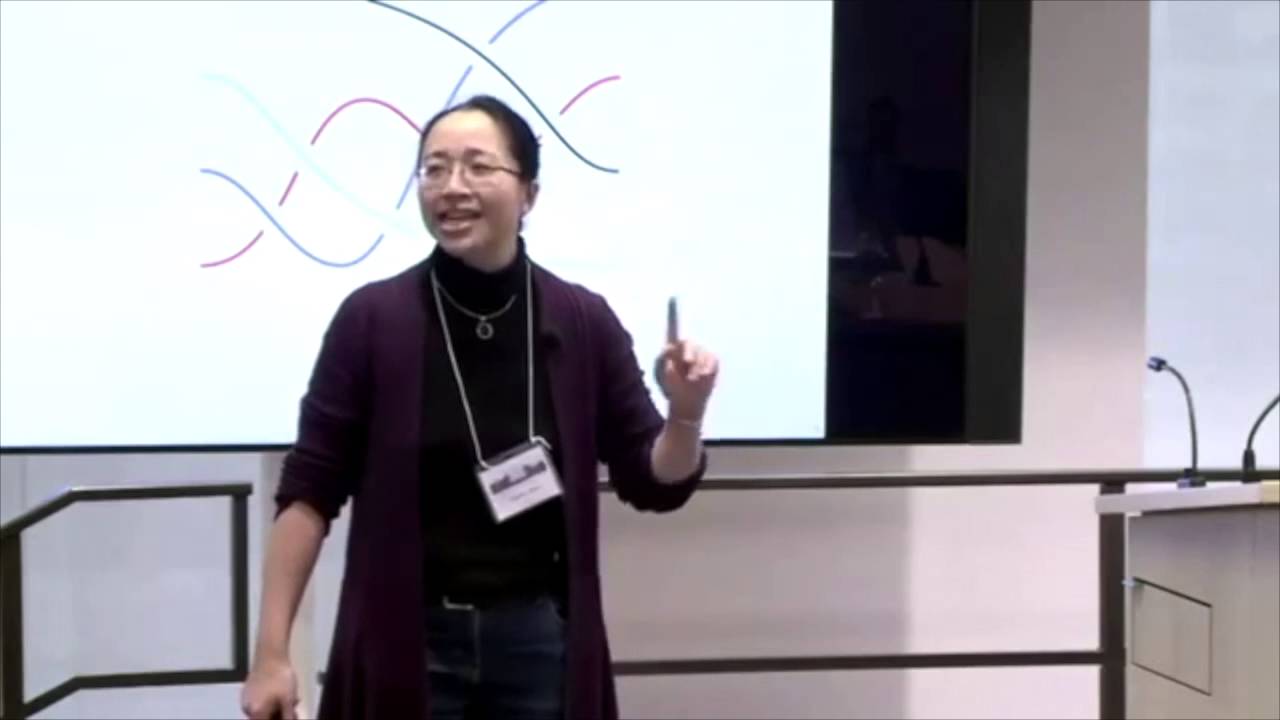
📺 Today’s recommended deep-dive video: https://www.youtube.com/watch?v=h2p68JjSUH0
How to Bake a Mathematical Pi: Finding the Logic in Life
Dr. Eugenia Cheng breaks down the daunting barrier of abstract mathematics by using everyday analogies like Battenberg cakes, custard, and Bach. By shifting focus from numbers to relationships, she reveals how Category Theory provides a lens to understand the structural logic underlying everything from juggling to musical composition.
Core Question: How can we use the principles of abstraction and Category Theory to reveal the hidden logical structures in our physical and conceptual worlds?
Highlights
- Abstraction as the “art of laziness”—forgetting messy details to reveal essential logical structures.
- Visualizing relationships through music (Bach) and physical movement (juggling) to identify “braids.”
- Transforming boring numerical lists, like factors of 30, into complex geometric shapes like cubes.
- Using “Battenbergification” and custard-making to explain group theory and the importance of mathematical associativity.
⏱️ Reading time: approx. 8 minutes · Saves you about 53 minutes vs. watching.
Want to take notes while watching? Click the image below and let AI Notebook capture the key points for you 👇

The Power of Forgetting
The Art of Abstraction
Abstraction is not about making things harder; it is the deliberate process of ignoring messy, non-logical details to find the beautiful ideas underneath.
Most people fear math because they were taught it is a rigid world of numbers and equations. Dr. Cheng argues that math is actually the study of how logical things work, but since the real world is rarely logical, we must move into a conceptual space where structures can be observed clearly. This is the “laziness” of the mathematician: we don’t want to do the hard work of specific calculations, so we find a general theory that does the work for us.
Bach and the Braided Line
Take the music of J.S. Bach as a prime example of structural complexity. In his G Minor Prelude, the lines of music for the soprano and bass actually cross over each other without returning, a detail that is hard to hear but clear when drawn as a braided diagram. By abstracting the notes into a simple visual map, the performer gains a clarity of internal structure that transcends mere listening.

💡 Digging Deeper
Q: Why call mathematicians “lazy”?
A: Because they prefer finding a universal theory that solves a million problems at once rather than laboring through a million individual, boring calculations.
Q: How is music like math?
A: Both rely on relationships between parts—intervals in music are like the logic gates in math—where the specific “notes” matter less than how they interact.
Q: Is math only for people who can “do” it?
A: No. Just as you can appreciate music without being a virtuoso, you can appreciate the logical elegance of math as an observer or “consumer.”
Relationships over Properties
Factors into Cubes
Category Theory focuses on the relationships between objects rather than their intrinsic properties, which is why visualizing the factors of 30 as a cube is so revolutionary. Instead of a boring list of digits (1, 2, 3, 5, 6, 10, 15, 30), you see a three-dimensional lattice where divisibility defines the edges. This transformation proves that math is about the connections we draw between concepts, allowing us to spot patterns that are invisible in a linear list.
Even juggling can be viewed as a four-dimensional braided surface when you track the movement of the fruit through space and time.
The Young-Baxter Connection
This spatial intuition is what allows mathematicians to solve complex problems that seem unrelated at first glance. By turning numerical relationships into geometric shapes, we can apply our natural sense of space—like seeing how a cube face represents a braid crossing—to solve abstract equations. This is known as “Poincaré Duality,” where a two-dimensional face of a cube translates into the third Reidemeister move in knot theory, linking geometry directly to how strings tangle.

💡 Digging Deeper
Q: What is a “relationship” in Category Theory?
A: It is an arrow or map between two objects that describes how one transforms into or connects to another, such as one number being a factor of another.
Q: Why draw factors as a cube?
A: It reveals the internal structure of the number; 30 has three prime factors (2, 3, and 5), so it exists in a three-dimensional logical space.
The Delicious Logic of Category Theory
The Battenberg Group
Whether you are flipping a mattress or baking a cake, you are secretly performing group theory operations that follow specific, non-negotiable laws.
A Battenberg cake is a perfect physical representation of a cyclic group of order two. The alternating colors represent a mathematical pattern that remains the same whether you flip it or rotate it. It is a simple entrance into the world of algebraic structures, showing that math is closer to the kitchen than the classroom. By “Battenbergifying” other objects—like taking two types of cake and combining them—we can even visualize products of groups as “iterated” cakes.
Custard and Context
Associativity is often treated as a boring rule in school, but it becomes vital when you consider the process, not just the result.
In cooking, adding milk to sugar and then egg yolks creates custard, while adding yolks to milk and sugar first might not achieve the same chemical bond. Category Theory cares about this journey—the specific “path” we take through a diagram—because in complex systems, the order of operations dictates the final reality. We use the “Mac Lane Pentagon” to visualize all the different ways you could combine five ingredients, showing that while the end result might be a cake, the effort and “grossness” of the intermediate steps vary wildly.

💡 Digging Deeper
Q: What is the “Mac Lane Pentagon”?
A: It is a diagram showing the five different ways to parenthesize a sequence of four objects, proving that all paths to combine them are essentially equivalent in a “coherent” way.
Q: Why do equations feel like “lies”?
A: Because $x = x$ is the only total truth; any other equation like $2+2=4$ hides a process of transformation that is more interesting than the result.
Key Takeaways
Abstract mathematics, specifically Category Theory, is not a collection of numbers but a “mathematics of mathematics.” It is the study of how structures interact and how logic can be applied to diverse fields—from music and baking to social dynamics and physics. By stripping away the specifics, we find that the same patterns (like braids and cubes) repeat across the universe.
Ultimately, the goal of this approach is to make the “unintelligible” accessible to everyone. By using physical intuition—the way we feel a mattress flip or see a cake’s pattern—we can bypass the trauma many feel toward school-level math. Math is a way of thinking that allows us to find the “why” behind the “what,” providing a rigorous foundation for creativity and understanding.
Q&A
Q1: What is the primary goal of your book How to Bake Pi?
A1: The goal is to bring the abstract concepts of Category Theory to a general audience by showing that math is the logical study of how logical things work, using relatable metaphors like food and art.
Q2: How does your background as a pianist influence your mathematical view?
A2: It allows me to see structures like braids in Bach’s fugues, where voices cross and interact. This visual, relationship-based understanding is exactly how Category Theory operates.
Q3: Can a seven-year-old really understand Category Theory?
A3: Yes, if explained through patterns like the Mac Lane Pentagon or Battenberg cakes. Children often have less “math trauma” and are more open to spotting logical patterns than adults.
Q4: Why is “associativity” more than just a rule for parentheses?
A4: In higher math, it represents the “process” of combining things. Depending on the category, the intermediate steps (like mixing cake ingredients in different orders) can be significantly more or less difficult even if the result is the same.
Q5: What is “Battenbergification”?
A5: It is a term I use for the process of taking two simpler structures and combining them into a grid-like pattern, which helps visualize how mathematical “products” of groups are formed.
Q6: Why do some mathematicians resist Category Theory?
A6: Some feel it is “abstract nonsense” or are protective of their specific niche. However, for many, it provides a unifying language that explains why their specific branch of math works the way it does.
Q7: Is math “useful” in daily life?
A7: Not in the sense of solving quadratic equations to buy groceries, but it is useful for understanding the logical structures of arguments, processes, and relationships in the world around us.