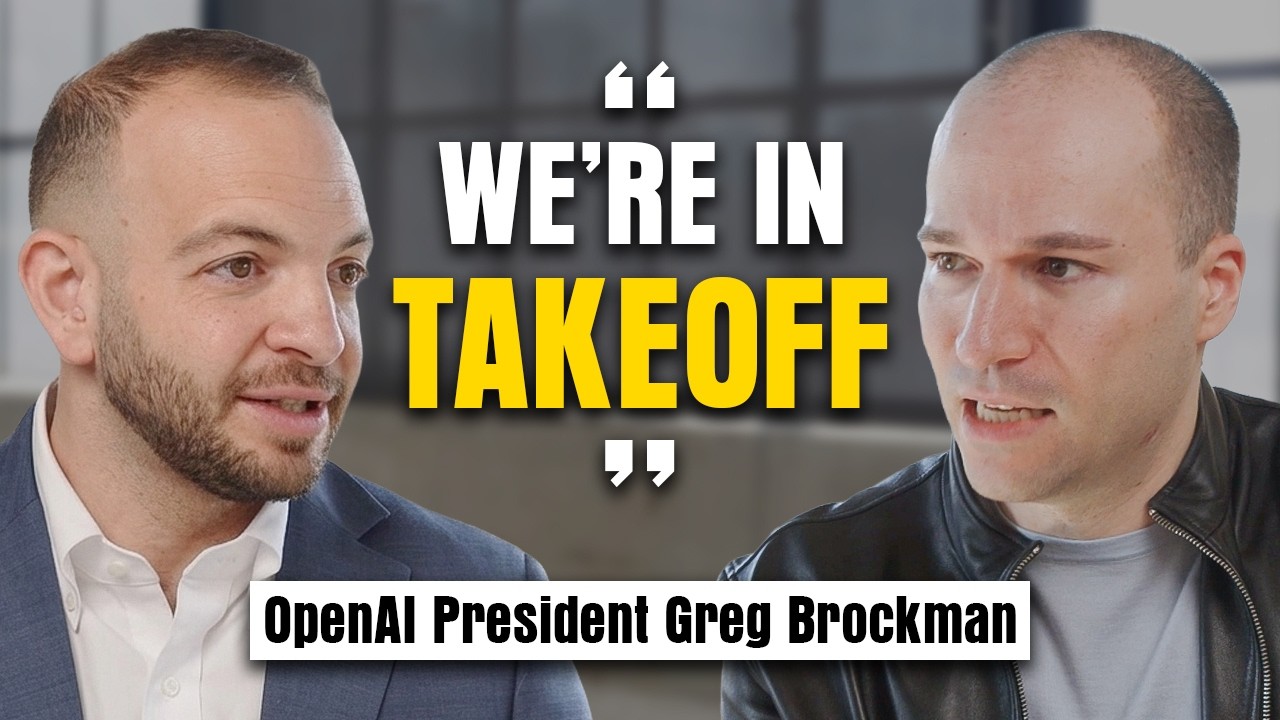
📺 Today’s recommended deep-dive video: https://www.youtube.com/watch?v=J6vYvk7R190
OpenAI’s Master Plan: The Super App and the Road to AGI
OpenAI co-founder Greg Brockman reveals a massive strategic pivot: the company is moving away from “side quests” like video generation to build a singular, world-changing “Super App.” This unified interface aims to deliver AGI-level personal assistance and autonomous problem-solving within the next couple of years.
Core Question: How is OpenAI reorganizing its technology and capital to navigate the “takeoff phase” of artificial general intelligence?
Highlights
- AGI is projected to arrive within the next few years, significantly raising the “floor” for all intellectual tasks.
- OpenAI is consolidating its research from specialized models (like Sora) into a unified reasoning-based “Super App.”
- The upcoming “Spud” base model incorporates two years of research to solve more nuanced and instruction-heavy problems.
- Compute remains the ultimate bottleneck, leading OpenAI to treat GPU procurement as a primary revenue-generating engine.
⏱️ Reading time: approx. 8 minutes · Saves you about 65 minutes vs. watching.
Want to take notes while watching? Click the image below and let AI Notebook capture the key points for you 👇

The Great Consolidation
Abandoning the Side Quests for a Unified Super App
OpenAI has realized it cannot do everything, leading to a strategic shutdown of specialized projects like video generation in favor of a unified AI.
Brockman describes this shift as a maturation of the technology, where the company must choose between divergent branches of the “tech tree.” While Sora was visually stunning, it represents a different architectural path than the core reasoning models found in the GPT series. By focusing on a single, high-intelligence envelope that handles text, voice, and browsing, the company can maximize the utility of its limited computational resources while delivering a more coherent user experience that scales across the global economy.
The goal is to build an iceberg-like application where the user sees a simple personal assistant, but the underlying infrastructure manages context, tools, and autonomous actions. This “Super App” will eventually replace fragmented software use by allowing the AI to navigate a computer’s desktop as naturally as a human. It brings together coding (Codex), browsing, and personal memory into a single digital representative for the user.

💡 Digging Deeper
Q: Why is OpenAI moving away from B2C to focus on a Super App?
A: It isn’t a move away from consumers, but rather a focus on the most impactful applications. They have realized that “Personal Assistants” and “Hard Problem Solvers” are the top two priorities that will consume all available compute.
Q: Is Sora dead?
A: No, but its research is being redirected toward robotics. For general knowledge work, OpenAI is prioritizing the GPT reasoning branch because it is more efficient to maintain a single “technological envelope.”
Q: What makes the Super App “agentic”?
A: It isn’t just a chatbot; it is a harness that connects the model to the world. It can use tools, remember your past interactions, and eventually operate software on your behalf without manual intervention.
The Coming Leap in Capability
Beyond the “Big Model Smell”
“Spud” represents a massive two-year research investment coming to fruition as a new foundational base model for the entire OpenAI ecosystem.
This upcoming release is expected to raise the floor for everyday tasks while simultaneously pushing the ceiling of what AI can solve in complex scientific fields like physics and chemistry. Brockman notes that users often experience a “disappointment phase” when new models launch because they haven’t adjusted their mental models to the new capabilities. However, once the “big model smell” settles in—a sense of increased nuance and instruction following—the technology becomes an indispensable part of the user’s cognitive workflow, solving problems that previously caused frustration.
The company is also developing an “automated AI researcher” that could perform the work of a research scientist in silicon. This creates a feedback loop where AI improves AI, potentially leading to a “takeoff” phase that accelerates progress.

💡 Digging Deeper
Q: What exactly is “Spud”?
A: It is a new pre-training base model. Brockman views it not as a single release, but as a foundation that will be refined through reinforcement learning and post-training to create massive leaps in reliability.
Q: Will “Spud” feel different to the average user?
A: Yes, particularly in its ability to follow instructions and handle long-time-horizon tasks. It aims to eliminate the “hallucination” and “misunderstanding” gaps that still plague current models.
Q: How does the “Automated Researcher” work?
A: It functions like a junior researcher in silicon. Human scientists provide the vision and feedback, while the AI performs the mechanical tasks of running experiments and analyzing plots at 100x human speed.
The Geopolitics and Infrastructure of Intelligence
Financing the Future of Compute
Building the infrastructure for AGI requires a level of capital investment that has few historical parallels, prompting OpenAI to secure massive funding for future data centers.
Brockman views compute not as a traditional cost center, but as a revenue-generating engine where every dollar spent on GPUs translates directly into expanded capacity for knowledge work. This philosophy justifies the “all-in” approach to hardware procurement, even if it leaves competitors scrambling for the remaining market supply of chips. The company projects that the entire growth of the global economy will soon be tied to how much computational power is available to power AI agents.
Addressing the public’s fear of resource consumption, Brockman claims that modern data centers can actually improve local electrical grids by funding transmission upgrades.

💡 Digging Deeper
Q: Why did Brockman donate to a pro-Trump PAC?
A: He identifies as a “one-issue donor.” His goal is to support any political path that leans into AI technology to ensure national competitiveness and security.
Q: Are data centers destroying the environment?
A: Brockman argues there is significant misinformation. He cites facilities that use water at the same rate as a single household and data centers that have actually lowered local utility rates by upgrading aging grids.
Q: Is AGI already here?
A: Brockman is “70-80% there.” He believes that while current models are “jagged” (superhuman at coding but failing at basic tasks), the gap will close within a few years.
Key Takeaways
OpenAI is moving through a period of intense focus. By consolidating their various research branches into a single GPT reasoning tree, they are betting that a general-purpose “Super App” will be more valuable than a collection of specialized tools. This app is designed to be a “personal AGI” that moves beyond the chat interface to become an autonomous agent capable of managing a user’s entire digital life, from coding and browsing to personal health research.
The transition to AGI is being fueled by a “takeoff” phase where AI begins to assist in its own creation. Brockman emphasizes that the massive investments in compute and data centers are not speculative gambles but necessary responses to an insatiable global demand. He believes the future economy will be defined by “computational agency,” where humans act as CEOs over fleets of AI agents.
Ultimately, Brockman’s message is one of cautious optimism. He encourages the public to move past the negative pop-culture tropes of the 1990s and engage with the tools directly. By developing “human agency” and learning to delegate to these systems, individuals can free themselves from mechanical digital tasks and focus on higher-level human connection and creativity.
Q&A
Q1: What was the “scariest moment” at OpenAI?
A: The holiday party after ChatGPT launched. Brockman felt a “vibe of winning” among the staff, which he found dangerous because it signaled complacency. He believes OpenAI must always maintain an “underdog” mentality to survive against larger incumbents.
Q2: How does OpenAI view the competition from open-source models?
A: Brockman believes in a “resilience ecosystem.” Rather than a single centralized actor, he prefers a world with many players, provided there is a societal infrastructure of safety standards and regulations similar to how the electricity industry is managed.
Q3: Is coding still a viable career for humans?
A: Brockman believes “Codex is for everyone.” The mechanical skill of writing syntax will become less important, but the ability to solve problems, manage context, and set the vision for software will become more valuable than ever.
Q4: How does the “Super App” handle privacy and memory?
A: It is designed to have a “long-term memory” and be aligned with your specific goals. It functions more like a digital representative than a stranger you talk to, requiring a high degree of trust and alignment.
Q5: What is the “Jagged Frontier” of AGI?
A: It refers to the fact that current AI is superhuman at complex tasks like high-level physics or coding, but can still fail at basic human-level tasks. AGI is achieved when that “floor” rises high enough to handle any intellectual task performed on a computer.
Q6: Why is OpenAI buying “all the compute”?
A: Because demand has consistently outpaced supply every year since ChatGPT launched. They must project hardware needs 18–24 months in advance, and the growth in knowledge work applications suggests they will remain compute-strapped for the foreseeable future.
Q7: Can AI solve terminal illnesses?
A: Brockman shares an anecdote of a friend who used ChatGPT to find an alternative cancer treatment after doctors said he was terminal. He believes AI will eventually move healthcare from reactive treatment to proactive, preventative care.