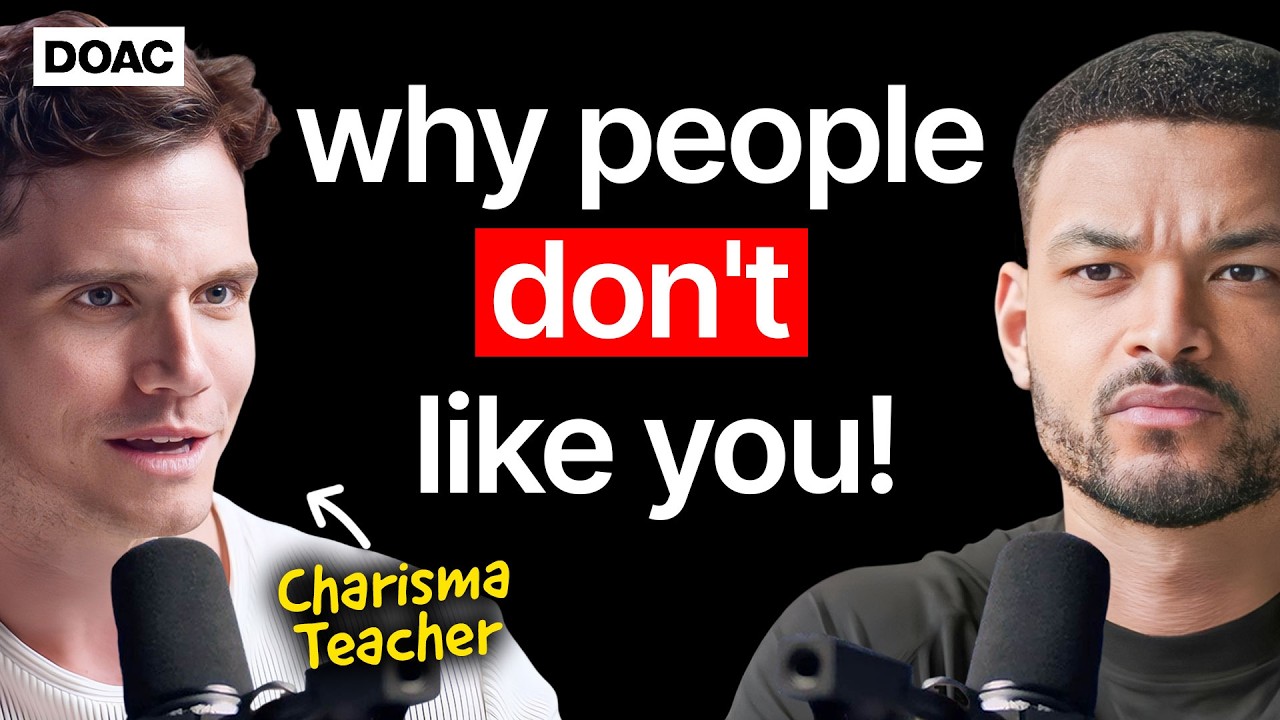
📺 Today’s recommended deep-dive video: https://www.youtube.com/watch?v=zg4Ta7vXiIM
Unlock Your Presence: The Science of Instant Charisma and Connection
Most people think charisma is a biological gift, but it is actually a learnable set of mindsets and physical cues. Charlie Houpert, founder of Charisma on Command, reveals how to move from being “invisible” to commanding any room through the power of vulnerability and status-shifting habits.
Core Question: How can anyone transform their social influence by mastering internal mindsets and external body language?
Highlights
- The “One More Sentence” rule for expanding social circles and building instant rapport.
- Distinguishing between “Prey” vs. “Predator” body language to signal safety and high status.
- The four pillars of a perfect first impression: Fun, Trust, Respect, and Interest.
- Why “shining less bright” is a common but destructive defense mechanism for successful people.
⏱️ Reading time: approx. 12 minutes · Saves you about 122 minutes vs. watching.
Want to take notes while watching? Click the image below and let AI Notebook capture the key points for you 👇

The Charisma Myth and the Power of First Impressions
Beyond Being “Invisible”
Charisma isn’t about throwing a football or being born with a specific look; it is the skill of projecting your best version in moments of pressure.
Charlie Houpert spent years feeling like a “normal” person who was essentially invisible to the world, safe from being picked on but isolated from any meaningful connections. This safety came at a high cost, as he eventually realized that “blending in” prevented any magical opportunities from occurring, leading to a mission to reverse-engineer social mechanics through trial and error while studying abroad.
By running small personal experiments—some of which failed hilariously, like his “big eyes” phase—he discovered that the way we approach conversations dictates the quality of the responses we receive.
The 60-Second Trust Filter
A massive mistake people make is trying to be “interested” in others before establishing their own value, which often leads to a low-status dynamic.
To flip this, you must communicate three things in under a minute: that you are fun, that you are trustworthy, and that you are respectable. The easiest way to project “fun” is to answer the standard “How are you?” with more enthusiasm than a simple “Fine,” using words like “fantastic” or “electric” to shift the room’s energy.
Once you establish this baseline, you can then express genuine interest in others without appearing like you are “seeking” something from them.

💡 Digging Deeper
Q: What is the “One More Sentence” rule?
A: It’s the habit of adding a single extra sentence to any “prescribed” social interaction, like talking to an elevator neighbor or a barista, to break the autopilot of small talk.
Q: How do you avoid the “Weather Talk” trap?
A: You leave “hooks” in your answers—brief mentions of your business, travels, or hobbies—that give the other person an invitation to opt into a deeper topic.
Decoding Social Status: Prey vs. Predator
The Body-State Loop
Slowing down your physical movements signals to your own brain—and the brains of everyone watching you—that you are safe and in control.
Prey animals like rabbits move with high-frequency, jerky motions because they are constantly scanning for threats, whereas predators like lions move with a slow, considered pace that reflects their position at the top of the food chain. Humans are highly attuned to these mammalian signals, meaning that if you are fidgety or “darty” with your eyes, you are subconsciously advertising low status and high internal anxiety to the room.
You can trigger a positive feedback loop by opening your body language and exposing “vulnerable” areas like the neck or palms, which forces your internal state to become more grounded.
High Conviction and The “Storm of Belief”
Interactions are often just two people with different “storms of beliefs” encountering one another, where the person with the higher conviction usually wins.
If your internal belief is “I don’t belong here,” others will pick up on that frequency and treat you accordingly, but if you enter with the belief “I am worthy and safe,” that energy bleeds through. This is why figures like Donald Trump or Conor McGregor are so influential; they possess a level of certainty that makes it nearly impossible for others to maintain a dissenting frame during a live interaction.
True leadership involves holding your “period” at the end of a sentence and refusing to be run off or interrupted, which sub-communicates that your thoughts have inherent weight.
💡 Digging Deeper
Q: Why do “filler words” like “um” and “uh” hurt charisma?
A: They are crutches used to avoid silence; replacing them with a pause creates a vacuum that actually pulls the audience’s attention toward you.
Q: Is it okay to “fake it till you make it”?
A: It is a starting tool to build “reps” of success, but it must eventually transition into a genuine internal state of self-approval to be sustainable.
The Six Charismatic Mindsets
Character Over Reputation
A leader must care more about their actual character than the public “optics” of their decisions.
In the modern world, people are terrified of “overshooting” or being too strong, yet they spend their entire lives “undershooting” and missing out on deep connections because they are afraid of a momentary social error. Charlie argues that you should prioritize your integrity by telling the truth even when it creates friction, as “white lies” like saying “I’m on my way” when you aren’t actually training your brain to be untrustworthy.
By being impeccably honest, you gain the ability to speak with a level of conviction that people who fudge the truth can never replicate.
The “Go There First” Principle
Whoever is willing to be vulnerable first in a social setting automatically becomes the leader of the interaction.
Whether it’s cracking the first joke, giving the first compliment, or sharing a real struggle, “going there first” gives everyone else in the room permission to stop performing and start being human. This breaks the “stiff” social norms that drain our energy and allows for “magical” connections that would otherwise be lost to the void of professional politeness.
When you stop trying to “convince” people and start offering “invitations” to join your mission or your fun, you attract high-quality partners who are opting in for the right reasons.

Key Takeaways
True charisma is the ability to bridge the gap between your private, comfortable self and your public persona, ensuring that you remain grounded regardless of the stakes. By mastering the physical “Predator” cues of slowness and expansion, you can effectively hack your nervous system into a state of safety, which then allows your natural personality to shine through without the interference of social anxiety.
Ultimately, the highest form of charisma is not a set of “tips and tricks” to manipulate others, but a commitment to internal alignment and radical honesty. Charlie’s journey from a shy, “invisible” kid to a global authority on communication highlights that social success is a byproduct of self-love and the courage to be seen, imperfections and all. When you stop fearing the “overshoot” and start leading with vulnerability, you stop merely surviving social interactions and start creating a life of deep, meaningful connection.
Q&A
Q1: How do I handle someone who is being subtly rude or “testing” me?
A1: Interpret ambiguous communications charitably or purposefully misinterpret them as a joke. If you don’t defend yourself against minor digs, you sub-communicate that the other person’s opinion doesn’t have the power to destabilize you.
Q2: What is the best question to ask at the end of a job interview?
A2: “If we look back a year from now and I’ve been a huge success in this role, what specifically will I have done to make you feel that way?” This forces the employer to visualize you succeeding and gives you the exact playbook for a promotion.
Q3: How can I be more attractive to others without focusing on looks?
A3: Have standards that go beyond physical beauty. When you communicate that you are looking for specific traits like “adventurousness” or “kindness,” you shift the power dynamic and show that you are filtering for a partner, not just chasing an image.
Q4: What should I do if I feel nervous before a big meeting?
A4: Get “warm” by talking to anyone—an Uber driver, a receptionist, or a security guard—before the meeting starts. Also, use the “Tony Robbins” method of physical incantations to shift your body state into one of high energy and self-approval.
Q5: Why is it important to share your “purpose” early on?
A5: People love to participate in a dream. When you proactively share what you are trying to build or prove to the world, you give others a reason to help you that goes beyond a simple transaction.
Q6: How do I know if a relationship is authentic or transactional?
A6: Pay attention to your “doubts.” If you feel guilty verifying someone’s claims or if you notice them telling tiny lies to others, they are likely manipulating the narrative to appear necessary rather than being truly useful.
Q7: Can introverts be charismatic?
A7: Absolutely. Charisma is not about being the loudest person; it’s about being grounded and present. Empathetic charisma (the “Oprah” style) is highly effective for introverts because it focuses on making the other person feel seen.