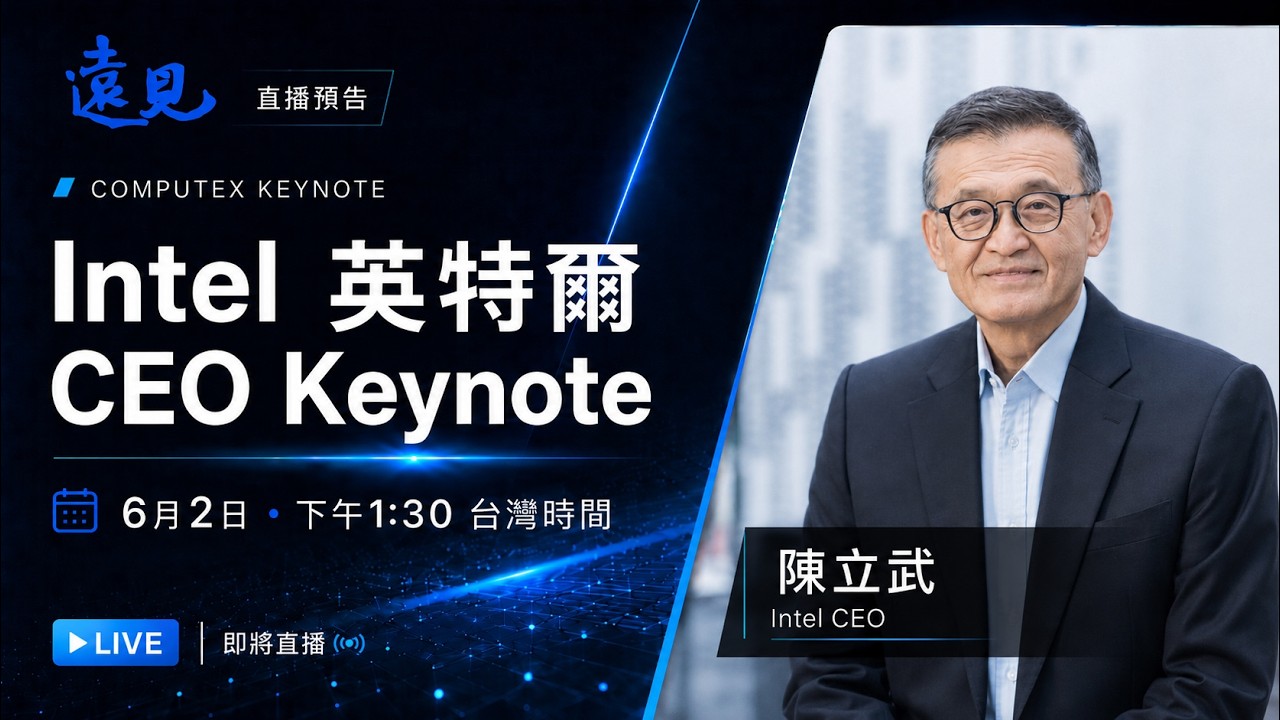
📺 Today’s recommended deep-dive video: https://www.youtube.com/watch?v=qxk7dKhkGUU
Intel’s 18A Architecture: Scaling the Next Generation of Agentic AI
Intel is pivoting from a traditional silicon provider to a full-stack systems engineering powerhouse, leveraging the 18A process to redefine performance from handheld gaming to massive data center racks. CEO Li Pan and his team showcase how a unified architecture is essential for the transition from simple chatbots to autonomous digital agents.
Core Question: How is Intel integrating its new 18A process and x86 architecture to orchestrate the complex demands of hybrid, agentic AI across client and enterprise ecosystems?
Highlights
- Launch of the Intel 18A process at full scale, powering the Core Ultra Series 3 and the ARK G3 handheld gaming chip.
- Introduction of “Hybrid Agentic Inference” in partnership with Perplexity to balance local privacy with cloud-based intelligence.
- Debut of Xeon 6 processors with up to 288 E-cores, designed for high-density orchestration in the modern “AI factory.”
- Expansion into purpose-built silicon through partnerships with Google, Siemens, and brain-inspired neuro-technology startups.
⏱️ Reading time: approx. 8 minutes · Saves you about 60 minutes vs. watching.
Want to take notes while watching? Click the image below and let AI Notebook capture the key points for you 👇

The 18A Frontier: From Ultra-Thins to Handheld Gaming
Scaling Performance Across Client Devices
Intel has officially moved its advanced 18A process technology into full-scale production, marking a return to aggressive engineering leadership under CEO Li Pan’s focused tenure.
The Core Ultra Series 3 represents the first flagship product of this era, setting new benchmarks for battery life and mobile response times. By blending high-performance CPU cores with improved GPUs and low-power NPUs, Intel is creating a foundation for PCs that function as proactive digital agents rather than passive tools.
Handheld gaming is receiving a massive boost through the ARK G3 chip, which offers stability that outperforms competitors by over 40 percent in key gaming benchmarks. This specialized silicon allows for AAA gaming at 1080p while consuming half the power of previous generations, proving that the 18A process is versatile enough to scale from enterprise workstations down to portable, battery-constrained consumer devices that require elite graphical fidelity.
Beyond traditional computers, Intel is pivoting these IPs toward “Physical AI” and edge robotics, targeting a projected 25 trillion-dollar market by 2050.

💡 Digging Deeper
Q: Why is the 18A process significant for the consumer market?
A: It allows for higher transistor density and better power efficiency, enabling premium performance in thinner form factors and longer-lasting handheld devices.
Q: How does the ARK G3 differ from standard laptop chips?
A: It is specifically tuned for high-performance graphics and battery longevity in the emerging handheld gaming console segment.
Q: What is “Physical AI” in the context of Intel’s strategy?
A: It refers to deploying AI silicon into manufacturing, robotics, and retail environments where digital intelligence interacts with physical world objects.
Orchestrating the Agentic Era: Hybrid AI and Perplexity
Moving Beyond Simple Prompts to Autonomous Systems
The shift from traditional AI to “Agentic AI” represents a fundamental change in how software interacts with hardware, moving from simple question-and-answer loops to complex, multi-step goal execution.
Intel and Perplexity are collaborating on “Computer,” an AI operating system that uses an orchestrator to manage up to 20 different AI models simultaneously. This system creates a “hybrid agentic inference” model where sensitive data, such as private financial files or transcripts, never leaves the local Intel Core Ultra device, ensuring total user privacy.
Local NPUs and GPUs handle the initial data classification and reasoning, while the cloud handles broader research tasks that do not involve proprietary information. This architecture solves the massive orchestration problem of balancing accuracy, privacy, and cost-per-token, which is the new metric for success in the AI era.
By running smaller, specialized models locally, users can maximize the “token value per watt,” making AI not just smarter, but economically viable for large-scale enterprise deployment.

💡 Digging Deeper
Q: What makes “Agentic AI” different from a standard chatbot?
A: Agentic AI is given goals rather than just prompts; it iterates, uses tools, and reflects on its own output to complete a task autonomously.
Q: How does hybrid compute protect user privacy?
A: It uses local models to identify sensitive files and prevents those specific data points from being uploaded to a centralized server during the reasoning process.
Q: Why does the CPU matter more for agents?
A: The CPU acts as the orchestrator, managing file systems, checking rules, and spinning up new agents, while the GPU handles the heavy language model math.
The New Data Center: Density, Disaggregation, and Custom Silicon
Scaling Intelligence with Xeon 6 and Open Blueprints
As AI inference grows to occupy 40 percent of all data center power demand, the divide between CPU-led infrastructure and GPU-heavy “AI factories” is rapidly disappearing.
The Intel Xeon 6 Plus, featuring 288 E-cores, addresses this by providing unprecedented density for orchestration tasks, allowing a single rack to support up to 150,000 active digital agents. This massive core count ensures that expensive GPUs are never left idle, as the Xeon processors handle the web fetching, unit testing, and tool execution required for modern AI workloads.
To simplify deployment, Intel is introducing “Rack Scale Blueprints” built on open standards, moving away from proprietary workarounds that have historically locked enterprises into specific vendors. Working with partners like Foxconn and Sambanova, Intel is proving that heterogeneous computing—combining CPUs, GPUs, and RDUs (Reconfigurable Dataflow Units)—is the only way to achieve two to three times faster inference speeds.
This aggregated approach allows enterprises to scale their digital agents across thousands of cores without hitting the traditional power and thermal walls of monolithic architecture.

💡 Digging Deeper
Q: Why did Intel increase the core count to 288 on the Xeon 6?
A: High core density is required to orchestrate the thousands of micro-tasks and “digital agents” that run concurrently in a modern AI inference environment.
Q: What is “Disaggregated Inference”?
A: It is a stack where CPUs handle tools/logic, RDUs handle decoding/token generation, and GPUs handle prefill to reduce overall latency.
Q: How does Intel’s partnership with Sambanova impact the market?
A: It provides an air-cooled, high-performance alternative to traditional liquid-cooled GPU clusters for enterprise AI inference.
Key Takeaways
Intel’s transition to the 18A process is more than a manufacturing milestone; it is the catalyst for a unified architecture that spans from a gamer’s palm to the global cloud. By focusing on the orchestration role of the x86 CPU, Intel has positioned itself as the “brain” of the agentic era, managing the complex interactions between different specialized chips. The emphasis on hybrid compute—keeping sensitive tasks local while using the cloud for scale—addresses the primary enterprise barriers of privacy and cost.
The collaboration with diverse partners like Perplexity for software, Foxconn for hardware, and Echo Neuro for brain-inspired computing demonstrates a shift toward an open ecosystem. This “built together” philosophy is designed to challenge proprietary models, offering customers the flexibility to choose the best silicon for their specific workloads. As AI matures into autonomous agents, Intel’s strategy of density and disaggregation appears ready to meet the massive demand for token generation at scale.
Q&A
Q1: What is the primary benefit of the Intel 18A process technology?
A1: It is Intel’s most advanced process node, designed to scale across all segments from mobile to data centers, offering superior energy efficiency and performance density.
Q2: How does Intel plan to compete in the handheld gaming market?
A2: By using the ARK G3 GPU, which offers 40% faster performance and consumes 50% less power than current competitors at 1080p resolutions.
Q3: What is “Hybrid Agentic Inference” in the context of the Perplexity partnership?
A3: It is a system where local Intel hardware handles sensitive data and initial reasoning, while cloud models provide broader intelligence, balancing privacy with power.
Q4: How does the Xeon 6 processor change data center density?
A4: With up to 288 cores per socket, it allows for over 36,000 cores per 32U rack, enabling the management of hundreds of thousands of AI agents simultaneously.
Q5: What is the “VC2” architecture mentioned by Robert Smith of Vista Equity Partners?
A5: It is the world’s first commercially available architecture for disaggregated inference, using Intel and Sambanova technology to provide low-latency AI as a service.
Q6: How is Intel involved in brain-inspired or biomed computing?
A6: Intel is partnering with companies like Echo Neuro to develop brain-trained algorithms and Greenstone Biosciences to use AI for scaling stem cell organoid research.
Q7: What is a “Rack Scale Blueprint”?
A7: It is a set of open-standard designs that allow partners like Foxconn to build integrated, scalable AI environments without using proprietary, vendor-locked hardware.