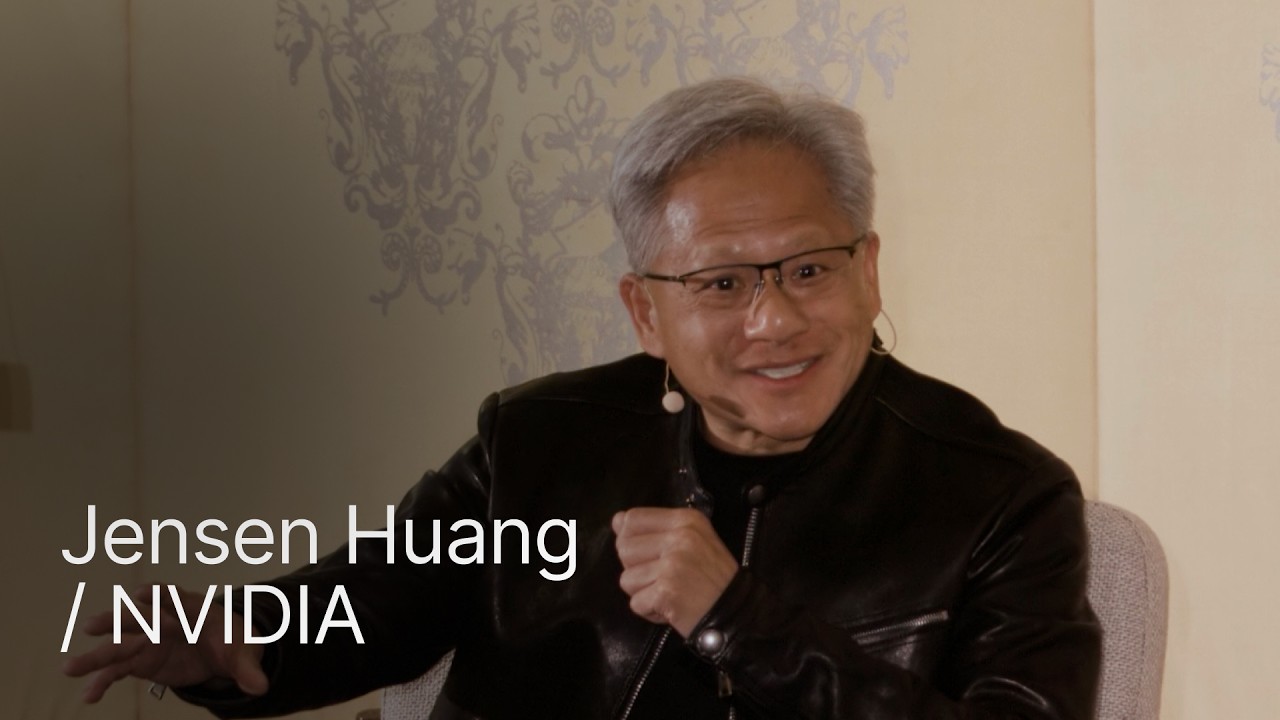
📺 Today’s recommended deep-dive video: https://www.youtube.com/watch?v=2UpQbeAZuqA
The AI Factory: Jensen Huang on the $20 Trillion Intelligence Revolution
We are currently witnessing the largest infrastructure buildout in human history, transitioning from a retrieval-based digital economy to a generative intelligence economy. Nvidia CEO Jensen Huang explains how “AI Factories” are replacing traditional data centers, moving beyond chatbots to create a world where intelligence is a manufactured commodity.
Core Question: How is the shift from data retrieval to real-time intelligence generation redefining global industry and the nature of human labor?
Highlights
- Paradigm Shift: Moving from 60 years of “retrieval-based” computing to a “generative” era where every pixel and thought is created in real-time.
- Agentic AI: The evolution of AI from simple generation to “thinking” systems that can use tools, solve problems, and work autonomously.
- The Five-Layer Cake: A strategic investment framework covering energy, hardware, infrastructure, models, and specialized applications.
- Task vs. Purpose: Why AI won’t steal jobs, but rather elevate professionals from performing repetitive tasks to fulfilling higher-level purposes.
⏱️ Reading time: approx. 8 minutes · Saves you about 33 minutes vs. watching.
Want to take notes while watching? Click the image below and let AI Notebook capture the key points for you 👇

From Data Centers to AI Factories
The End of the Retrieval Era
For the last sixty years, computing has been based on a simple “record and retrieve” model. We wrote programs, took photos, or recorded music, saved them to a disk, and used computers to fetch those files later. This is why we called them “data centers”—their primary job was to store and serve data that already existed.
Everything is about to change.
The future of computing is not retrieval; it is generation. In this new paradigm, every interaction is produced originally and in real-time based on your specific context, background, and intent. Jensen Huang compares this to a power grid: just as a dynamo converts motion into electricity, an AI factory converts electrons into “tokens” of intelligence. These tokens are the new units of value for the global economy.

💡 Digging Deeper
Q: What exactly is a “token” in this context?
A: Tokens are the fundamental units of AI output, whether they are words, pixels, protein structures, or robotic commands; they are essentially “raw intelligence” formatted into usable data.
Q: Why does Huang call it a “factory” instead of a server farm?
A: A factory implies a production line that takes raw materials (data and electricity) and outputs a refined product (intelligence) at scale, rather than just storing information.
Q: How does context change the output?
A: Because the system reasons in real-time, the same prompt will yield different, highly-tailored results based on who is asking, why they are asking, and what the current environment dictates.
The $20 Trillion Five-Layer Cake
Mapping the Industrial AI Stack
To understand where the investment is flowing, we must look at the “five-layer cake” of the AI industry. At the base is Energy, the single greatest growth opportunity for sustainable power in a century. Above that sits Chips and Networking, the physical silicon that enables computation. The third layer is Infrastructure, encompassing the land, cooling, and data center operations required to house these machines.
The fourth layer is the Model Layer, where companies like OpenAI and Anthropic reside. However, Huang notes that the real frontier isn’t just language; it’s the language of physical structure—proteins, genes, and physics.
The final, fifth layer is the Application Layer. This is where $100 billion in venture capital is currently flowing to create specialized tools for legal, financial, and healthcare sectors.

The Language of Everything
Computer scientists have discovered that anything with structure can be learned as a language. We aren’t just teaching AI to speak English; we are teaching it the “language” of human biology and physical movement. If a system is predictable—like the way a cell reacts to a chemical or how gravity affects a falling object—it has a structure that can be tokenized.
This means AI will soon manage the $80 trillion physical world. By learning the “meaning” of a protein the way it learns the meaning of a word, AI transitions from a digital assistant to a biological and mechanical architect.
The Elevation of Human Labor
Task vs. Purpose
There is a pervasive fear that AI will eliminate jobs, but this stems from a “naive understanding” of work. Huang argues that we must distinguish between a task and a purpose. A radiologist’s task might be scanning images, but their purpose is diagnosing disease and treating patients. When the task of image scanning was automated, the demand for radiologists actually increased because they could treat more people more effectively.
AI doesn’t take jobs; it automates tasks so humans can focus on their mission.
A software engineer’s job is not “typing code,” but solving problems. A plumber tomorrow might use AI to become a designer; a furniture salesperson might become an interior decorator. By automating the technical “drudgery,” AI provides a “superpower” that elevates the craftsman to an architect.

Closing the Technology Divide
For 40 years, the digital divide widened as programming languages became more complex, leaving only 2% of the population capable of “talking” to computers in C++. Generative AI has closed that gap.
Now, the programming language is “human.”
This shift democratizes technology. Because anyone can now give a prompt, the barrier to innovation has been removed, allowing the other 98% of the world to participate in the computer revolution. Huang’s message is clear: do not fear the technology, but engage with it, because the only person who will lose their job is the person who refuses to use AI.
Key Takeaways
The transition from retrieval to generation is the most significant pivot in the history of computing. We are moving away from computers that act as libraries and toward computers that act as engines of thought. This “intelligence grid” will eventually cocoon the planet, providing cognitive power as a utility just like electricity or the internet.
Investment opportunities are vast, but they require looking beyond just “chatbots.” The real value lies in the physical and industrial applications of AI—using it to decode biology, manage energy grids, and control robotics. This is a $20 trillion ecosystem that is currently only 5% of the way through its buildout.
Finally, the social impact of AI is one of elevation, not replacement. By lowering the technical barrier to entry, we are enabling a new era of human creativity. The goal is to move from being “keyboard operators” to “problem solvers,” using AI as the ultimate tool to enhance our natural capabilities.
Q&A
Q1: What is the most expensive piece of equipment in the AI factory?
A: A single rack containing 72 chips weighs two tons, costs $4 million, and contains 1.5 million parts.
Q2: Will AI lead to mass unemployment for software engineers?
A: No. While AI can handle the task of coding, the purpose of an engineer is to solve problems and innovate. Demand for engineers is currently higher than ever because they can solve more problems in less time.
Q3: How much money is being invested in AI infrastructure annually?
A: The market is currently putting about $1 trillion into the AI “five-layer cake” annually, but Huang expects this to grow into a $20 trillion a year ecosystem.
Q4: Is AI safe to use?
A: Yes. Huang argues that the technology industry is heavily invested in safety. He points out that modern AI hallucinates significantly less than it did two years ago because it now “reflects” and “researches” before providing an answer.
Q5: What should parents tell their children about the AI revolution?
A: They should encourage them to engage with AI. It is a “superpower” that provides an advantage to those who use it. The risk isn’t losing a life to AI, but losing a competitive edge to someone who utilizes the tool.
Q6: Why is energy considered the “bottom layer” of AI?
A: Because an AI factory is essentially a machine that converts electricity (electrons) into intelligence (numbers/tokens). Without a massive, sustainable energy grid, the “intelligence revolution” cannot scale.
Q7: How does AI close the “technology divide”?
A: Previously, only the 2% of people who knew coding languages like C++ could control computers. Now that computers understand human language, the other 98% of the population can “program” simply by speaking.