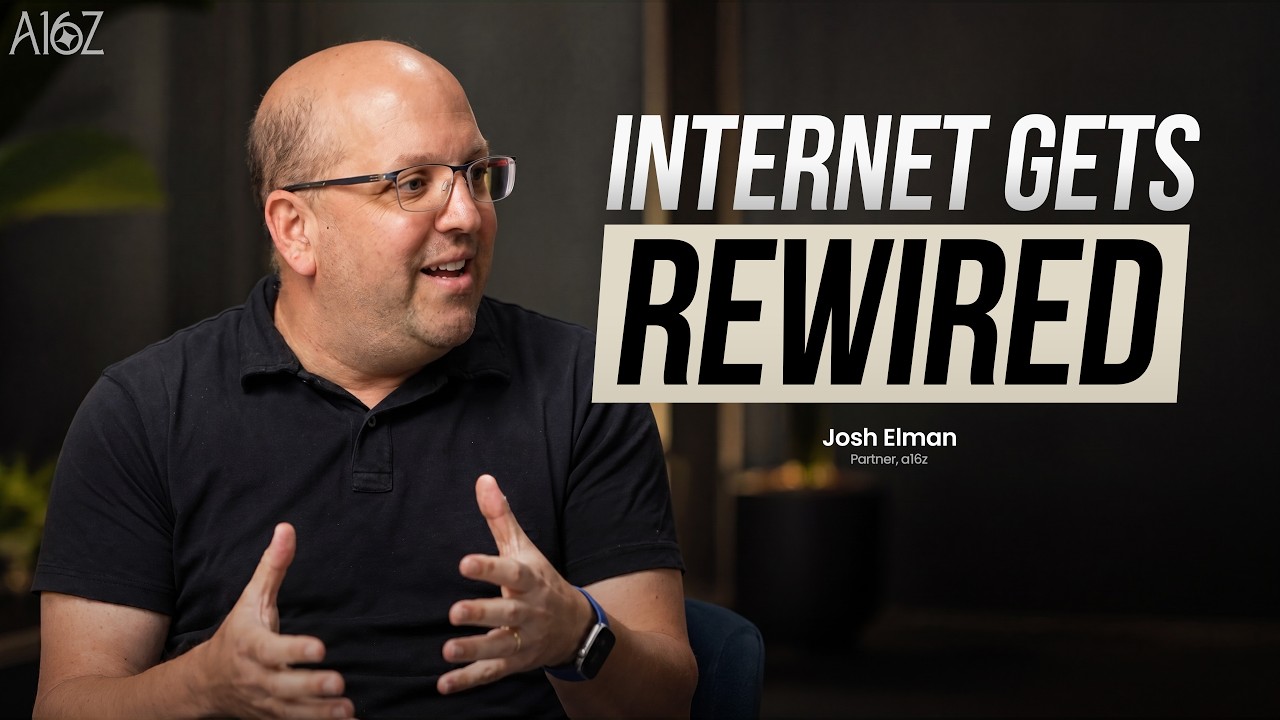
📺 Today’s recommended deep-dive video: https://www.youtube.com/watch?v=tTv0Hl5xfXw
Beyond the Bot: Building the Next Generation of Consumer AI
Josh Elman, a veteran of Facebook, Twitter, and Apple, explores the shift from AI as a mere productivity tool to a context-aware personal life companion. He breaks down why the “personal” in personal intelligence represents the next massive platform shift for the consumer internet.
Core Question: How can startups leverage personal context and new distribution loops to build AI products that consumers truly retain?
Highlights
- The transition from “productivity AI” to “personal intelligence” that understands your unique messages, mail, and calendar.
- Why retention, rather than viral distribution, remains the ultimate metric for measuring consumer success in the AI era.
- The evolution of growth tactics: moving from simple “give-ten-get-ten” referrals to gamified psychological rewards like Robinhood’s stock lottery.
- The strategic advantage startups hold over big “Labs” by exploring human connection and specialized niches that incumbents are too cautious to touch.
⏱️ Reading time: approx. 6 minutes · Saves you about 47 minutes vs. watching.
Want to take notes while watching? Click the image below and let AI Notebook capture the key points for you 👇

The Personal Intelligence Revolution
From Task Completion to Contextual Awareness
Technology is no longer the underdog in our society; it has become the default operating system for modern human existence. We have moved past the era where being “online” was a separate state of being, as the pandemic solidified the digital world as our primary venue for connection and commerce.
At Apple, Elman focused on the concept of “personal intelligence”—the idea that an assistant isn’t just a search engine but a context-aware partner. When you can tell your phone to “navigate to dinner” without specifying a location because it has already scanned your messages to find the restaurant name, the friction of daily life begins to evaporate into a seamless, trusted flow of information. This level of intimacy requires a fundamental shift in how we build and trust our devices.
We are rapidly moving away from the “productivity” phase of AI, where the primary goal was simply to replace professional tasks or save work hours for enterprises. The next wave is about helping you get more out of your actual life, using natural language as a substrate to tinker with and customize the world around you in ways that feel uniquely yours.

💡 Digging Deeper
Q: Why does the “personal” matter more than the “intelligence”?
A: Because general intelligence is becoming a commodity, but personal context creates an indispensable life partner that understands your history and preferences.
Q: How does this change the “Siri” experience?
A: It moves from a command-and-control interface to one that anticipates needs by connecting the dots between disparate apps like Mail and Maps without the user having to bridge the gap manually.
The New Playbook for Growth and Distribution
Beyond the Viral Loop
The social era of growth relied on viral loops and aggressive address book scraping, but modern consumers have grown jaded and resistant to those legacy tactics. Today, trust is brokered through creator relationships and organic word-of-mouth where the product’s 10x improvement over the status quo—like ChatGPT’s superiority over Google links—is the primary driver of adoption.
Retention is the only metric that truly matters; if users don’t move their lives into your product, your distribution is just expensive noise.
Look at Robinhood’s success: they didn’t just offer boring cash referrals that felt like a transaction. By giving away a “lottery” stock that could be worth $2 or $100, they tapped into a gamified psychological reward system that was both cost-effective for the company and highly shareable for the user. This demonstrates that for AI startups, the mechanism of growth must be as innovative and emotionally resonant as the underlying technology itself.

💡 Digging Deeper
Q: Is paid acquisition still viable for startups?
A: Yes, but only if the retention loop is so strong that you aren’t “burning” users to find the one who sticks. Paid should be a catalyst, not a life support system.
Q: What is “Generative Engine Optimization” (GEO)?
A: It is the practice of ensuring your product or service is the one recommended by AI agents when a user asks a broad question like “How do I plan a trip to Japan?”
Startups vs. The Labs: Finding the “Soul”
The Vulnerability of Incumbents
Founders often fear that the “Labs” like OpenAI, Google, or Apple will swallow the entire market, but history suggests incumbents struggle with specialized human needs. Big companies are built on committees that prioritize safety, broad utility, and brand protection, which often results in stripping away the “soul” or the specific, sometimes controversial, nuances that make a personal product feel human.
Startups can explore “human” niches like AI companions or highly specific social experiences that would be a PR nightmare for a trillion-dollar company to release. This “indirection”—joining a volleyball team to make friends, or using an AI to practice dating conversations—is where the most interesting consumer value resides because it addresses emotional needs rather than just utility.
The ultimate goal of the toolmaker is not to replace human relationships but to augment our fundamental ability to be human.

💡 Digging Deeper
Q: Will agents replace apps entirely?
A: No. While agents are great for starting a task via chat, users will still want rich, immersive experiences and visual interfaces to explore and consume content.
Q: How can a startup compete with Apple’s “on-device” advantage?
A: By focusing on the “sycophantic” or personality-driven aspects of AI that a utility-focused assistant like Siri intentionally avoids to maintain a neutral brand.
Key Takeaways
The transition from the productivity-focused “work” era of AI to the “life” era is the most significant opportunity for today’s founders. By focusing on personal context—the data that lives only on a user’s device or within their private accounts—startups can create experiences that general-purpose models cannot replicate. This “personal intelligence” turns the AI from a search bar into a true assistant that knows your friends, your schedule, and your intentions.
Success in this new landscape requires a return to the fundamentals of product-market fit, where retention is prioritized over raw user acquisition. As distribution shifts toward creator trust and agent-based recommendations, the products that “stick” will be those that offer a 10x improvement in how we spend our time, rather than just how much time we save. Whether through gamified referrals or highly specific social “souls,” the next generation of billion-user platforms will be built on augmenting, not replacing, the human experience.
Q&A
Q1: How did Musical.ly (TikTok) achieve such massive scale through other platforms?
A1: They allowed users to create high-quality content that wasn’t possible elsewhere and made it trivial to share that content on Instagram with a visible “bug” or watermark, creating a perpetual discovery loop.
Q2: Why is “time well spent” a better metric than “time saved” for consumers?
A2: Enterprises want to save time to increase profit, but consumers want to spend their time on activities they enjoy. AI should help users move from “idling” to “exploring.”
Q3: What makes Gen Alpha’s relationship with software different?
A3: Having grown up on Roblox and Minecraft, they expect to have a sense of ownership and the ability to “tinker” with or customize their digital environments rather than just being passive users.
Q4: Can startups build large-scale products when inference costs are so high?
A4: Yes, by using “edge” computing. Smart founders will push less complex tasks to the user’s device (phone or laptop) and only use expensive cloud inference for the most difficult queries.
Q5: What was the “secret sauce” of the Robinhood referral program?
A5: They used a “lottery” mechanic where users could get a stock worth anywhere from $2 to $100. The psychological excitement of potentially winning a high-value stock drove much higher engagement than a flat $10 credit.
Q6: Should AI agents be part of our social group chats?
A6: Eventually, agents will act on our behalf to negotiate plans or retrieve information, acting as a level of indirection that can help diffuse emotionally charged situations and focus on the “truth” of a task.
Q7: Is the “blinking cursor” a problem for consumer AI?
A7: Yes. Most consumers don’t want to be high-agency prompt engineers; they want experiences pushed to them that spark motivation or provide a clear path to follow.