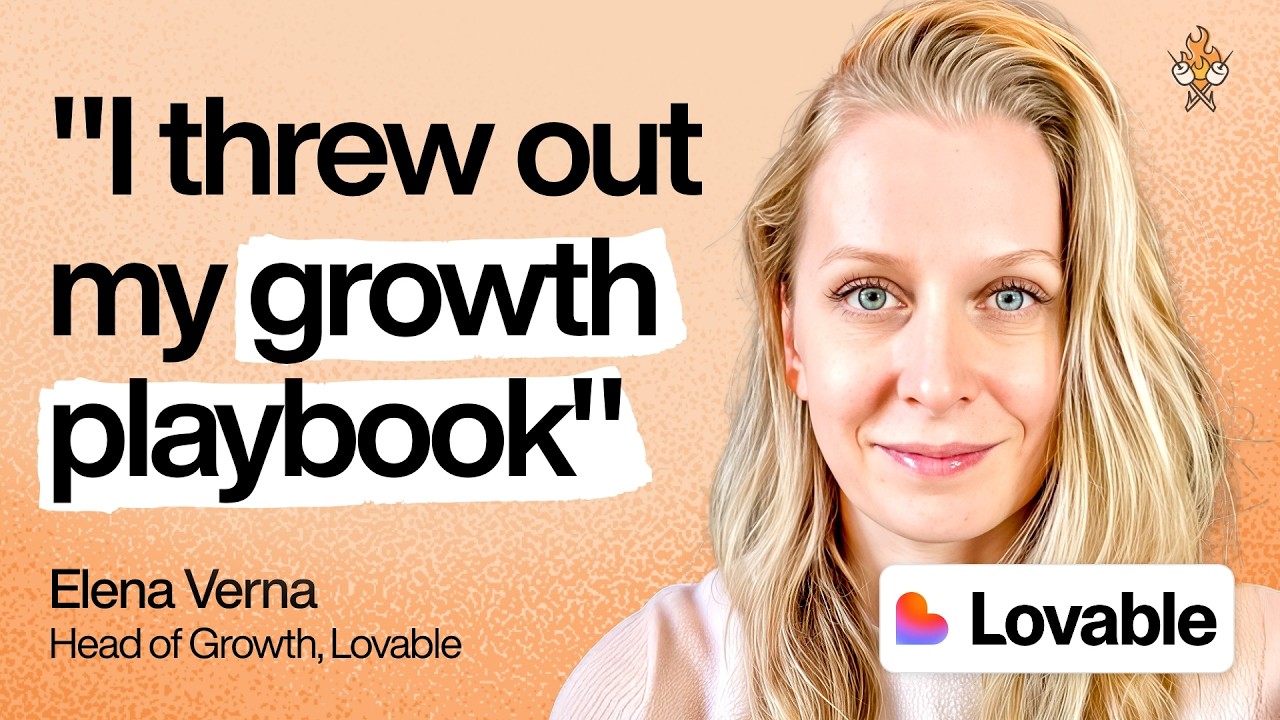
📺 Today’s recommended deep-dive video: https://www.youtube.com/watch?v=6qAB6aUMIeA
The New AI Growth Playbook: How Lovable Hit $200M ARR in One Year
Elena Verna reveals how Lovable became one of the fastest-growing companies in history by discarding traditional growth strategies. Instead of micro-optimizing conversion funnels, the team focuses on extreme shipping velocity and the “vibe coding” revolution to stay ahead.
Core Question: How does the growth engine change when product-market fit must be recaptured every three months in the face of rapidly evolving AI capabilities?
Highlights
- Why only 30-40% of the traditional growth playbook transfers to the current AI landscape.
- The rise of the “Vibe Coder” role and why high-agency generalists are replacing specialists.
- How to use “Minimum Lovable Products” (MLP) and building in public to generate massive word-of-mouth.
- Why giving your product away for free is a high-efficiency marketing strategy in competitive AI markets.
⏱️ Reading time: approx. 12 minutes · Saves you about 80 minutes vs. watching.
Want to take notes while watching? Click the image below and let AI Notebook capture the key points for you 👇

The Death of the Traditional Growth Playbook
From Optimization to Radical Innovation
In the fast-moving waters of generative AI, 80% of the old growth playbook is officially dead. Elena Verna, having led growth at giants like Miro and Dropbox, argues that the predictable patterns of user acquisition and conversion no longer apply when the underlying technology shifts every quarter. Most growth teams spend their lives tweaking dials, but in this new era, those micro-optimizations are a waste of resources.
The traditional approach involves identifying a funnel, finding a drop-off point, and running A/B tests to improve activation by a few percentage points. At Lovable, this has been flipped on its head. Elena now spends 95% of her time innovating on new growth loops and only 5% on optimization. If you are focused on optimizing a solution that the market is about to reinvent, you are essentially arranging deck chairs on the Titanic.
Success today requires a “race car” mentality where the goal is to grease the wheels of a vehicle moving at breakneck speed. This means shipping features that create their own noise rather than waiting for a marketing team to package them. The product itself must be the marketing engine, fueled by a shipping velocity that makes the software feel “alive” to the user base.

💡 Digging Deeper
Q: Why is optimization less valuable right now?
A: Because the category is evolving too fast. When the core capability of an LLM changes, the previous user journey often becomes obsolete. It is better to build a new loop than to polish a dying one.
Q: What replaces traditional SEO in this model?
A: Founder-led social and building in public. The “organic” strategy has shifted from Google search results to real-time engagement on X and LinkedIn, where the personality of the builders creates trust.
Q: How does Lovable handle activation if not through traditional funnels?
A: Activation is treated as a core product feature. The AI agent team is obsessed with the “wow moment” of the first prompt generation, making micro-optimizations at the UI layer less critical than the agent’s reasoning.
Vibe Coding and the Minimum Lovable Product
The Rise of the Non-Technical Builder
Software is entering a “capability stage” where the primary question is no longer “How do I use this?” but “What is possible?” This has birthed the era of “Vibe Coding,” where non-technical founders and employees use AI to generate full-stack applications through natural language. This shift lowers the barrier to entry so significantly that a “Minimum Viable Product” is no longer enough to win—you must ship a “Minimum Lovable Product” (MLP).
An MLP focuses on emotional resonance and the “superpower” feeling a user gets when they see their idea come to life instantly. Elena highlights that at Lovable, if a feature isn’t “lovable,” it doesn’t ship. This isn’t just a brand sentiment; it is a tactical requirement. In a world where AI makes the cost of building software move toward zero, the only remaining differentiator is the quality of the user experience and the delight it provides.
Interestingly, this has led to the creation of new internal roles, such as the “Full-time Vibe Coder.” This individual acts as a bridge between pure product management and engineering, using the tool itself to prototype high-fidelity solutions in hours rather than weeks. This collapses the feedback loop, allowing the growth team to test market hypotheses with working software before the core engineering team ever touches a line of code.

💡 Digging Deeper
Q: What is a “Full-time Vibe Coder”?
A: A high-agency individual, often non-technical, who uses AI tools to build prototypes, internal tools, and marketing assets. They move faster than traditional dev cycles by focusing on “the vibe” and functional outputs.
Q: How does the MLP concept change hiring?
A: It places a premium on designers and “product engineers” who care about the humanity of the software. You need people who are passionate about the “love marks” in a product, not just utility.
Q: Can vibe coding be used for enterprise-grade tools?
A: Yes, Lovable uses it for all internal tools. By building their own software with their own tool, they ensure the product remains robust enough for complex business use cases.
The Three-Month Product-Market Fit Treadmill
Recapturing the Pioneer Market
Product-Market Fit (PMF) used to be a milestone you reached and then scaled for years. In AI, PMF is a treadmill that moves faster every time a new model drops. Elena explains that because LLM capabilities change so radically every few months, companies must effectively recapture their product-market fit on a quarterly basis. If you stop innovating to focus on scaling, a competitor using a newer model will leapfrog you.
This creates a tension between serving “Pioneers”—the early adopters who crave the newest capabilities—and the “Adjacent Users” or the latent majority. Most companies fail because they try to scale to the majority too early, only to find the pioneers have moved on to a more advanced tool. Lovable’s strategy is to stay hyper-focused on the pioneers, trusting that their success will eventually pull the rest of the market forward.
Maintaining this pace requires an organization that can handle chaos. Employees must be comfortable with the fact that their work from three months ago might be rendered obsolete by a new technology release. This “3-month cycle” is the new reality for any company building on top of foundational AI models, requiring constant reinvention of the solution rather than just scaling the business.

💡 Digging Deeper
Q: How do you know when you’ve lost PMF?
A: You see a dip in engagement retention even if your acquisition remains high. Pioneers are the “canaries in the coal mine”—if they stop sharing your tool, your PMF is at risk.
Q: Is it dangerous to ignore adjacent users?
A: Yes, there is a risk of becoming a “techie-only” tool. However, in the current market, losing the pioneers to a more capable competitor is a more immediate death sentence than failing to capture the majority.
Q: How does a $200M ARR company stay in “startup mode”?
A: By keeping the team small (100 people) and maintaining a culture where everyone is a “product person.” You avoid the bloat of traditional sales and marketing departments to keep the innovation-to-optimization ratio high.
Key Takeaways
The landscape of growth has shifted from a game of efficiency to a game of velocity and “lovability.” Lovable’s success—hitting $200M ARR in a year—stems from a fundamental belief that software is no longer a static utility but a living, human-centric experience. By prioritizing the “Minimum Lovable Product” and empowering non-technical “Vibe Coders,” they have unlocked a level of shipping speed that traditional organizations cannot match.
Distribution in the AI era is about noise and generosity. Building in public and giving away product credits for free creates a word-of-mouth engine that is far more cost-effective than competing for expensive Google or Meta ad real estate. In this environment, the product is the marketing, and the brand is built through every interaction the user has with the AI agent.
Ultimately, the goal is to survive the “PMF treadmill” by leaning into high-agency talent and AI-native workflows. Whether you are a founder or an employee, adopting these tools is no longer optional. The gap between those who use AI to augment their creativity and those who don’t is widening, and the future belongs to the builders who can convert chaos into clarity every ninety days.
Q&A
Q1: How does Lovable justify giving so much of the product away for free?
A: They view the high LLM pass-through costs of free credits as a marketing expense. It is more efficient to spend money on letting a user run a hackathon than to spend it on AdWords. If users get a “wow” moment, they become the company’s best advocates.
Q2: What is the most important trait when hiring for an AI startup?
A: High agency and the ability to create clarity out of chaos. Lovable looks for “fireballs”—people who treat work as their hobby and passion. Failed founders are particularly valuable because they already have the autonomy required to own projects from start to finish.
Q3: Does the fast pace of shipping lead to a “Frankenstein” product with too many features?
A: It is a risk, but it’s mitigated by hiring top-tier talent and maintaining a strong “lovable” filter. If a feature doesn’t meet the brand’s standard for design and delight, it doesn’t stay, even if it was shipped quickly.
Q4: How do you maintain work-life balance at such a fast-growing company?
A: Elena emphasizes “work-life integration” over balance. She ruthlessly protects time for sleep, health, and family, but she also uses AI tools to augment her own productivity, allowing her to deliver outsized results in fewer hours.
Q5: Why is “Vibe Coding” considered a revolution for non-technical people?
A: It removes the “syntax barrier” of traditional coding. Someone who understands a business problem but can’t write React code can now build a functional app. This democratizes software creation in the same way Excel democratized data analysis.
Q6: What is the “Adjacent User Theory” and why is it tricky in AI?
A: It’s the idea that you grow by moving from core users to those just outside that circle. In AI, this is hard because the “core” (pioneers) demands such rapid innovation that teams rarely have the breathing room to simplify the product for the “adjacent” (less technical) users.
Q7: Is SEO completely dead for B2B AI companies?
A: Not entirely, but its dominance is fading. Organic growth now happens on social platforms like X and LinkedIn through founder-led narratives and community-building on Discord, where real-time feedback and “building in public” occur.