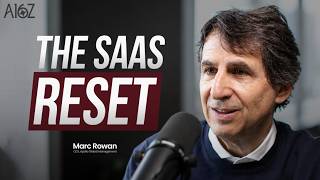
📺 Today’s recommended deep-dive video: https://www.youtube.com/watch?v=oYK_MmZW9XI
The Clean Sheet Revolution: Marc Rowan on the Future of Private Markets
In this deep-dive interview, Apollo CEO Marc Rowan dissects the structural shift from traditional private equity to a global credit and retirement powerhouse. Rowan explains why the “software eating the world” era is being superseded by a massive industrial renaissance powered by AI, energy, and private capital.
Core Question: How is the democratization of private markets and the rise of “clean sheet thinking” reshaping the global financial landscape for both retirees and entrepreneurs?
Highlights
- The Death of Asset Buckets: Traditional institutional “buckets” for equity and fixed income are failing to capture the best risk-adjusted returns found in private investment-grade credit.
- Retirement as a Social Good: Apollo has pivoted to become a retirement services giant, matching long-term liabilities with safe, originated credit assets rather than speculative bets.
- AI’s Impact on Enterprise Software: Rowan warns of “disastrous” returns for legacy software private equity as AI drastically reduces the barriers to entry and changes the cost of starting new businesses.
- Moral Leadership: A candid discussion on standing up against anti-Semitism at UPenn and why Apollo prioritizes “merit adjusted for distance traveled” over immutable characteristics.
⏱️ Reading time: approx. 11 minutes · Saves you about 44 minutes vs. watching.
Want to take notes while watching? Click the image below and let AI Notebook capture the key points for you 👇

The Drexel Diaspora and the Birth of Clean Sheet Thinking
Solving Problems from First Principles
Financial services firms generally die from one of two specific causes: sudden heart attacks caused by funding risk or slow cancer resulting from bad assets. Rowan’s early years at Drexel Burnham Lambert taught him that understanding the fundamental business model is far more important than the nuances of public offerings. When Drexel collapsed in 1990, the founding team was forced to operate without a safety net, leading to the creation of Apollo with a “clean sheet” mentality that prioritized solving client problems over following established industry norms.
Clean sheet thinking is not just about being smart; it is about the refusal to accept legacy structures when the facts on the ground have changed. At Drexel, there were no high-yield bonds or ETFs, so every product—from silver-indexed bonds to highly confident letters—was a bespoke solution to a specific hurdle. This culture of “intellectual insubordination” remains the bedrock of Apollo today, where the right answer is expected to win regardless of who in the hierarchy proposes it.

💡 Digging Deeper
Q: What was the primary lesson learned from Michael Milken?
A: The most valuable takeaway was the “business-first” mentality—understanding the core credit and fundamentals of a company rather than relying on third-party ratings or market momentum.
Q: How did Apollo survive the 1990 global recession?
A: By pivoting from M&A to deploying capital for the Government of France through Credit Lyonnais, managing $6 billion at a time when almost no one had that kind of scale.
Q: Why does Apollo avoid “heart attack” risk?
A: The firm refuses to lend long and borrow short, a fundamental funding mismatch that destroyed Bear Stearns and Lehman Brothers.
From Private Equity to Retirement Infrastructure
The Trillion-Dollar Pivot
Apollo is no longer just a private equity firm; it is an investment-grade credit machine that manages over a trillion dollars in assets. Roughly 80% of the firm’s portfolio is now dedicated to credit, with the vast majority focused on investment-grade assets that provide steady income for retirees. This shift was driven by the realization that to achieve massive scale, a firm must serve a fundamental societal good, which for Apollo is closing the global retirement income gap.
The current public market is dangerously concentrated, with just ten stocks making up nearly 50% of the S&P 500 and carrying identical trend exposures. If you are an investor seeking actual diversification, there is almost no place to find it other than in private markets, which represent 80% of global economic activity. Apollo’s strategy involves originate-to-manage, where they create safe, long-term yield assets—like financing for AT&T or Air France—to match the low-cost liabilities of their retirement services business, Athene.

💡 Digging Deeper
Q: Is private credit just “risky lending”?
A: No. Apollo focuses on private investment-grade credit, lending to massive entities like Intel and Meta for complex infrastructure projects that don’t fit into “plain vanilla” public bond markets.
Q: Why is Apollo moving toward daily mark-to-market pricing?
A: Five major markets—individuals, insurance, 401ks, debt buckets, and traditional managers—demand transparency and liquidity that the old “draw-down fund” model cannot provide.
AI and the Global Industrial Renaissance
When Software Stops Eating the World
The era of enterprise software dominance is facing a reckoning as AI proliferates, making legacy SaaS business models increasingly vulnerable to new, low-cost challengers. Rowan predicts that private equity returns in the software sector could be “disastrous” because many firms paid premiums for a future that did not account for AI-driven commoditization. In this new landscape, the value shifts from code—which can now be checked and generated by AI—to judgment, know-how, and physical infrastructure.
We are currently witnessing a global industrial renaissance that requires a quantum of capital every bit as large as “every dollar since the invention of fire.” This build-out of data centers, chips, robotics, and energy transmission is too capital-intensive for equity alone to finance efficiently. Instead, these projects are being financed through complex credit structures that parcel out risk, allowing financial entrepreneurs to partner with technical visionaries to build the physical backbone of the AI age.

💡 Digging Deeper
Q: Why is robotics the next big frontier for private credit?
A: Once the “Waymo problem” of self-driving in complex environments is solved, applying that tech to construction or manufacturing becomes an equipment rental and financing play, not just a venture bet.
Q: How does AI change employment at a firm like Apollo?
A: Jobs that have a “right answer” (accounting, trade ops) will likely be replaced, while roles requiring judgment and human relationship-building will be enhanced by AI augmentation.
Key Takeaways
The financial world is moving away from the “bucket” mentality where assets must be strictly labeled as public or private, equity or debt. Marc Rowan highlights that the most significant opportunities now live in the “hybrid” space—private investment-grade assets that offer better risk-adjusted returns than public bonds but more safety than traditional private equity. By focusing on origination rather than just picking stocks, firms like Apollo are becoming essential infrastructure providers for the modern economy.
Ultimately, the success of this transition depends on a culture that prizes “right over easy” and maintains a “play to win” spirit even as it scales to thousands of employees. Whether it is challenging university leadership on moral grounds or refusing to overpay for software companies in an AI-disrupted world, the goal is significance rather than just success. The next five years will likely see a total transformation of how retirement income is generated and how the world’s most ambitious industrial projects are funded.
Q&A
Q1: How does Apollo define its culture as it grows to over 4,000 employees?
A: Culture is built on six principles, but the core is “playing to win” and “clean sheet thinking,” where professionals are encouraged to admit mistakes quickly through a “wall of shame” to foster a fail-fast mentality.
Q2: What is “merit adjusted for distance traveled”?
A: It is a hiring philosophy that ignores immutable characteristics (like race or religion) and instead focuses on an individual’s achievements relative to the obstacles they have overcome.
Q3: Why is the firm so focused on energy transition and hydrocarbons?
A: Apollo follows a simple rule: “Make it better, not worse.” This means they will finance the transition to green energy while acknowledging that hydrocarbons remain necessary for current global stability.
Q4: Will private markets eventually replace public markets?
A: Not replace, but they will provide the necessary diversification that public markets can no longer offer due to extreme concentration in a few mega-cap tech stocks.
Q5: What is “intellectual insubordination”?
A: It is a cultural norm where team members are expected to challenge ideas and find the “right answer” regardless of seniority, ensuring the firm doesn’t fall into the trap of bureaucratic process over product.
Q6: How does Apollo view the current state of higher education?
A: Rowan believes universities must return to academic excellence and research rather than social engineering, emphasizing that they should be “moral institutions” that uphold fundamental principles like merit and free speech.
Q7: Why does Rowan believe we are in an “industrial renaissance”?
A: Because the sheer scale of the chips, data centers, and energy infrastructure needed for AI requires a level of physical construction and capital intensive investment not seen in decades.