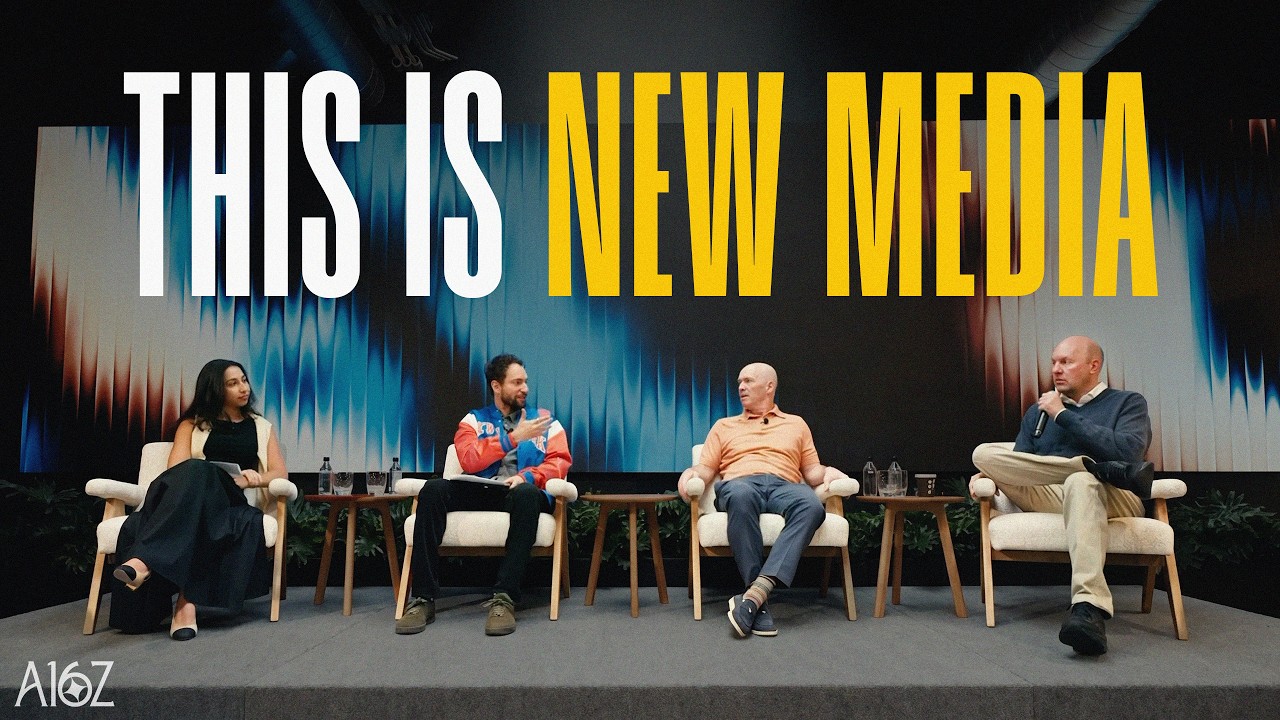
📺 Today’s recommended deep-dive video: https://www.youtube.com/watch?v=XROaLetSxg0
The New Rules of Media: Why the Founder Is the Brand
In a world where centralized media is collapsing, the era of the “plastic CEO” who avoids controversy at all costs is officially over. Success now belongs to the founders who can ditch the teleprompter, embrace “going direct,” and engage in visceral, long-form authenticity.
Core Question: How can founders navigate the shift from defensive, corporate-branded legacy media to the offensive, personality-driven world of modern storytelling?
Highlights
- Legacy media is defense-oriented and aims for “zero news,” while new media is offense-oriented and rewards interesting perspectives.
- The “corporate brand” is an artifact of 20th-century media scarcity; modern decentralized media requires a human face.
- Authenticity is the ultimate competitive advantage, defined as saying in public exactly what you would say to a friend at lunch.
- The most effective marketing is “outside-in,” situating your company within the context of the most interesting global narratives.
⏱️ Reading time: approx. 7 minutes · Saves you about 34 minutes vs. watching.
Want to take notes while watching? Click the image below and let AI Notebook capture the key points for you 👇

The Death of the “Plastic CEO”
From Defensive Gatekeepers to Offensive Storytellers
Old media was built on a foundation of restriction. Because there were only three TV networks and a handful of major newspapers, information had to be squeezed through an incredibly narrow straw. This scarcity forced companies to distill their identities into bland, abstract corporate brands like “International Business Machines” or “General Electric” to ensure nothing controversial ever leaked out.
The goal for a 20th-century CEO was to walk off a stage and be proud they didn’t make any news.
For decades, media training focused on stripping away a person’s humanity. Executives were put in front of cameras, grilled by simulated “adversaries,” and then forced to watch their own tapes in a grueling process of self-critique designed to eliminate every “um,” “ah,” and interesting thought. The result was a generation of “plastic people” who spoke in innocuous, media-trained platitudes that protected the company but bored the audience to tears.
In the new media landscape, being uninteresting is the only unforgivable sin. If you are not offensive—in the sense of playing offense with your ideas—you are invisible.

💡 Digging Deeper
Q: Why was legacy media so adversarial?
A: It operated on a mission to “afflict the comfortable,” which often devolved into an agenda-driven attempt to stop people from saying what they actually thought.
Q: Is media training still valuable?
A: Only if it teaches you to “go direct.” The best advice today is to speak with the same visceral interest you would use when talking to an intimate friend.
Q: What is the “Joe Rogan” test?
A: It is the new bar for leadership; you must be interesting enough to sustain a three-hour, unscripted conversation without a teleprompter.
The Rise of the Personal Brand
Why Your Name Is Effectively on the Door
We have returned to an era similar to the early 1900s, where companies were synonymous with the people who built them. Just as Henry Ford and Thomas Edison were the faces of their empires, today’s winners—SpaceX, Palantir, Anduril—are defined by the personalities of Elon Musk, Alex Karp, and Palmer Luckey.
In new media, the brand is no longer the company; the brand is the person.
This shift is a logical response to the collapse of centralized media gatekeepers. When you have unlimited channels and infinite formats, the audience gravitates toward individuals they can trust or, at the very least, understand. You cannot build a lasting presence through a “Vice President of Marketing” who will be gone in three years; the brand must be anchored by a permanent fixture of the organization.
The “narrow straw” of the past necessitated abstract logos, but the “wide pipe” of the present demands human authenticity and long-form engagement.

💡 Digging Deeper
Q: Can a founder avoid being the spokesperson?
A: You can, but it creates a massive marketing deficit and puts a ceiling on your company’s opportunity.
Q: What if the founder is an introvert?
A: It is a developable skill; even leaders like Donald Trump or Alex Karp evolved their communication styles significantly over decades to match the medium.
The “Outside-In” Narrative Strategy
Stop Gazing at Your Own Navel
The most common mistake founders make is thinking inside-out: “Me, my company, and my product.” This is the “navel-gazing” approach to marketing, and it is fundamentally uninteresting to anyone who doesn’t already work for you. No one cares about your product launch in a vacuum; they care about how it relates to the chaos and excitement of the world at large.
The “cheat code” for great marketing is to identify the most interesting thing happening in the world and then explain how your company relates to it.
Take Alex Karp of Palantir as the “grand wizard” of this technique. He rarely talks about the technical specifics of his software. Instead, he speaks about the future of the U.S. military, the ethics of AI, and global geopolitics. By becoming the person everyone calls to explain the big picture, he makes Palantir’s importance implicit rather than explicit.
When you explain the world to people, you earn the right to explain your company.

💡 Digging Deeper
Q: How do you find your “outside-in” story?
A: Work backward from the outcome you want—if you want to hire engineers, talk about the technical challenges of the industry, not just your job openings.
Q: Is this just propaganda?
A: No, it is the responsibility of tech leaders to honestly explain profound changes to a public that is often confused by noise.
The Art of the Strategic Fight
Why You Need the Right Enemies
In the age of new media, being neutral is a death sentence. You want people to love you or hate you, but you never want them to be lukewarm. A certain amount of friction is actually a sign of success; if no one is attacking you, it probably means you aren’t doing anything important enough to matter.
A well-chosen fight can take a brand from obscurity to national prominence in a single shot because “everyone loves a fight.”
However, you must be disciplined. Responding to every “hater” with 50 followers on X is a degenerate waste of time that only amplifies people who haven’t earned the right to speak to you. The goal is to pick high-level battles—like a conflict with a major newspaper or a dominant industry incumbent—that allow you to highlight your own position and boost your brand by association.
If you don’t have anyone who hates you, you probably don’t have anyone who truly loves you either.

💡 Digging Deeper
Q: When should you stay quiet?
A: Stay quiet when the criticism is “bait” intended to get you to highlight a stupid or irrelevant opinion.
Q: Does negative press hurt the brand?
A: When you reach a certain size, “puff pieces” vanish forever; you must learn to use negative attention as an opportunity to galvanize your supporters.
Key Takeaways
The transition from old to new media is not just a change in tools; it is a fundamental shift in the “laws of physics” for communication. In the old world, the goal was to minimize controversy and hide behind a corporate logo. In the new world, the founder must step into the light, embracing long-form conversations and the inherent messiness of being a real person.
Founders must recognize that storytelling is a core business function, not an elective. By focusing on “going direct,” building a personal brand, and situating their company within global narratives, they can bypass traditional gatekeepers and build a direct, authentic relationship with their audience.
Q&A
Q1: What is the biggest mistake CEOs make when trying to “go direct”?
A: They over-index on distribution tactics—like trying to “go viral”—before they have a message that is actually interesting or strategic.
Q2: Why is “going direct” more important than traditional PR?
A: Because legacy media has become so agenda-driven that it is nearly impossible to get a fair or accurate story told through traditional channels anymore.
Q3: Does the founder have to be the one doing the media?
A: Ideally, yes. It must be a permanent fixture of the company. A rotating VP of Marketing cannot build the long-term trust required for a modern brand.
Q4: How does one develop the skill of being “authentic” on camera?
A: By ignoring traditional media training and focusing on talking about topics you know intimately, as if you were explaining them to a friend at lunch.
Q5: What is the “outside-in” approach to marketing?
A: Instead of talking about your product, you talk about the most interesting trends in the world and then show how your company relates to those trends.
Q6: Why is the “corporate brand” dying?
A: Corporate brands were a workaround for the limited airtime of the 20th century; now that airtime is infinite, people prefer to follow and trust other people.
Q7: Is all news good news?
A: Not necessarily, but for a growing startup, a strategic fight with a major incumbent or a biased media outlet can be a massive opportunity to define your brand.