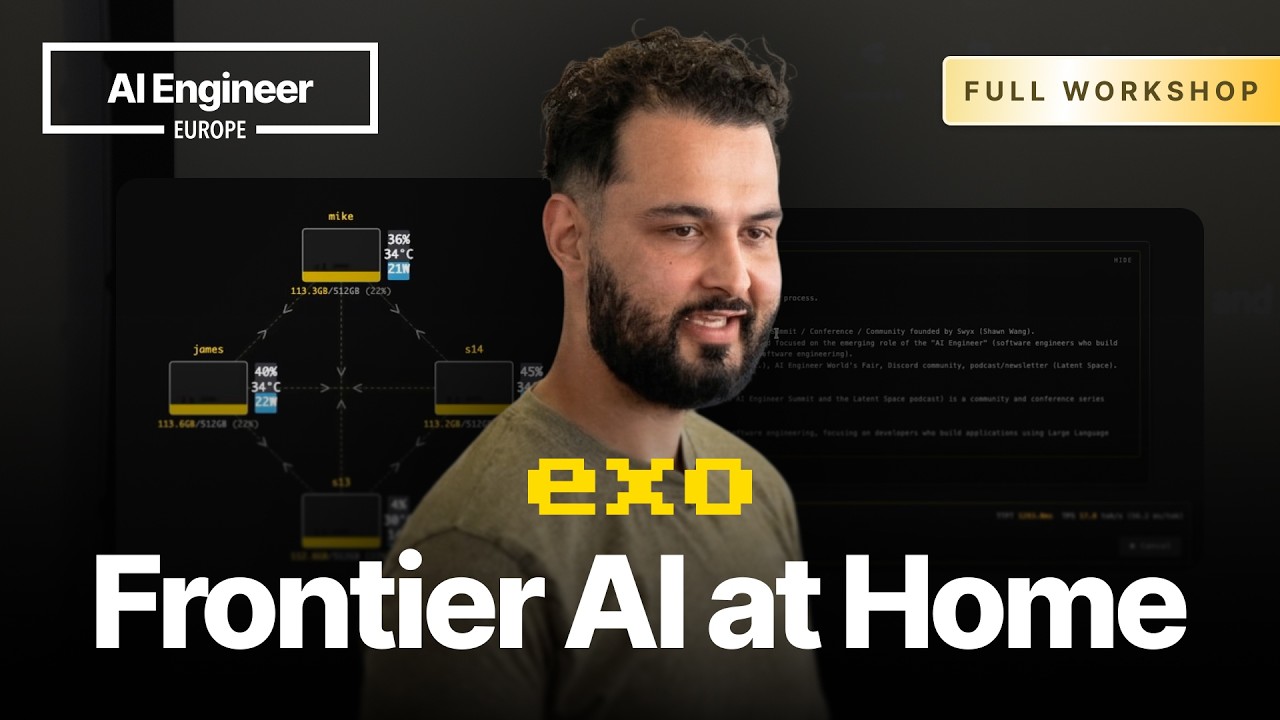
📺 Today’s recommended deep-dive video: https://www.youtube.com/watch?v=ESbWpPT_9-o
The Exocortex Revolution: Running Frontier AI on Your Own Hardware
Most people today rent their digital intelligence from massive cloud providers, but a new wave of local inference technology is making frontier-level AI accessible on consumer hardware. By optimizing the full stack—from custom kernels to heterogeneous hardware clusters—we are moving toward a world where you can own your “brain” rather than subscribing to it.
Core Question: How can we decentralize frontier AI to run efficiently on local hardware clusters instead of billion-dollar data centers?
Highlights
- The “Not your weights, not your brain” philosophy emphasizes the privacy and security risks of centralized AI.
- LLM performance is primarily memory-bound during the decode phase, making memory bandwidth more critical than raw compute for local use.
- Heterogeneous clustering allows users to combine the high memory capacity of Apple Silicon with the high compute of Nvidia GPUs.
- Future scaling will likely shift from massive training runs to test-time scaling and search-based approaches that favor local hardware.
⏱️ Reading time: approx. 10 minutes · Saves you about 95 minutes vs. watching.
Want to take notes while watching? Click the image below and let AI Notebook capture the key points for you 👇

The Case for the Local Exocortex
Why “Renting Your Brain” is a Risky Strategy
The term “Exo” comes from the concept of an exocortex: a functional extension of your biological brain. If AI is going to act as a part of your cognitive process, you have to ask yourself if you are comfortable renting your own thoughts from a third-party corporation.
“Not your weights, not your brain” is the guiding principle for the next generation of local AI enthusiasts.
We have already seen the dangers of centralization, where developers and researchers are suddenly locked out of API providers like Claude or ChatGPT for innocent testing or “wrong-think.” Relying on a few massive organizations for the tools needed to be competitive in the modern world creates a power law that favors rent-seeking. By enabling local inference, we create a competing force that ensures these powerful models remain open and accessible to everyone without a million-dollar hardware barrier.

💡 Digging Deeper
Q: Is local AI just for privacy enthusiasts?
A: No, it is also about cost and reliability; users spending thousands on API tokens daily can break even on hardware in months.
Q: What is the “Hardware Lottery”?
A: It’s the idea that current AI research is biased toward what Nvidia GPUs do well (training), rather than exploring better architectures for inference.
Engineering the Full Stack for Inference
Prefill vs. Decode: Understanding the Bottlenecks
Inference consists of two distinct phases: the prefill stage, which is compute-bound, and the decode stage, which is memory-bound. While the prefill stage loads your context and generates KV (Key-Value) caches, the decode stage is what generates tokens one by one.
In a local setting, you usually run at a low batch size, which means memory bandwidth is the ultimate bottleneck for speed.
We discovered that even on optimized platforms like Apple Silicon, there is significant “low-hanging fruit” in the software stack. By fusing unnecessary kernels together, we recently increased inference performance by 30% without changing the hardware at all. Most current software isn’t actually getting the best utilization out of the hardware because it wasn’t designed for the specific resource constraints of a local machine.

💡 Digging Deeper
Q: Why don’t phones run frontier models well yet?
A: Energy consumption is the main issue; a phone’s battery might only last one hour under the 10-15 watt load of heavy inference.
Q: What is “Intelligence per Joule”?
A: It is a metric tracking how much “work” a model does per unit of energy, which has improved about 15x over the last two years through hardware and model gains.
The Power of Heterogeneous Clustering
Combining the Best of Apple and Nvidia
The current hardware market forces a difficult choice: you can buy a Mac with massive unified memory but lower compute, or an Nvidia GPU with massive compute but limited VRAM. The optimal solution is to do both, using a cluster to run different parts of the model on different devices.
By offloading the compute-heavy prefill to an RTX GPU and the memory-heavy decode to a Mac Studio, you get the best price-to-performance ratio.
To make this work, we had to solve the massive latency issues inherent in consumer networking. We integrated low-latency RDMA (Remote Direct Memory Access) over Thunderbolt 5, which reduced synchronization times between machines from 300 microseconds to single-digit microseconds. This 100x improvement allows us to split a single model across multiple Macs using tensor parallelism without the communication overhead destroying the token-per-second rate.

💡 Digging Deeper
Q: How does Exo handle hardware discovery?
A: It uses a mesh network and event sourcing to automatically discover and sync devices when they are plugged in.
Q: Can I use different versions of macOS in one cluster?
A: It is possible, though version mismatches can sometimes cause minor compatibility warnings in the current beta.
The Future of Scaling and Local Intelligence
Moving Beyond Massive Training Runs
The “Fog of War” in AI is getting closer, making it harder to predict the next six months, let alone the next six years. However, we are seeing a shift toward “test-time scaling,” where instead of just training a bigger model, we use search-based approaches like “best of N” to get better results from smaller models.
Scaling with search allows us to batch requests locally, which drastically improves the utilization of your hardware.
We are also looking toward “continual learning,” where the model weights actually update as you use them. This would effectively break the unit economics of the cloud because you could no longer batch a million users onto one static model. Local AI becomes 10x more valuable in this scenario because your model becomes a personalized reflection of your own data and experiences.
Key Takeaways
The transition from cloud-based AI to local clusters is an inevitability driven by the compounding gains of “intelligence per joule.” Within the next 18 to 24 months, consumer-grade boxes costing around $5,000 will likely deliver frontier-level performance that currently requires expensive data center subscriptions.
The software layer is the final hurdle, requiring a “time machine” style simplicity where users can just plug in hardware and let the system orchestrate the workload.
By focusing on the full stack—from the kernel level to the mesh network—we can reclaim digital sovereignty. Local inference isn’t just a technical achievement; it is a necessary infrastructure for a future where AI is an inseparable part of the human experience.
Q&A
Q1: Is an Apple Mac really better than an Nvidia GPU for AI?
A1: It depends. Macs offer massive unified memory (up to 128GB+) which is essential for fitting large models, but Nvidia GPUs still offer much higher raw compute and faster memory bandwidth for smaller models.
Q2: How much does a “frontier-ready” local setup cost today?
A2: To run a trillion-parameter model at reasonable speeds, you are looking at roughly $40,000 in Mac Studios, but for smaller frontier models, a $5,000 setup is becoming viable.
Q3: Can I run a model from a standard SSD or Hard Drive?
A3: You can, but it is painfully slow. Disk-based inference is generally not recommended unless you are using advanced “expert offloading” tricks, and even then, memory is always the superior choice.
Q4: Does local AI require a high-speed internet connection?
A4: Only for the initial download of the model weights, which can be hundreds of gigabytes. Once downloaded, the system can run entirely offline.
Q5: What is the benefit of the “Exo” app specifically?
A5: It simplifies the orchestration of heterogeneous hardware, allowing different devices to discover each other and split the model automatically without manual network configuration.
Q6: Will models eventually become too big for home hardware?
A6: While models are getting bigger, they are also getting more efficient. Smaller models today often outperform the massive models of two years ago, creating a “good enough” threshold for most consumer tasks.
Q7: Is it possible to rent out my idle local compute?
A7: It is a future possibility, but it only makes sense at a massive scale. For now, the focus is on utilizing your own hardware for your own proactive agents.