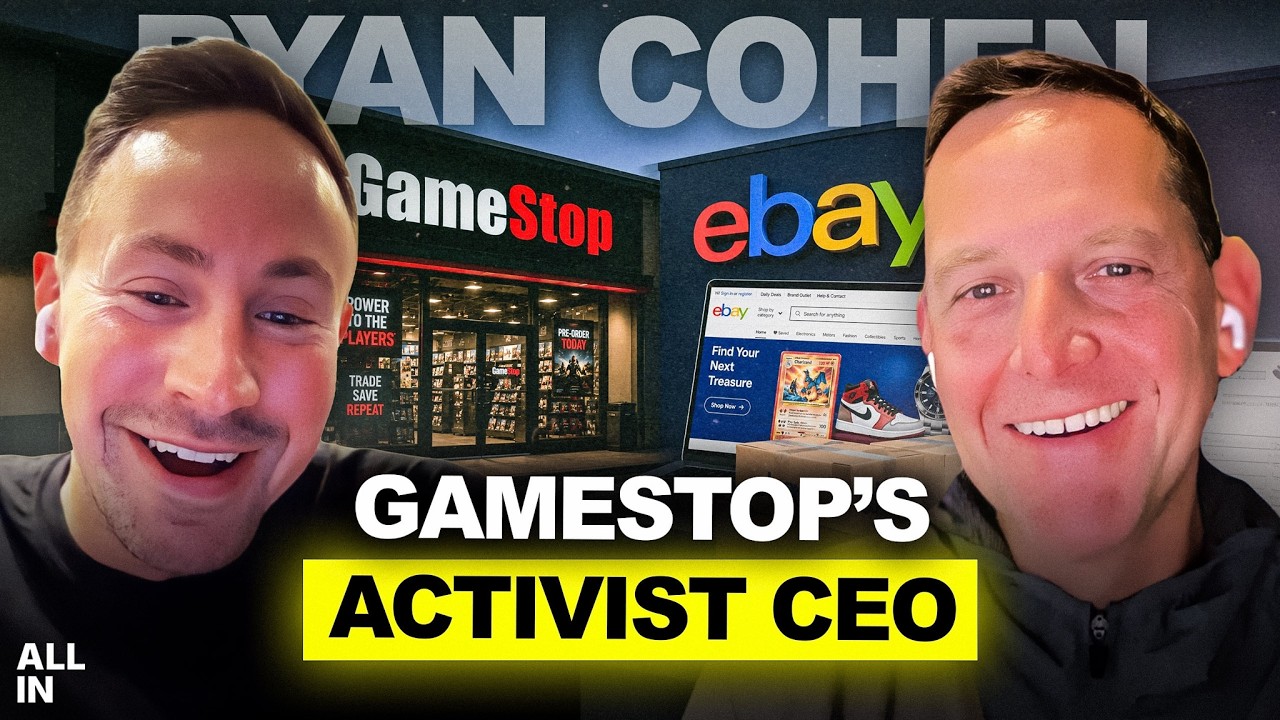
📺 Today’s recommended deep-dive video: https://www.youtube.com/watch?v=4j9RPGLENNI
The Activist’s Gambit: Ryan Cohen on Transforming GameStop and Rescuing eBay
Ryan Cohen didn’t just build a billion-dollar pet empire; he is rewriting the rules of retail by betting his own skin in the game. From the “burning house” of GameStop to an audacious $60 billion bid for eBay, he reveals the operational friction and “psychotic” drive required to challenge entrenched legacy management.
Core Question: How does an owner-operator transition from building a category killer like Chewy to attempting one of the most controversial mergers in internet history?
Highlights
- Why Cohen’s initial “Chewy playbook” failed at GameStop and how he pivoted to collectibles.
- The $2 billion cost-cutting plan designed to trim eBay’s “bloated” professional management layer.
- A vision for eBay Live, using 1,600 GameStop stores as studios and fulfillment nodes for creators.
- The untapped multi-billion dollar market for liquidating in-game digital assets like skins and weapons.
⏱️ Reading time: approx. 9 minutes · Saves you about 54 minutes vs. watching.
Want to take notes while watching? Click the image below and let AI Notebook capture the key points for you 👇

The “Psychopath” Philosophy
Building Chewy on Pennies and Passion
Cohen started Chewy because he realized the jewelry market lacked the recurring revenue necessary for scale. While he built the backend to mirror Amazon’s supply chain efficiency, the frontend was designed to replicate the “neighborhood pet store” experience—complete with handwritten cards and 24/7 service.
He sought “will over skill” in his early hires.
The culture was intentionally intense, populated by what Cohen calls “fellow psychopaths” who were willing to obsess over the business 24/7. This wasn’t a place for people seeking work-life balance; it was a place for those who wanted to win a game of pennies where being “in the red” meant failure and being “in the black” meant survival.
Negotiating with suppliers was a combat sport.
If a supplier sent a gift in the mail, Cohen saw it as a sign they were overpaying. He took pride in suppliers telling him they never wanted to speak to him again after a contract was signed. This relentless focus on unit economics allowed Chewy to scale to billions in revenue with negative working capital before its $3.35 billion sale.

💡 Digging Deeper
Q: Why did you sell Chewy if it was your “baby”?
A: The investment bankers suggested it was an incredible price at the time, though the business later went public at a much higher valuation. Cohen views it as a necessary chapter that led him to his current path.
Q: What is the “will over skill” hire?
A: He looks for drive and relentlessness over a perfect resume. He cites his former head of customer service, who worked in an old folks’ home but applied repeatedly until she was hired, eventually becoming an “incredible” leader.
The GameStop Pivot
Running into a Burning House
When Cohen first invested in GameStop, the media consensus was that the company was a “walking ghost” destined for bankruptcy. He entered as a passive investor, seeing value in the upcoming console cycle, but quickly realized the board was more interested in protecting their seats than saving the company.
He admits his first year as Chairman was a mistake.
He tried to apply the “Chewy Playbook” by hiring a massive e-commerce team from Amazon and Chewy to turn GameStop into a digital-first shipping giant. It didn’t work because physical retail is a “different animal” where inventory turns and physical footprint matter more than just a slick website.
Once he stepped in as CEO, he pivoted to “maniacal cost-cutting.”
The strategy shifted toward high-margin collectibles and sports cards. By leveraging the existing “trade-in” model for physical cards (PSA 8 and above), GameStop found a way to stay relevant in a world where software is increasingly digital. Today, collectibles make up over 40% of the business, and the company sits on a nearly $10 billion cash hoard.

💡 Digging Deeper
Q: Why do you think the media is so hostile toward GameStop?
A: Cohen believes the media is stuck in a narrative they created during the “meme stock” craze. To admit he is a competent operator would require them to admit their previous assessments of the company were wrong.
Q: How did you learn physical retail?
A: Through first principles and “beginner’s mind.” He worked directly with long-term employees who knew the stores best rather than relying on high-priced outside consultants.
The Audacious Bid for eBay
The “Toilet Epiphany” and the $2B Trim
Cohen’s plan to acquire eBay isn’t just about size; it’s about a fundamental belief that the company has stagnated under “professional management.” He notes that since COVID, every metric at eBay—GMV, active users, and operating earnings—has trended downward while operating expenses have ballooned.
He sees $2 billion in immediate cost savings.
eBay has no inventory and no warehouses, yet its operating expenses are over half of its revenue. Cohen argues that a business this lean should not be spending $2.4 billion on sales and marketing for zero user growth. He views the current management as “overpaid employees” with no skin in the game, contrasted with his own $500 million personal stake in the deal.
The vision for “eBay Live” is the core growth vector.
Currently, content creators on eBay face a buggy platform and a slow approval process. Cohen wants to turn GameStop’s 1,600 stores into studios where creators can film, fulfill, and authenticate items in real-time. This merges the trust of physical authentication with the scale of a global digital marketplace.

💡 Digging Deeper
Q: Why not an all-cash offer for eBay?
A: Raising $60 billion in cash is nearly impossible. More importantly, Cohen wants eBay shareholders to roll their stock into the new entity so they can benefit from the massive upside he plans to create through better management.
Q: What is the “Digital Collectible” play?
A: Not NFTs. Cohen wants to create a liquid marketplace for in-game assets (skins, weapons) in AAA titles. He believes these have more “utility” than cardboard trading cards and represent a massive untapped market.
Q: Why has the eBay board rejected the offer?
A: Cohen claims they are “playing games,” pointing him to high-priced advisors while refusing to schedule a meeting. He believes they are protecting their “big paydays” and $100 million golden parachutes.
Key Takeaways
The chasm between “Owner-Operators” and “Professional Managers” is the central theme of Cohen’s career. He argues that managers who do not buy their own stock in the open market are fundamentally misaligned with shareholders. By risking $500 million of his own capital in the eBay transaction, Cohen is attempting to prove that “skin in the game” produces superior operational results compared to the consultant-led strategies of legacy boards.
The future of retail is a hybrid of high-trust physical nodes and high-velocity social commerce. Cohen’s strategy for the GameStop-eBay merger relies on using physical stores as more than just points of sale; they become infrastructure for the “creator economy.” By providing authentication and logistics for live-streamers, the combined entity could dominate the collectibles market in a way that Amazon—focused on new, first-party inventory—cannot easily replicate.
Finally, Cohen emphasizes that “beauty is in the eye of the beholder.” While the media focuses on the volatility of his stocks, he is focused on free cash flow, debt elimination, and market share. Whether it is dog food, video games, or used auto parts, the formula remains the same: cut the waste, obsess over the “psychotic” details, and ignore the noise of those who want you to fail.
Q&A
Q1: What was the main reason for switching from jewelry to pet food at the start of Chewy?
A: Cohen realized jewelry was an occasional purchase, whereas pet food is a recurring, consumable item. He wanted a business model where he could “treat customers well” and have them return every few weeks.
Q2: How does Ryan Cohen define a “psychopath” in a business context?
A: It refers to someone who is “all in,” obsessive about details, and willing to work 24/7 to solve the root causes of problems. He seeks out people who are as relentlessly focused on execution as he is.
Q3: What did GameStop get wrong in its first year of transformation?
A: They tried to copy the Chewy/Amazon ecommerce model too closely. They hired too many people for digital scale before realizing that GameStop’s real strength was its physical store network and the niche collectibles market.
Q4: What is the specific plan for eBay’s $2 billion in cost-cutting?
A: Cohen targets the massive overhead in sales, marketing, and general administrative expenses. He argues that for a business with no inventory, the current spending is inefficient and primarily supports a bloated management layer.
Q5: Why does Cohen believe in-game digital items are better than NFTs?
A: Because in-game items (skins, weapons) have actual “utility” within a digital ecosystem. Unlike many NFTs, which he views as “ego plays” with no use, digital gaming assets have an established user base and inherent value to players.
Q6: Why is Cohen critical of the eBay CEO?
A: He points out that the CEO has not bought a single share of stock with his own money and has been selling tens of millions of dollars worth of shares while the company’s metrics decline.
Q7: What is the significance of the “1,600 nodes”?
A: These are the GameStop physical stores. Cohen envisions using them as local hubs for eBay sellers to handle photography, authentication, and shipping, which solves the “trust gap” in peer-to-peer marketplaces.