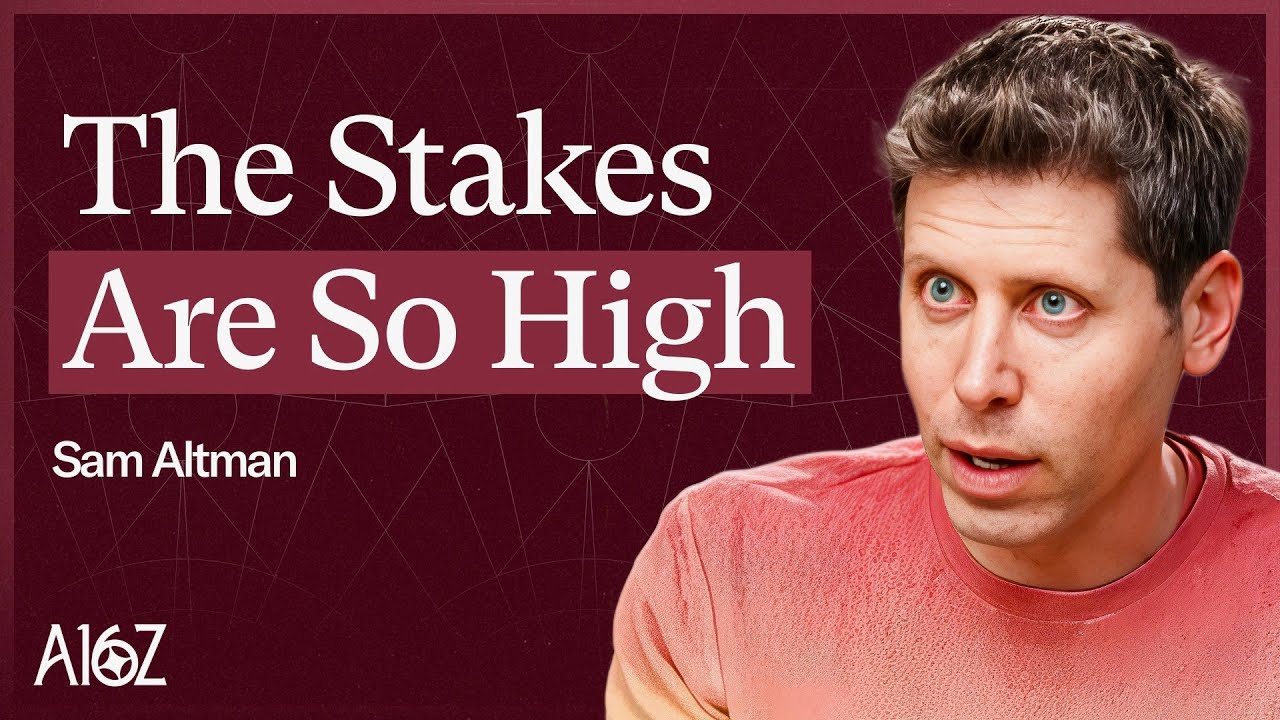
📺 Today’s recommended deep-dive video: https://www.youtube.com/watch?v=JfE1Wun9xkk
Scaling the Miracle: Sam Altman on OpenAI’s Vertical Stack and the Era of AI Science
OpenAI is often viewed as a singular entity, but Sam Altman describes it as a complex fusion of research, infrastructure, and consumer technology. As deep learning continues to yield “miracle” breakthroughs, the company is shifting its focus toward the “AI Scientist” and the massive energy demands of global scale.
Core Question: How is OpenAI evolving from a research lab into a vertically integrated powerhouse capable of sustaining the AGI revolution?
Highlights
- The “AI Scientist” is the next milestone, with GPT-5 showing early signs of making novel math and physics discoveries.
- Vertical integration is now seen as essential for AGI, mirroring Apple’s strategy with the iPhone to ensure mission delivery.
- AGI will likely arrive “whooshing by” rather than as a single “Big Bang” event, as society is more adaptable than we realize.
- The ultimate bottleneck for AI is energy, leading to a necessary convergence of AI development and advanced nuclear/solar power.
⏱️ Reading time: approx. 8 minutes · Saves you about 41 minutes vs. watching.
Want to take notes while watching? Click the image below and let AI Notebook capture the key points for you 👇

The Vertical Stack of AGI
From Research Lab to Infrastructure Giant
OpenAI is not just a research lab; it is a vertically integrated stack combining consumer apps, massive infrastructure, and cutting-edge science.
Altman admits he was once skeptical of vertical integration, believing the economy worked best when companies focused on one niche, but the complexity of delivering AGI has forced a change in heart. To deliver on the mission, OpenAI has found it necessary to do more things than originally planned, moving closer to the model of the iPhone—perhaps the most integrated and successful product in history.
The mission requires an unprecedented coordination between the electrons fueling the data centers and the algorithms running on the chips. To support a personal AI subscription that billions of people will eventually use, OpenAI must operate the largest infrastructure project in human history while simultaneously pushing the boundaries of what these models can actually reason through in a scientific context.

💡 Digging Deeper
Q: Is the massive infrastructure meant only for OpenAI’s products?
A: Currently, the infrastructure exists to support OpenAI’s research and first-party services, though Altman acknowledges that at this scale, it may eventually serve other purposes.
Q: Why prioritize vertical integration now?
A: Because the specialized needs of AGI—from chip design to model distribution—cannot be met by the current horizontal market fast enough.
Q: How does the culture of a research lab survive this scaling?
A: Altman treats research culture like a seed-stage venture firm, betting on “founders” (researchers) rather than treating them like traditional product employees.
Beyond Chat: The Interface and the AI Scientist
The Passing of the Scientific Turing Test
While the popular conception of the Turing Test has already “whooshed by,” the new benchmark for intelligence is the ability to perform original science.
For the first time, GPT-5 is showing glimpses of this capability, making small but novel discoveries in biology and physics. This marks a shift from AI being a tool for “chitchat” to AI being an engine for scientific progress, which Altman believes is the primary driver of human quality of life improvements.
The capability overhang is immense; while the general public is just beginning to understand ChatGPT, “nerds in Silicon Valley” and elite scientists are already seeing models perform tasks that were unthinkable three years ago. This gap suggests that even if development stopped today, the world would still have years of “catching up” to do to fully utilize existing intelligence.

💡 Digging Deeper
Q: Is the chat interface saturated?
A: Only in the narrow sense of basic conversation; as an interface for solving complex problems like curing cancer, we are nowhere near the limit.
Q: How does Sora fit into the AGI roadmap?
A: Sora is a “world model” that helps AI understand physical reality, which is a critical, often underestimated component of general intelligence.
Q: Will users get their own “AI personalities”?
A: Yes; the current “one-size-fits-all” approach is a naive assumption that OpenAI is actively moving away from in favor of personalized interactions.
The Energy Frontier and the Regulatory Balance
Solving the “Hated” Bottleneck
Energy and AI were once independent interests for Altman, but they have now converged into a singular, urgent problem.
The highest impact way to improve life is cheaper, more abundant energy. Currently, the US will likely rely on natural gas for short-term baseload energy, but the long-term future of AI depends on a combination of solar-plus-storage and advanced nuclear (SMRs and fusion).
If nuclear power becomes “crushingly economically dominant,” the political and regulatory hurdles currently blocking it will likely dissolve under the pressure for cheap compute.

💡 Digging Deeper
Q: What is the biggest danger in AI regulation?
A: Over-regulating less capable models, which would “cramp” innovation like the European style of regulation, rather than focusing on superhuman frontier models.
Q: What is the future of copyright in the age of Sora?
A: Altman predicts training will be deemed “fair use,” but a new model will emerge for protecting IP—rights holders might even get upset if their characters aren’t used enough in the AI ecosystem.
Q: How will OpenAI monetize expensive video models like Sora?
A: Likely through a “pay-per-generation” model, as the high cost of video compute doesn’t fit the standard subscription mold yet.
Key Takeaways
The journey toward AGI is less about a single “Big Bang” breakthrough and more about the continuous, improbable success of deep learning. Sam Altman emphasizes that the “miracle” of scaling laws keeps giving, but it requires a massive, coordinated bet on global infrastructure and energy. As the “AI Scientist” emerges, the focus of intelligence shifts from mere text generation to the acceleration of human knowledge itself.
Society is far more adaptable than we give it credit for. While experts worry about a “Singularity,” the reality is likely to be a “whooshing” transition where radical new capabilities are integrated into daily life with surprising speed and relative calm. The real challenge lies in ensuring that the energy grid and regulatory frameworks can keep pace with an intelligence that is becoming near-infinite and near-free.
Q&A
Q1: Is OpenAI becoming more like Apple?
A: In terms of vertical integration, yes. To deliver on the mission of AGI, OpenAI has found it must control the entire stack, from research to the infrastructure that powers the user experience.
Q2: What is the “capability overhang”?
A: It is the gap between what current models can actually do and what the public (or even power users) has realized they can do. The intelligence already exists; we just haven’t finished finding all its applications.
Q3: How does Altman view the “Turing Test” today?
A: He believes the popular conception of the test has been passed and largely forgotten. The new “test” he cares about is whether an AI can perform original, high-level scientific research.
Q4: Will OpenAI ever run ads?
A: Altman is open to it but cautious. The high-trust relationship users have with ChatGPT means that biased recommendations (paid ads) could destroy that trust, though “value-add” ads like those on Instagram are a possible inspiration.
Q5: Why is energy so central to the AI conversation?
A: Because compute scale is ultimately a function of electricity. The progress of AI is now inextricably linked to the ability to produce massive amounts of cheap, clean power through nuclear and solar.
Q6: What is the risk of “open-sourcing” frontier models?
A: While open source is generally good, Altman worries about seeding control of model interpretation to foreign actors (like China) if their open-source models become the global standard.
Q7: Will AGI lead to a “Singularity”?
A: Altman doubts there will be a single “Big Bang” event. Instead, he expects a continuous evolution where society and technology co-evolve, with humans adapting to each new level of intelligence as it arrives.