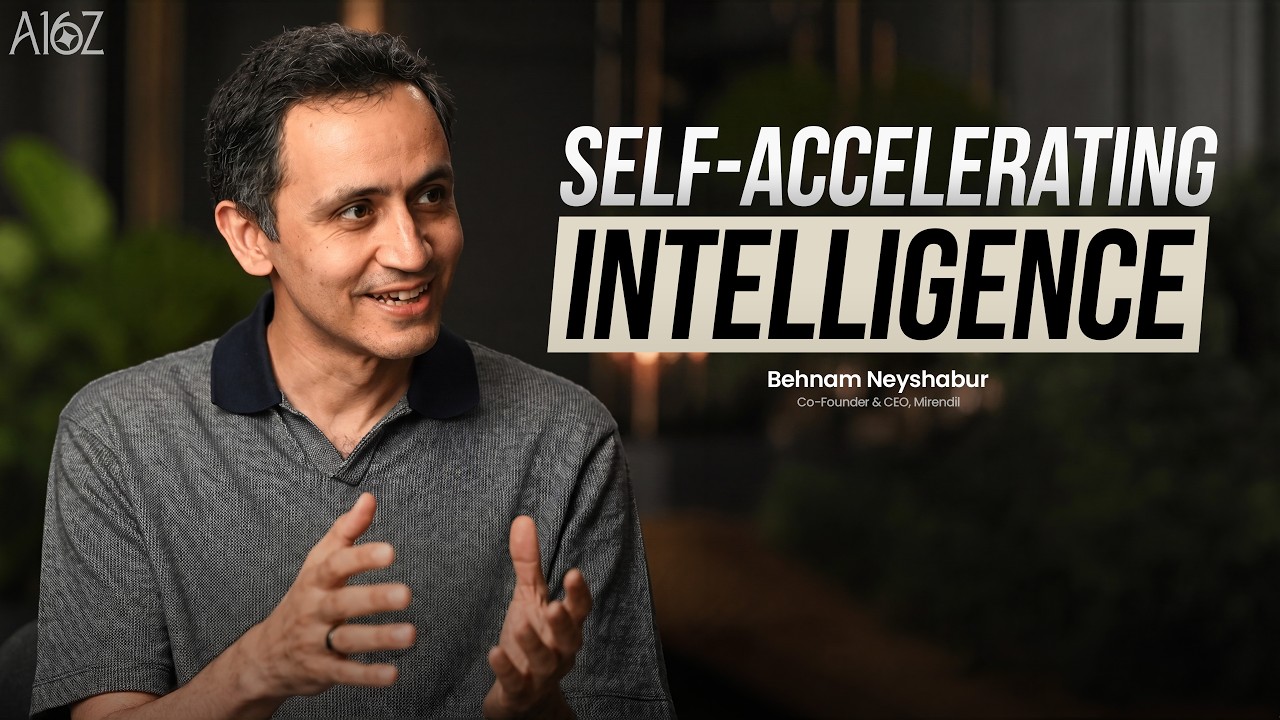
📺 Today’s recommended deep-dive video: https://www.youtube.com/watch?v=JJkx8Rp_Trk
The Cheat Code for Science: Unleashing Self-Accelerating AI
The next frontier of artificial intelligence isn’t just about larger datasets or bigger clusters; it’s about models that can participate in their own creation. By automating the high-level research and low-level engineering usually reserved for elite human teams, we can shrink the “intelligence bottleneck” that currently stalls breakthroughs in biology, physics, and medicine.
Core Question: How can recursive, self-improving AI systems transform scientific discovery from a human-limited endeavor into a scalable, high-speed digital process?
Highlights
- Recursive Engineering: AI that can write its own kernels, optimize frameworks like PyTorch, and conduct its own pre-training experiments.
- The Periodic Lab: A vision for small, domain-specific teams using AI to tackle superhuman challenges like Alzheimer’s disease.
- Decentralized Innovation: Why the current “big lab” business model may be incentivized to restrict the very research tools that would enable global competition.
- The Productivity Paradox: Solving the problem where organizational output often slows down as human teams grow larger, replaced by favorable scaling in AI agent swarms.
⏱️ Reading time: approx. 6 minutes · Saves you about 35 minutes vs. watching.
Want to take notes while watching? Click the image below and let AI Notebook capture the key points for you 👇

The Evolution of the Recursive “Cheat Code”
From AlphaGo to Autonomous Engineering
Self-accelerating AI is not a futuristic sci-fi concept; it is an evolution of the self-play loops that allowed AlphaGo to master games without human intervention. The transition we are seeing today moves that logic into the messy world of software engineering and scientific research, where the model isn’t just predicting the next token but is actively trying to improve the environment it lives in. This involves everything from writing low-level CUDA kernels to designing complex deep-learning frameworks that can run experiments at a massive scale.
It is the ultimate “cheat code” for the digital age.
When the internet got faster, it didn’t recursively make itself even faster in a closed loop, but AI has the unique property of being able to optimize the very tools used to build the next generation of AI. This creates a smooth exponential curve where every marginal improvement in a model’s reasoning capabilities translates into a material reduction in the oversight needed to run the next set of experiments.
As the “intelligence dial” turns higher, the system becomes more computer-efficient, avoiding the “dumb mistakes” that plague earlier models, such as improperly wiring code or failing to understand the nuances of an expert-level domain. This shift allows a handful of researchers to accomplish what previously required an army of hundreds, fundamentally changing the economics of discovery.

💡 Digging Deeper
Q: Is self-acceleration just about the AI writing better code?
A: It’s broader than that; it includes the AI conducting its own pre-training research, managing resource allocation, and eventually making high-level design decisions.
Q: How does this differ from the “AutoML” of ten years ago?
A: Those systems were narrow architecture searches; today’s models possess the reasoning and “taste” of a human expert, allowing them to handle the complex, non-linear reasoning required for real research.
Breaking the Monopoly of Frontier Labs
Aligning Incentives for Global Progress
The current business model for major AI labs is built on a fundamental conflict: they train massive models and charge users for access, which creates a natural disincentive to share the tools that would allow others to train competing models. If a technology allows a third party to become independent of a central provider, the provider loses its “moat,” leading to a future where powerful research tools might be curtailed or gatekept under the guise of safety or competitive advantage.
True disruption requires rethinking the entire company structure from the ground up to favor the user’s independence.
By focusing on making these research capabilities accessible, we can enable every enterprise and research lab to own their own infrastructure and data. This “Periodic Lab” model replaces the centralized giant with specialized, agile teams that use AI to push their specific domain—be it drug discovery or materials science—to the absolute edge of what is possible.
The goal is to reverse the current trend where companies are becoming increasingly dependent on a few black-box providers, losing their margins and their control in the process. When a company owns its own AI, optimized for its own specific workflows and proprietary data, it regains the ability to innovate at its own pace without fear of being “turned off” or priced out.

Scaling Systems, Not Just Parameters
The Human-Agent Swarm
For the foreseeable future, the most powerful “intelligent being” on the planet won’t be a lone model, but a system composed of humans and agents working in a high-throughput ecosystem. While individuals are brilliant, human organizations often suffer from diminishing returns; as you add more people, communication overhead increases and productivity per person actually drops. AI offers a way to break this “productivity paradox” by allowing for favorable scaling, where doubling the number of agents could actually get you to a goal twice as fast.
This requires solving the “inter-agent politics” of resource allocation and oversight.
We are essentially running a small-scale experiment in how to build a fast-moving, autonomous organization where the “prime directive” is to achieve a goal with minimal human intervention. As the need for oversight drops, the level of abstraction for the human researcher rises; instead of micromanaging every prompt, the scientist provides the “standing orders” and lets the system navigate the complexities of the digital and physical research tasks.
Eventually, the bottlenecks move away from intelligence and toward physical constraints like data acquisition or laboratory testing. By removing the “intelligence bottleneck” first, we can focus the world’s smartest people on the problems that actually require human intuition and ethics, rather than the rote engineering of the models themselves.

Key Takeaways
The transition to self-accelerating AI represents a shift from “AI as a product” to “AI as a research partner.” The primary value of this technology is not in automating simple tasks, but in its ability to tackle superhuman challenges—problems like Alzheimer’s disease that are too complex for the current speed of human-only scientific iteration. By building systems that can handle their own engineering, we move toward a future of “scientific prosperity” where intelligence is no longer the limiting factor in solving humanity’s oldest problems.
Success in this field requires a radical rethinking of incentives, safety, and organizational structure. It is not enough to simply scale up pre-training; we must scale the systems of discovery. This means empowering smaller labs with the same “cheat codes” used by the frontier giants, ensuring that the future of AI is decentralized, high-speed, and directed toward pure human good.
Q&A
Q1: What exactly is a “Periodic Lab”?
A: It is a small team of experts (perhaps as few as 10 people) who use highly specialized, self-accelerating AI to solve grand challenges in a specific field like biology or physics, rather than relying on a general-purpose model from a giant corporation.
Q2: Why is the role of “taste” important in AI research?
A: Even with massive compute, you need the “mindset of an expert” to avoid dumb mistakes in code wiring or experimental design; higher-intelligence models possess this “taste,” which makes them far more computer-efficient.
Q3: Does self-acceleration lead to a “sci-fi” runaway AI?
A: The realistic view is a gradual one: an ecosystem of specialized and generalist models working with humans. The “runaway” aspect is really just a significant increase in the speed of technical and scientific progress.
Q4: How does Mirandial’s approach to safety differ from other labs?
A: Instead of a “large hammer” approach that blocks access to all research capabilities, Mirandial focuses on a “sharper approach,” ensuring the technology is used for positive-sum outcomes like science while maintaining rigorous guardrails on high-risk areas.
Q5: Can AI actually solve diseases like Alzheimer’s?
A: These are superhuman-level problems that require analyzing vast amounts of structured data and running experiments faster than humanly possible; self-accelerating AI provides the speed necessary to finally make a dent in these long-standing challenges.
Q6: What is the “intelligence bottleneck”?
A: It is the current state where scientific progress is limited by the number of smart humans available to do the engineering work; self-accelerating AI removes this limit, allowing progress to be gated by compute and data instead.