📺 Today’s recommended deep-dive video: https://www.youtube.com/watch?v=8wRJ6gDmZiQ
The Steve Jobs Blueprint: Mastering the Art of In-Situ Presentations
Most presenters focus on their slides, but true masters focus on the stage. Learn how Steve Jobs turned grueling practice into effortless performance by mastering “in-situ” simplicity and tactical stagecraft.
Core Question: How can a presenter transform complex information into a seamless, high-stakes performance that survives even the worst technical failures?
Highlights
- The shift from “stem solutions” to “in-situ” simplicity that actually works in the real world.
- Why the 10,000-hour rule is the non-negotiable foundation for looking “natural” on stage.
- Tactical maneuvers for handling hardware crashes using the “storytelling buffer” method.
- Strategic Q&A techniques to maintain control when faced with difficult or unknown questions.
⏱️ Reading time: approx. 5 minutes · Saves you about 27 minutes vs. watching.
Want to take notes while watching? Click the image below and let AI Notebook capture the key points for you 👇

The Philosophy of Simplified Solutions
Finding “In-Situ” Simplicity
Most educational delivery fails because it relies on “stem solutions” that look good on paper but fall apart when applied to real-world scenarios. We often oscillate between overly simplistic ideas that lack depth and immeasurably complex structures that nobody can actually follow or implement. The sweet spot, according to the Steve Jobs philosophy, is the “in-situ” solution—a refined simplicity that arises only after you have wrestled with the deepest complexities of the subject matter.
You must distill the essence of your message so it works immediately upon delivery, regardless of the chaos surrounding the live event environment.
Jobs was famously obsessive-compulsive about his products, but he didn’t just walk onto a stage and wing it. He understood that simplicity is a result of extreme labor, not a lack of effort. This rigorous approach allowed him to appear natural while every movement was actually perfectly calculated to drive a specific emotional response.

💡 Digging Deeper
Q: Why won’t simple “stem” solutions work?
A: Because they are detached from the environment; they lack the nuance required to survive the “friction” of a live audience.
Q: How did Steve Jobs view product complexity?
A: He believed in being an “energy converter,” transforming complex technical specifications into a show that regular people could understand and enjoy.
Q: Is temperamental behavior a requirement for success?
A: No, the transcript suggests Jobs’ temper was a byproduct of his obsession, but his success came from his ability to hire coaches and learn how to present, not his personality flaws.
The Rigor of Stage Presence
Why Practice Makes Perfect Appearance
It is a common mistake to spend hours perfecting a PowerPoint presentation while spending zero time learning how to operate the remote control. If you cannot navigate your own tools under pressure, the quality of your research becomes irrelevant to the audience. Stage presence is the final bridge between your knowledge and your listeners.
Consider the lengths Jobs went to: he had backup generators on-site and even kept “backup” people ready in case his own physical condition failed during a keynote. He understood that a show must go on perfectly, even if the power grid crashes or the presenter is physically weak. This level of contingency planning is what separates a professional communicator from an amateur who is paralyzed by a single technical glitch.
True brilliance on stage is rarely spontaneous; it is the visible result of thousands of hours of invisible, grueling, and repetitive rehearsal.

Mastering the Mechanics of the Room
Eye Contact and Technical Crashes
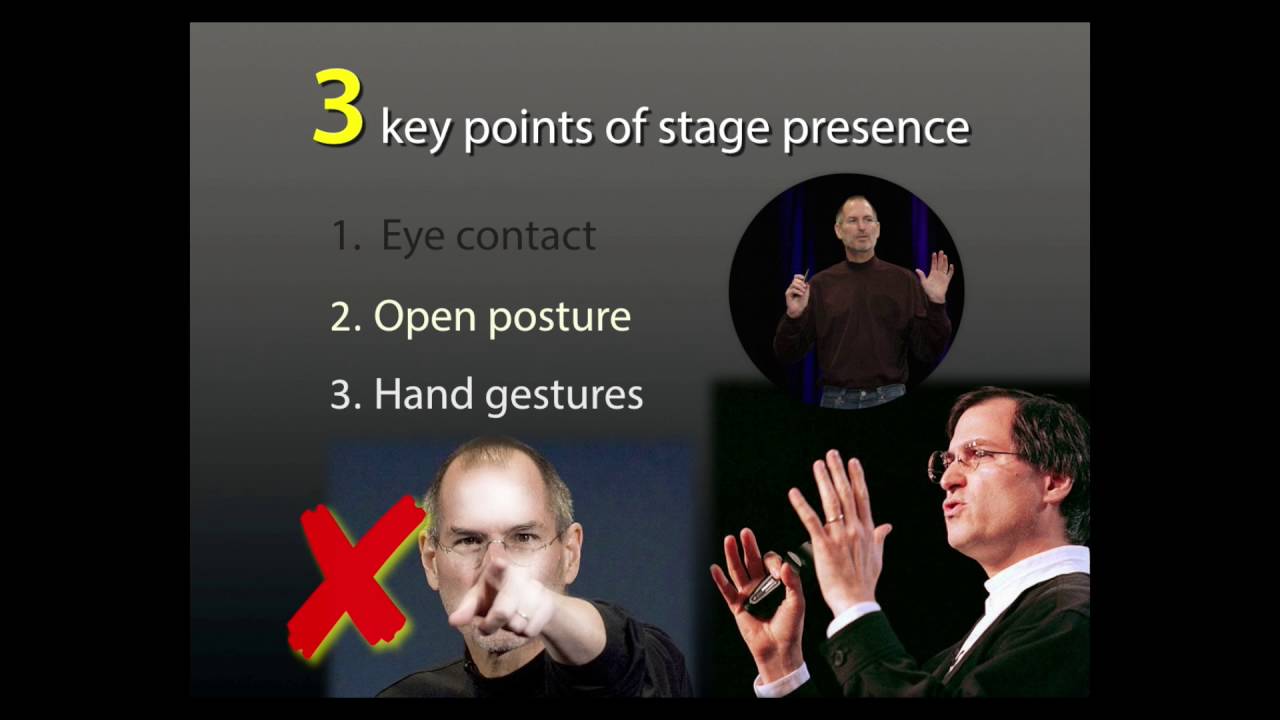
Humans have a natural tendency to stare at their own slides, but this breaks the connection with the audience instantly. Effective stagecraft requires a coordinated scanning of the room—starting with a physical sweep of the left side, then moving to the center, and finally engaging the right. By opening your body and eyes to every corner of the auditorium, you command the space rather than being a prisoner of the podium.
When the technology inevitably fails, you must have a “story bank” ready to distract the audience while the technicians scramble to fix the hardware.
During a famous iMac launch, the computer crashed during a demo. Instead of panicking, Jobs told a funny story about his high school days. This “buffer” kept the audience engaged and prevented the technical failure from defining the event. Handling the Q&A section requires even more finesse, especially when you encounter “machine gun” questions. Rephrasing a difficult query gives you precious seconds to think and ensures the rest of the audience is on the same page before you pivot back to your core conclusion.

Key Takeaways
Presentations are not just about passing information; they are about delivering a lived experience. By focusing on stage presence and “in-situ” simplicity, you ensure that your message survives the friction of the real world. Success is not found in the slides, but in the 10,000 hours of practice that make the complex look effortless.
Always maintain a contingency plan for your technology and your physical state. Whether it’s a backup generator or a repertoire of personal stories to fill dead air, the “show” must be insulated from the reality of technical failure.
Remember that mastery requires staying hungry for improvement and foolish enough to take the risks necessary for true innovation.
Q&A
Q1: What are the three levels of solutions described?
A1: Simple solutions from “stem” courses (ineffective), complex solutions (too difficult to implement), and simple solutions from “in-situ” (the ideal, simplified from complexity).
Q2: How much practice is required to reach a professional level?
A2: The transcript cites the 10,000-hour rule as the threshold for producing true expertise in any field, including public speaking.
Q3: What is the “machine gun” question strategy?
A3: When faced with rapid-fire or difficult questions, you should rephrase the question to buy time and ensure clarity before answering.
Q4: What should you do if you don’t know the answer to a question?
A4: You can acknowledge it is a “good question” (a classic stalling tactic) or reframe the question toward a topic you are prepared to discuss.
Q5: How did Steve Jobs handle a computer crash on stage?
A5: He didn’t wait for the technician in silence; he immediately began telling stories about his youth to keep the audience’s attention.
Q6: Why is eye contact vital for a presenter?
A6: Human nature draws our eyes to the screen, but to lead an audience, you must consciously scan the room in a coordinated “sweep” to engage everyone.
Q7: What is the ultimate goal of a lecture?
A7: To deliver an experience and a story, rather than just summarizing facts or data that the audience could have read elsewhere.