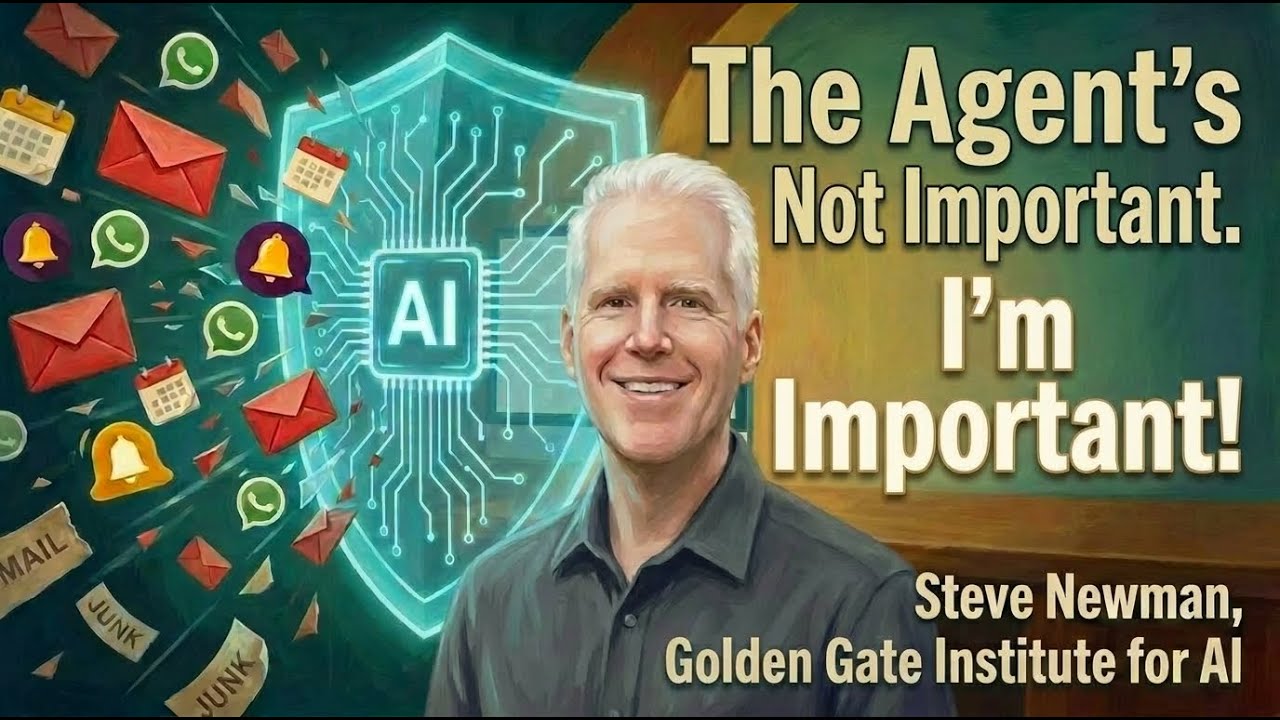
📺 Today’s recommended deep-dive video: https://www.youtube.com/watch?v=FYpTTChGhSk
The Attention Firewall: Designing Your Personal AI Operating System
Steve Newman, the software veteran who built the foundation for Google Docs, is now pioneering a new frontier: “vibe coding” a bespoke suite of AI tools to reclaim human focus. By treating autonomous agents as disposable labor rather than precious infrastructure, he has constructed a private ecosystem that filters the modern digital deluge into a high-signal stream.
Core Question: How can we move beyond generic AI assistants to build personalized, locally-controlled software that acts as a cognitive shield?
Highlights
- The transition from “measuring twice, cutting once” to a rapid “vibe coding” workflow where iteration speed is the primary metric.
- Designing an “attention firewall” that consolidates Slack, WhatsApp, and email into a single, LLM-filtered urgency dashboard.
- Why a “universal logging solution” is the most critical component for allowing AI agents to debug their own errors autonomously.
- The philosophy of “human-centric optimization,” prioritizing the user’s mental flow over the efficiency of AI token usage.
⏱️ Reading time: approx. 12 minutes · Saves you about 121 minutes vs. watching.
Want to take notes while watching? Click the image below and let AI Notebook capture the key points for you 👇

Building the Personal AI Stack
Constructing the Attention Firewall
Steve Newman receives over fifty newsletters and hundreds of messages daily, a workload that would normally paralyze deep work. To combat this, he built “Radar,” an attention firewall that serves as a custom interface for his digital life.
This system is less about responding and more about shielding focus.
The application pulls data from Gmail, Slack, and even WhatsApp through a read-only SQLite hack, feeding every message into an LLM. Based on a one-page rubric of Newman’s specific priorities, the agent determines if a message is truly urgent or can wait until the end of the day. This filtered view stays on a dedicated second monitor, ensuring he only glances at notifications when they actually matter, effectively decoupling his response time from the chaotic rhythm of incoming pings.

💡 Digging Deeper
Q: Why use Cloudflare for the backend instead of a more robust provider like AWS?
A: Cloudflare offers a simplified toolkit of databases, cron jobs, and hosting that is sufficient for a single-user application without the massive overhead and configuration complexity of AWS.
Q: How do you integrate with platforms like WhatsApp that lack open APIs?
A: Newman uses a clever workaround by having a local script read the unencrypted SQLite database generated by the WhatsApp desktop application, allowing for real-time monitoring without risking account bans.
The Philosophy of Vibe Coding
Moving from “Teams” to “Teams of One”
The modern software engineer is no longer just a writer of code; they are a conductor of parallel autonomous agents.
Steve often runs five agents simultaneously across different projects, each performing specific tasks like debugging or feature implementation.
This shift requires a fundamental unlearning of traditional engineering habits that emphasize cautious design and manual oversight. In the “vibe coding” era, the most effective developers are those who are comfortable navigating without a map, allowing the AI to handle the implementation of languages like TypeScript while the human maintains the high-level architectural vision.

The Universal Logging Solution
Newman identifies “systematic debugging” as the primary unlock for agentic productivity.
Every application in his stack—from the frontend Chrome extensions to the backend cron jobs—reports to a centralized logging database.
When a feature fails, he doesn’t manually inspect the code; he simply commands the agent to “debug this.” Because the agent has access to the full log history and execution context, it can identify the root cause and deploy a fix with nearly 100% accuracy, eliminating the most tedious part of the development lifecycle.
💡 Digging Deeper
Q: Is there a risk of “token maxing” or over-optimizing for the agent’s time?
A: Newman argues that “the agent isn’t important, the human is.” Developers should optimize for their own mental flow, letting agents sit idle rather than feeling pressured to keep the AI constantly fed with prompts.
Q: Does vibe coding require knowing the specific programming language?
A: Not necessarily. Newman builds complex TypeScript applications without deep knowledge of the language, relying on the LLM to handle the syntax while he manages the logic and system integrations.
Future Thresholds and Global Impacts
Recursive Improvement and AGI
While AI is roaring through software engineering, Newman remains cautiously skeptical about the timeline for full Artificial General Intelligence.
He notes that “long timelines aren’t what they used to be,” but argues that we are still far from “all the smart at all the things.”
The ability of a model like Claude to find security vulnerabilities is impressive, but translating that into the nuanced judgment required for business strategy or human social interaction remains a significant hurdle. We are likely to see “threshold effects” where specific industries, like software R&D, are automated rapidly, while the physical world and social roles lag behind due to their inherent complexity and lack of training data.
AI and the Climate Crisis
The intersection of AI scaling and energy consumption is a growing concern for the tech industry.
Earlier predictions that AI would have a negligible impact on emissions have been challenged by the sheer scale of the current data center land rush.
However, Newman suggests a potential counter-narrative: the efficiency gains AI brings to the broader industrial base could outweigh its direct energy costs. If AI-driven breakthroughs in material science, robotic agriculture, and chemical processing make the global economy 20% more efficient, it could result in a net reduction of planetary emissions despite the growth of the power grid.
💡 Digging Deeper
Q: How will the “app layer” change as more people build their own tools?
A: We may see a “bearish” trend for traditional SaaS UIs. Users might treat established platforms merely as data backends, interacting with them through personal, custom-coded interfaces that better suit their workflows.
Key Takeaways
The transition to AI-assisted living is not about finding better prompts, but about building personalized infrastructure that protects your most valuable asset: your attention. By constructing “disposable” tools like attention firewalls and automated feed readers, individuals can curate a digital environment that serves their specific cognitive needs rather than the engagement metrics of big-tech platforms.
The future of professional work belongs to the “Team of One.” As the cost of software creation plummets toward zero, the distinction between a product manager and an engineer will continue to blur. Success in this new era requires a willingness to embrace “vibe coding”—a process of high-speed experimentation where the human acts as the orchestrator of a small army of autonomous, specialized agents.
Q&A
Q1: How do you handle the security risks of giving AI access to your entire digital history?
A: This is a major concern. Newman maintains a “duty of care” by keeping data in private databases and being conservative about which tools get full read/write access. He prefers local or self-hosted solutions over broad integrations with third-party “assistant” apps.
Q2: What is the most effective way to use AI while traveling or away from a desk?
A: Instead of trying to code on a mobile device, Newman uses voice dictation to do “brain dumps” of ideas and requirements. He then uses an LLM to organize that raw audio transcript into a structured coding prompt for when he returns to his terminal.
Q3: Why build a custom UI instead of just using a command-line agent for everything?
A: Agents are great for “verbs” (actions like “summarize this”), but apps are about “nouns” (the data itself). Having a persistent UI allows you to see the status of all your tools and messages at a glance without having to prompt an agent every time you need a simple status update.
Q4: Will AI eventually replace the need for traditional software engineering jobs?
A: The nature of the job will change fundamentally, but the demand for software is likely to explode. We may see a “Jevons Paradox” where making code easier to produce leads to a massive increase in the total amount of software the world consumes, potentially keeping employment high for “full-stack product managers.”
Q5: What is the benefit of breaking a mono-repo into multiple micro-projects for AI?
A: Smaller projects keep the “context window” manageable for the agent. By isolating different tools (like a to-do list versus a feed reader), you ensure the AI doesn’t get confused by irrelevant code, which leads to fewer errors and faster iteration cycles.
Q6: What is the Golden Gate Institute’s role in the AI ecosystem?
A: It is a non-profit focused on “collective sense-making.” They aim to bridge the gap between machine learning experts, policy makers, and civil society through in-person events like “The Curve” to ensure a diverse range of perspectives shapes the future of the technology.
Q7: How does “Radar” handle WhatsApp messages without an official API?
A: It monitors a local SQLite database file on the computer that the WhatsApp desktop app uses to store messages. This allows the AI to read messages in real-time without technically “interfacing” with Meta’s servers in a way that would trigger security bans.