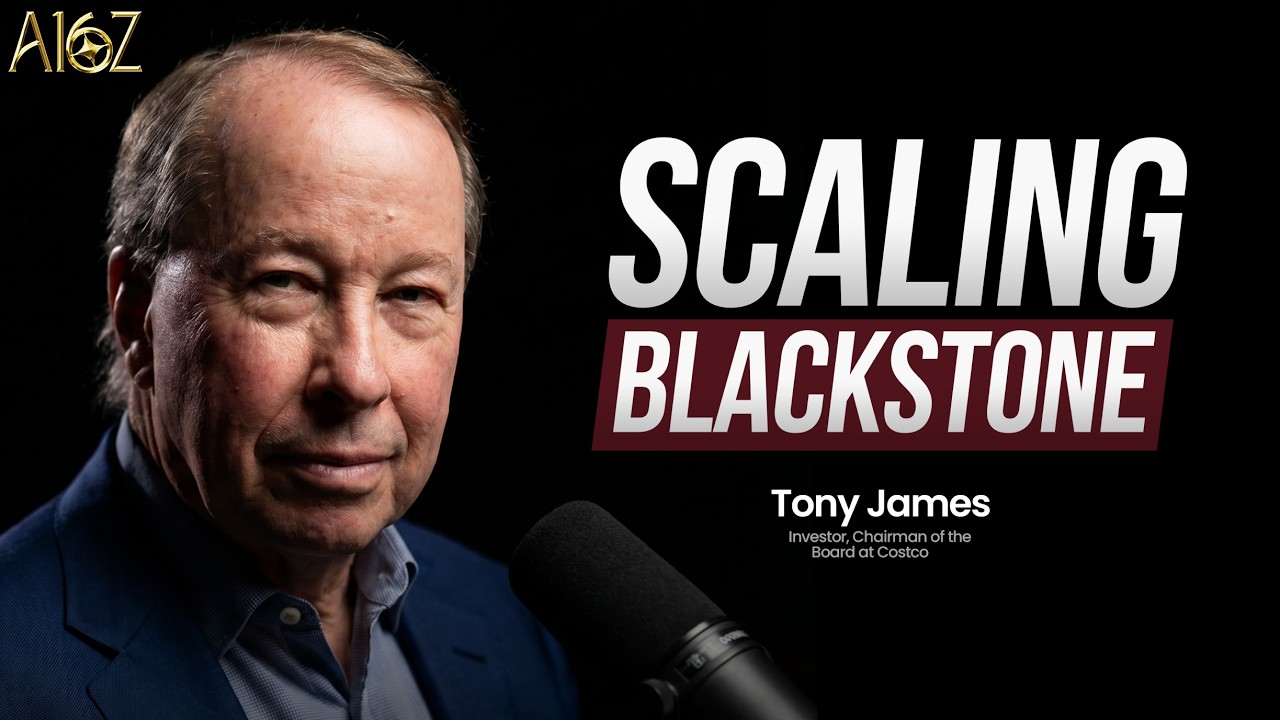
📺 Today’s recommended deep-dive video: https://www.youtube.com/watch?v=Z4i1adGvD2A
The Architect of Private Equity: Tony James on Scaling Blackstone and the Costco S-Curve
Tony James didn’t just join Blackstone; he transformed it from a collection of talented individuals into a trillion-dollar institutional machine. This conversation explores the transition from boutique investment banking to global dominance and why “focus” is the only metric that truly matters in building a legacy.
Core Question: How does an investment leader scale a firm through the steepest part of the “S-curve” without sacrificing culture or returns?
Highlights
- Why the 1980 Houdaille LBO changed the trajectory of Wall Street.
- The internal mechanics of building a “Navy SEAL” culture at Blackstone.
- Lessons from a 38-year board tenure alongside Charlie Munger at Costco.
- The strategic “secret project” behind Blackstone’s historic IPO and $170B value creation.
⏱️ Reading time: approx. 7 minutes · Saves you about 76 minutes vs. watching.
Want to take notes while watching? Click the image below and let AI Notebook capture the key points for you 👇

The DLJ Era and the Birth of Merchant Banking
From Agency to Principal Investing
Tony James joined DLJ in 1975 when the investment banking team consisted of just five people and zero deals in two years.
The big turning point arrived in 1980 with the Houdaille Industries LBO. This transaction proved that massive public companies could be taken private using debt, allowing smaller firms like DLJ to end-run the established giants like Goldman Sachs. While the big firms remained ambivalent about competing with their own clients, DLJ plowed through the opening, creating a “magic synergy” between advisory and principal investing that eventually built their merchant banking empire.
By the time DLJ was sold to Credit Suisse for $14 billion in 2000, it had grown at 15% annually for 25 consecutive years.
The timing was impeccable, occurring just before the tech bubble burst and regulatory shifts like the end of Glass-Steagall altered the industry’s competitive landscape. James recognized that the firm’s success was unsustainable without a massive increase in balance sheet capacity, which the Swiss bank provided—at the cost of the firm’s unique entrepreneurial spirit.

💡 Digging Deeper
Q: Why were big firms like Goldman Sachs initially afraid of the LBO business?
A: They suffered from institutional ambivalence; they didn’t want their advisory clients to complain that the firm was competing against them by buying companies.
Q: How did DLJ compete with Drexel Burnham Lambert’s “highly confident” letters?
A: DLJ created a “bridge fund” where they literally bet the firm’s own capital on loans to prove they could close deals, rather than just promising to raise the money.
The Costco Connection and the Munger Method
Betting on a Force of Nature
James led the Series A into Costco before the company had a single dollar of revenue, identifying a “force of nature” in Jim Sinegal.
Sinegal’s obsession with the smallest execution details and his refusal to compromise on customer value created a model that proved resilient against giants like Walmart and Amazon. James notes that Costco’s strategy was deceptively simple: every penny saved in the supply chain was passed back to the customer rather than being kept as profit margin. This created an unassailable value proposition that made the membership model work as a primary profit engine.
Serving on the Costco board for nearly four decades provided James with a unique window into consumer behavior and supply chains.
For 30 years, James served on the board alongside Charlie Munger, whom he describes as his “rock.” Munger’s ability to distill complex economic realities into sharp soundbites—like calling newspapers “oil wells depleting to zero”—became a foundational part of James’s own decision-making framework. Munger never cut corners, never compromised intellectually, and provided the unwavering confidence necessary to expand even when competitors like Walmart were at their peak.

Engineering the Blackstone Trillion
Scaling Through the S-Curve
When James joined Blackstone in 2002, the firm managed just $14 billion and was grappling with sub-scale businesses and “disastrous” early private equity investments.
He focused immediately on culture, moving the organization from a collection of “independent partnerships” to a unified team oriented toward shared processes. This meant replacing leadership across nearly every business unit to ensure that the “cultural crucible” of the investment committee functioned as a search for truth rather than a display of status. James believes that in elite investment organizations, the manager must be a “Navy SEAL” type leader who can challenge the best investors on an equal footing.
The goal was to take Blackstone through the steepest part of the “S-curve,” growing the market value from $1 billion to over $170 billion.
Scaling required turning disadvantages into moats. By building a massive retail distribution arm—complete with “Blackstone University” for training brokers—the firm created a source of permanent capital that competitors couldn’t easily replicate. This structural advantage allowed Blackstone to remain aggressive even when traditional institutional capital pools became crowded. James effectively industrialized the alternative investment landscape by treating distribution and data as strategic assets rather than back-office functions.

Key Takeaways
Success in private equity depends on the ability to catch signals early. James emphasizes that by the time a trend is obvious, it is already priced into the market. To counter this, he built Blackstone into a “mosaic” where insights from different sectors—like seeing the growth of e-commerce through warehouse demand—could be synthesized to create conviction before the rest of the market caught on.
The transition from a “fund” to a “firm” is the hardest leap in finance. Most organizations are collections of individuals seeking “carry,” but a true firm builds sources of compounding competitive advantage that exist independently of any one star performer. James achieved this through rigorous succession planning, moving himself out of the COO seat while he “still had gas in the tank” to ensure Jon Gray could lead the next phase of growth without losing momentum.
Ultimately, culture is the only sustainable moat. Whether at Costco or Blackstone, the refusal to take short-term “expedient” wins at the expense of long-term quality is what defines the world’s most valuable companies. James argues that leaders must model the behavior they want to see, which means working as hard as the juniors and maintaining a “lack of status hierarchy” where the best idea always wins, regardless of who proposed it.
Q&A
Q1: How did you manage the internal politics of the Blackstone IPO?
A: It was a “secret project” for nine months. I worked on the plumbing and the equity splits at night with external lawyers so the deal teams wouldn’t be distracted or demotivated by seeing their future net worth on a spreadsheet before it was finalized.
Q2: What was your strategy for making acquisitions work?
A: We looked for “team hires” rather than fully built-out franchises. We wanted to buy small and scale them, ensuring the culture fit and making the purchase price contingent on future earnings so the founders stayed hungry.
Q3: Why do you believe in “long-hold” private equity?
A: Traditional drawdown funds are inefficient; you sell a winner after five years, pay taxes and carry, and then have to find a new deal. Holding great assets for the long term allows for true compounding, similar to the family office or endowment model.
Q4: What is the “S-curve” in company development?
A: It starts small and entrepreneurial, then hits a period of rapid escalation where the most value is created, and eventually plateaus into “protecting the castle.” My passion was always the steep, high-growth middle section.
Q5: What did you learn from serving with Charlie Munger?
A: Intellectual honesty and extreme distillation. He taught me to ignore the “noise” of competitors like Amazon or Walmart and focus entirely on whether the company was continuing to deliver superior value to the customer.
Q6: What is the mission of your work with HBCUs?
A: We donate “private equity style” management capabilities—IT, pricing, and marketing experts—to Historically Black Colleges to help them graduate more students and improve financial stability, leveraging their high success rate with first-generation students.
Q7: What is your advice for a young person starting a career?
A: Look for unstructured opportunities where you can figure out “how” to do things rather than being told. Prioritize lifelong learning and firm growth over a slightly higher salary at a static organization.