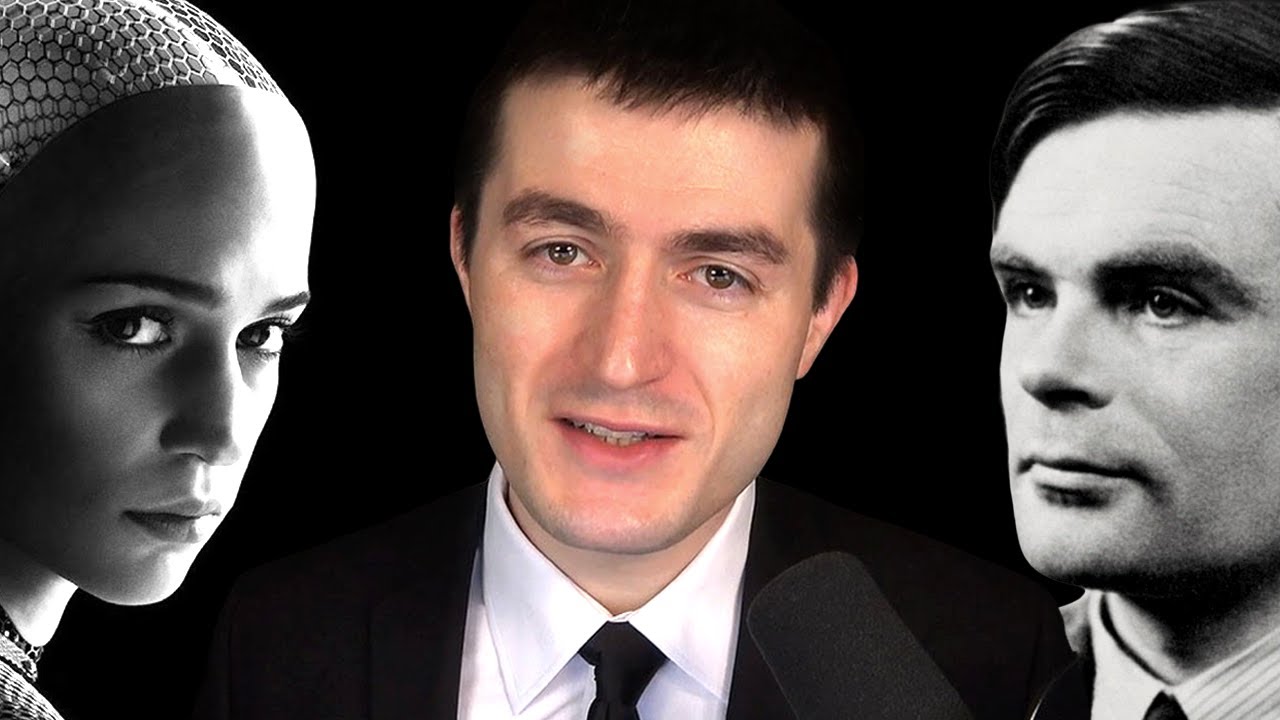
📺 Today’s recommended deep-dive video: https://www.youtube.com/watch?v=MGW_Qcqr9eQ
Beyond the Imitation Game: Decoding Alan Turing’s Vision for AI
Seventy years ago, Alan Turing bypassed the metaphysical trap of defining “thought” by proposing a concrete engineering benchmark known today as the Turing Test. While often dismissed as a mere philosophical thought experiment, this 1950 paper planted the dream of human-level machine intelligence that fuels the deep learning revolution today.
Core Question: Can a machine’s intelligence be quantifiably proven through its ability to imitate human conversation and social interaction?
Highlights
- The transition from abstract philosophy to the “Imitation Game” as a measurable engineering benchmark.
- A deep dive into Turing’s nine original objections, ranging from religious skepticism to Lady Lovelace’s “surprise” factor.
- Critical evaluation of modern benchmarks like the Alexa Prize, the Hutter Prize, and Google’s Meena chatbot.
- Why the “messiness” of human interaction is not a distraction, but the final frontier for artificial intelligence.
⏱️ Reading time: approx. 8 minutes · Saves you about 52 minutes vs. watching.
Want to take notes while watching? Click the image below and let AI Notebook capture the key points for you 👇

The Birth of the Imitation Game
From Definitions to Benchmarks
Turing famously opened his paper by stating, “I propose to consider the question, ‘Can machines think?'” However, he immediately identified a trap: common definitions of “machine” and “think” would lead to nothing more than a statistical survey of public opinion. To avoid this, he replaced the question with a concrete test—the Imitation Game. In this scenario, a human interrogator communicates via text with two entities behind a wall—one human, one machine—and must decide which is which.
This was a profound leap in engineering logic.
By stripping away the physical appearance of the machine and focusing solely on output, Turing created a functional benchmark that bypassed the unsolvable mysteries of the “soul” or internal consciousness. He predicted that by the year 2000, a machine with 100 megabytes of storage could fool 30% of human judges in a five-minute conversation, a milestone that signaled his belief that intelligence is a matter of performance rather than essence.
💡 Digging Deeper
Q: Why did Turing focus on written conversation instead of physical action?
A: Written word provides a narrow communication bandwidth that levels the playing field, allowing the focus to remain strictly on cognitive ability and linguistic nuance.
Q: Has the 100MB prediction aged well?
A: While 100MB is laughably small by today’s standards, Turing’s insight that learning machines (machine learning) would be the primary vehicle for success was remarkably prescient.
Q: What is the most significant social prediction in the paper?
A: Turing believed that the phrase “thinking machine” would eventually cease to be seen as a contradiction, suggesting that AI would become a mundane, integrated part of human society.

The Nine Objections and the Chinese Room
Defending the Thinking Machine
Turing anticipated the backlash his ideas would face and categorized nine distinct objections to machine intelligence. These ranged from the “Head in the Sand” objection—the fear that AGI is too scary to contemplate—to the Mathematical Objection based on Gödel’s Incompleteness Theorem. Turing’s rebuttal to the latter was simple: humans are also flawed and irrational, so why should we demand machines be infallible to be considered intelligent?
The most enduring critique is the Lady Lovelace objection, which argues that machines can only do what we program them to do.
Turing countered this by noting that machines surprise us constantly. As code bases grow in complexity, the mapping from input to output becomes non-intuitive even for the creator. This debate was further refined by John Searle’s “Chinese Room” thought experiment in 1980, which argued that mimicking syntax is not the same as understanding semantics. Searle claimed that a person following a rulebook to translate Chinese doesn’t “understand” Chinese, implying that programs are merely formal, not meaningful.
💡 Digging Deeper
Q: How does Turing address the requirement of consciousness?
A: He argues that we cannot prove other humans are conscious either; we only judge them by their appearance of consciousness, so machines should be held to the same standard.
Q: What is the “Negative Nancy” objection?
A: It is the intuitive claim that machines will never do “X” (fall in love, enjoy a meal, create art), which Turing dismissed as a vapid opinion based on past limitations.
Q: Is telepathy relevant to the Turing Test?
A: Turing jokingly suggested a “telepathy-proof” room, reflecting the popular interest in ESP at the time, but the core point was to exclude all non-conversational cues.
Modern Benchmarks: Beyond the Script
From Mitsuku to Google Meena
The quest for the Turing Test continues through the Loebner Prize and the Amazon Alexa Prize. Historically, winners like the Mitsuku chatbot have relied heavily on scripted, rule-based systems rather than end-to-end learning. These systems often fail when a human introduces tangents or complex logic, revealing “gaps of inhumanity” in the conversation. In 2014, the bot Eugene Goostman “passed” by portraying a 13-year-old Ukrainian boy, using his age and language barrier as a shield for his limitations.
Google’s “Meena” represents a shift toward massive, 2.6 billion parameter neural networks.
To measure its success, researchers proposed the Sensibleness and Specificity Average (SSA). Sensibleness ensures a response makes sense in context, while Specificity prevents the bot from being “boring” by giving generic answers like “I don’t know.” While Meena scores significantly higher than scripted bots (79% vs 56%), humans still dominate at 86%, proving we are still a long way from a machine that can sustain a truly deep, meaningful connection.
💡 Digging Deeper
Q: Why don’t major labs like DeepMind focus more on the Loebner Prize?
A: Many researchers view it as a “PR stunt” or a distraction, preferring to focus on narrow, measurable tasks like chess, Go, or specific image recognition benchmarks.
Q: What is the Winograd Schema?
A: It is a test of common-sense reasoning using ambiguous pronouns (e.g., “The trophy didn’t fit in the suitcase because it was too large”—what is ‘it’?), which requires real-world knowledge to solve.
Q: How does the Hutter Prize define intelligence?
A: It equates intelligence with data compression, arguing that the better a system can compress a gigabyte of Wikipedia data, the more it “understands” the underlying patterns of knowledge.

The Abstract Reasoning Corpus (ARC)
Reaching for IQ-Level Logic
François Chollet’s “Abstraction and Reasoning Corpus” (ARC) offers a more clinical alternative to the Turing Test. Instead of language, ARC uses grid-based visual puzzles similar to human IQ tests. These tasks require the machine to understand “priors”—fundamental concepts like object persistence, symmetry, and spatial contiguity—that humans take for granted.
By removing the reliance on massive datasets, ARC tests a system’s ability to learn a new task from just a few examples.
This gets to the heart of fluid intelligence. While the Turing Test captures the social and linguistic “messiness” of being human, ARC attempts to isolate the pure reasoning capability of the mind. Both are essential, but they represent two different poles of the AI journey: one focused on the social connection, the other on the logical architecture of thought.

Key Takeaways
The Turing Test is not just a relic of the 1950s; it remains a North Star for the AI community. While narrow benchmarks like chess and Go have been conquered, the open-domain conversation remains the ultimate frontier because it requires a synthesis of logic, emotion, and common sense. Turing’s decision to focus on appearance over internal mechanics was a pragmatic choice that allowed computer science to flourish without getting bogged down in the “hard problem” of consciousness.
As we move forward, the “messiness” of human interaction—our boredom, humor, and irrationality—must be embraced rather than avoided. Research should not shy away from human-robot interaction simply because it is difficult to quantify. Ultimately, the successful AI of the future will likely be an end-to-end learning system that doesn’t just calculate, but connects, proving its intelligence by building a relationship with us over time.
Q&A
Q1: What is the main difference between a scripted bot and a learning bot like Meena?
A1: Scripted bots use “if-then” rules written by humans, making them rigid; learning bots analyze billions of conversation parameters to generate responses based on statistical context.
Q2: Why was Eugene Goostman’s 2014 victory controversial?
A2: Critics argued the bot used “smoke and mirrors”—like pretending to be a non-native child—to lower the judges’ expectations and avoid complex dialogue.
Q3: How does the Amazon Alexa Prize measure success?
A3: It uses the duration of the conversation. The goal is a 20-minute meaningful chat, reflecting the idea that humans won’t stay in a conversation that lacks value.
Q4: What is the “prior knowledge” mentioned in Chollet’s ARC paper?
A4: These are innate concepts like “objects stay the same even when hidden” or “symmetry,” which humans don’t need to be taught but machines must be programmed to understand.
Q5: Can a machine pass the Turing Test without being conscious?
A5: According to Turing, yes. If the machine mimics consciousness perfectly, the distinction becomes irrelevant for all practical engineering purposes.
Q6: What is the “Total Turing Test”?
A6: An extension of the original test that includes physical modalities like vision and robotic manipulation, requiring the machine to interact with the physical world.
Q7: Why does Lex Fridman argue that intelligence is a “journey, not a destination”?
A7: He suggests that we should judge intelligence by how a system improves and learns over months or years of interaction, rather than in a single five-minute window.