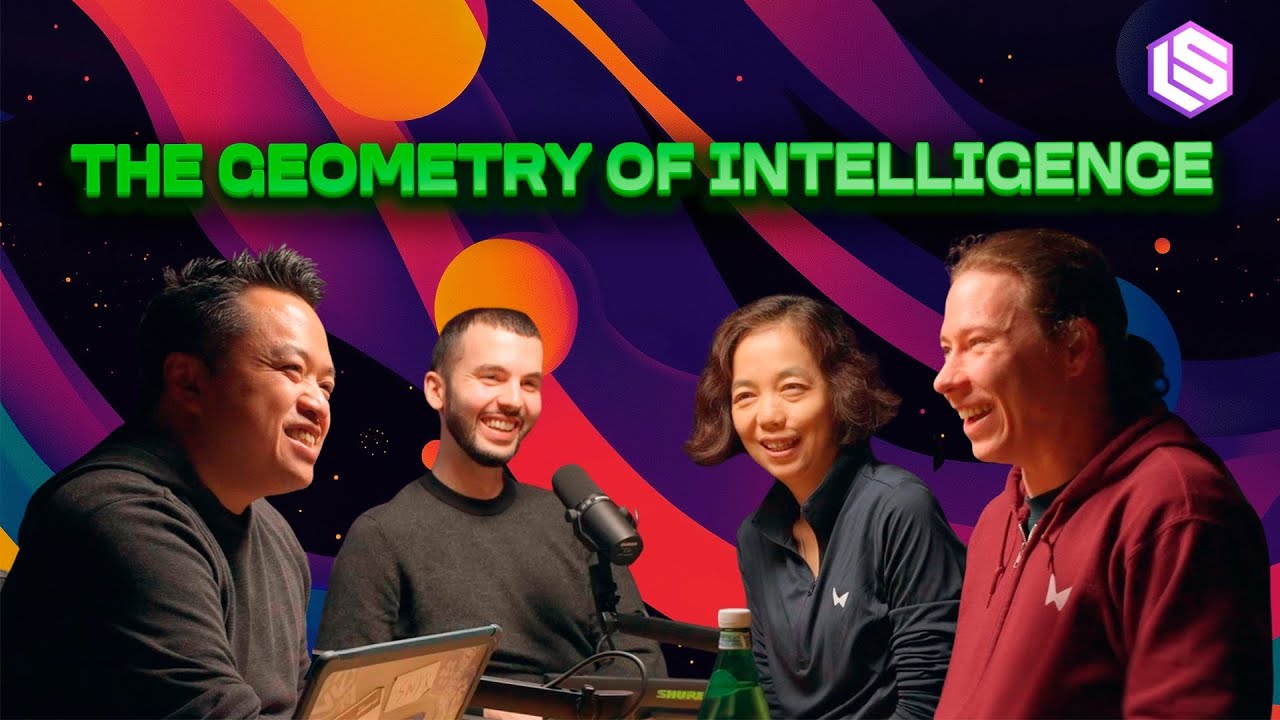
📺 Today’s recommended deep-dive video: https://www.youtube.com/watch?v=60iW8FZ7MJU
Beyond Language: The Era of Spatial Intelligence and World Models
Artificial Intelligence has mastered the art of conversation, but it remains largely untethered from the physical, three-dimensional world we inhabit. World Labs founders Fei-Fei Li and Justin Johnson are changing that by developing “spatial intelligence”—a new frontier that moves beyond static pixels and text to create interactive, persistent 3D world models.
Core Question: Can we scale computer vision to transition from simple pattern recognition to building functionally intelligent world models that understand space, geometry, and physics?
Highlights
- The million-fold increase in compute since the 2012 AlexNet era finally makes 3D world modeling a viable engineering challenge.
- Spatial intelligence is a foundational form of cognition that predates language by 500 million years, serving as the basis for how we interact with the physical world.
- World Labs’ first product, Marble, utilizes Gaussian splats to generate editable 3D environments with precise camera control.
- Future AI architectures may move beyond “sequence-to-sequence” models, as Transformers are natively models of sets rather than just linear strings of data.
⏱️ Reading time: approx. 12 minutes · Saves you about 49 minutes vs. watching.
Want to take notes while watching? Click the image below and let AI Notebook capture the key points for you 👇

From ImageNet to World Models
Scaling the Third Dimension
The history of deep learning is, in many ways, the history of scaling compute to meet the complexity of the data we wish to process.
When AlexNet won the ImageNet challenge in 2012, it required a fundamental jump from CPUs to GPUs, yet we are now seeing performance gains of a thousand-fold per card compared to that era. Justin Johnson notes that the amount of compute we can marshal today on a single model is roughly a million times greater than what was available at the start of his PhD. This massive increase in resources is what finally allows researchers to move past 2D language and images into the data-heavy domain of 3D world modeling.
While language models have proven incredibly lucrative and capable, they lack an inherent understanding of the “gestalt” of a physical scene.
By focusing on spatial intelligence, World Labs aims to build models that don’t just predict the next pixel but understand the underlying geometry and counterfactuals of a space. This involves creating a system where you can input text or images and receive a fully realized 3D world that matches those inputs. It is the evolution of computer vision from a niche laboratory discipline into a “civilizational technology” that can eventually navigate and reason within our physical reality.

💡 Digging Deeper
Q: Why is academia struggling to keep up with industry labs?
A: It is primarily a resource imbalance; academia lacks the massive GPU clusters and funding required to train state-of-the-art scaling models, though it remains the best place for “wacky,” long-range ideas.
Q: What is the “hardware lottery” mentioned in the discussion?
A: It refers to the idea that our current AI architectures, like Transformers, are popular because they fit the matrix multiplication strengths of current GPUs, potentially stifling other architectures that might suit different hardware.
Q: How has the role of a PhD student changed in the last decade?
A: Previously, a student could train state-of-the-art models on a few GPUs; now, the focus has shifted toward theoretical understanding, interdisciplinary work, and blue-sky thinking that doesn’t require massive scale.
Defining Spatial Intelligence
The 540-Million-Year Head Start
Vision is often underappreciated because it feels effortless to humans, yet it is one of the most complex biological feats ever optimized by evolution.
Fei-Fei Li points out that nature spent roughly 540 million years perfecting perception and spatial intelligence, while language has only existed for about half a million years. This is why we have to be taught to read and write, but we are born with the latent ability to link our eyes to our motor movements. Spatial intelligence is what allows us to grasp a mug or navigate a room—processes that are incredibly difficult to reduce to pure language without losing vital information.
We often assume that because LLMs can describe a physical law, they “understand” it, but there is a fundamental gap between narration and embodiment.
A language model might know that “A is on top of B,” but it doesn’t inherently understand that A cannot fall through B due to physical forces. Spatial intelligence is about opening that “black box” of reasoning and mapping information back to a three-dimensional representation. It is the difference between reading a weather report and actually feeling the wind and rain while navigating a storm.

💡 Digging Deeper
Q: Can language models eventually “distill” spatial intelligence?
A: While they can use language as a proxy, the “bandwidth constraint” of words makes it a lossy channel; you cannot fully narrate the precise geometry of a 3D movement.
Q: Did Isaac Newton need language to understand gravity?
A: He had the spatial intuition first from being an embodied agent in the world; language and math were merely the tools used to formalize and communicate that intuition.
Q: Is there such a thing as “pixel maximalism”?
A: Yes, it’s the idea that pixels are a more lossless representation of the world than tokens, as they preserve fonts, layouts, and the 2D/3D arrangement of information.
Engineering the World: Marble and Beyond
The Atomic Units of 3D
Building a world model requires a decision on what the “atomic unit” of that world should be.
While language models use tokens, World Labs’ product “Marble” natively outputs Gaussian splats—tiny, semi-transparent particles with specific positions and orientations in 3D space. These splats are revolutionary because they can be rendered in real-time on consumer devices like iPhones or VR headsets. This allows for precise camera control, where a user can move through a scene with 60 FPS fluidity rather than waiting for a server to generate a video frame-by-frame.
The goal is to create a horizontal technology that touches everything from gaming and VFX to interior design and architecture.
Justin Johnson explains that Marble isn’t just a science project; it’s a tool that allows users to record scenes, edit objects (like changing the color of a water bottle), and export worlds. This interactivity is key. If you are an architect, you don’t just want a “plausible” image; you need a model that obeys the forces of the world so the building doesn’t collapse. While Marble is currently focused on creative industries, its ability to generate synthetic 3D data is a massive “unlock” for the field of robotics.

💡 Digging Deeper
Q: Why use Gaussian splats over meshes or voxels?
A: Splats offer a superior balance of high-fidelity visual quality and real-time rendering efficiency on mobile and edge devices.
Q: How does Marble handle physics?
A: Currently, it focuses on visual fidelity and 3D consistency, but future versions could imbue splats with physical properties like mass and “virtual springs” for simulation.
Q: Is “sequence-to-sequence” modeling the final answer for AI?
A: Likely not. Transformers are actually models of “sets,” and for 3D worlds, we may need architectures that go beyond one-dimensional sequences to handle complex spatial data.
Key Takeaways
Spatial intelligence represents the missing link in the quest for Artificial General Intelligence. While language allows for high-level reasoning and theory building, it is our ability to perceive and interact with the 3D world that provides the grounding for those theories. World Labs is betting that by scaling compute and visual data, we can create models that understand the physical “gestalt” of reality, moving AI out of the data center and into the world.
The immediate applications for this technology are already emerging in creative fields. Tools like Marble allow for a level of directorial control that traditional video-generation models cannot match, providing precise “XYZ” camera placement and object-level editing. Beyond art, this technology serves as a critical bridge for robotics, providing the high-fidelity synthetic environments needed to train embodied agents without the “data starvation” prevalent in real-world physical training.
Ultimately, the transition to world models is a return to the roots of intelligence. It acknowledges that vision is not a subset of language, but a massive, high-bandwidth foundation upon which language was built. By mastering space, AI moves closer to becoming an “alien intelligence” that can not only talk to us about the world but actually function within it alongside us.
Q&A
Q1: What was the significance of the “Dense Captioning” work done at Stanford?
A: It was an early attempt to move beyond simple object recognition. It allowed a model to draw boxes around multiple parts of an image and describe them in detail, creating a “gestalt” understanding of a scene in a single forward pass.
Q2: How much has compute scaled since the AlexNet paper in 2012?
A: Performance per GPU has increased about 1,000x, and we now use thousands of GPUs simultaneously. In total, a single model today might use a million times more compute than AlexNet did.
Q3: Why does Fei-Fei Li argue that vision is underappreciated?
A: Because it is effortless for humans. We are born with the ability to see and link perception to movement, whereas hard tasks like language or math require years of schooling, leading us to mistake “hard for us” as “hard for AI.”
Q4: What is the difference between a “video model” and a “world model”?
A: Video models generally predict frame-by-frame pixels in 2D. A world model like Marble creates a consistent 3D volume (often using Gaussian splats) that maintains structural integrity as you move a camera through it.
Q5: Are Transformers limited to sequential data?
A: No. Architecturally, Transformers are models of “sets.” The only thing that makes them sequential is the “positional embedding” we give the tokens. Without that, they treat all data points as a permutation-equivariant set.
Q6: How can spatial intelligence help solve “data starvation” in robotics?
A: Real-world robotic data is hard to get. World models can generate near-infinite amounts of high-fidelity, physically plausible synthetic data to train robots in simulation before they ever touch the real world.
Q7: Can an LLM discover Newton’s Laws (F=MA) from data alone?
A: It’s unlikely. While a model might predict the trajectory of a planet based on past data, the high-level abstraction of a physical law like F=MA requires a different level of causal reasoning than next-token prediction.