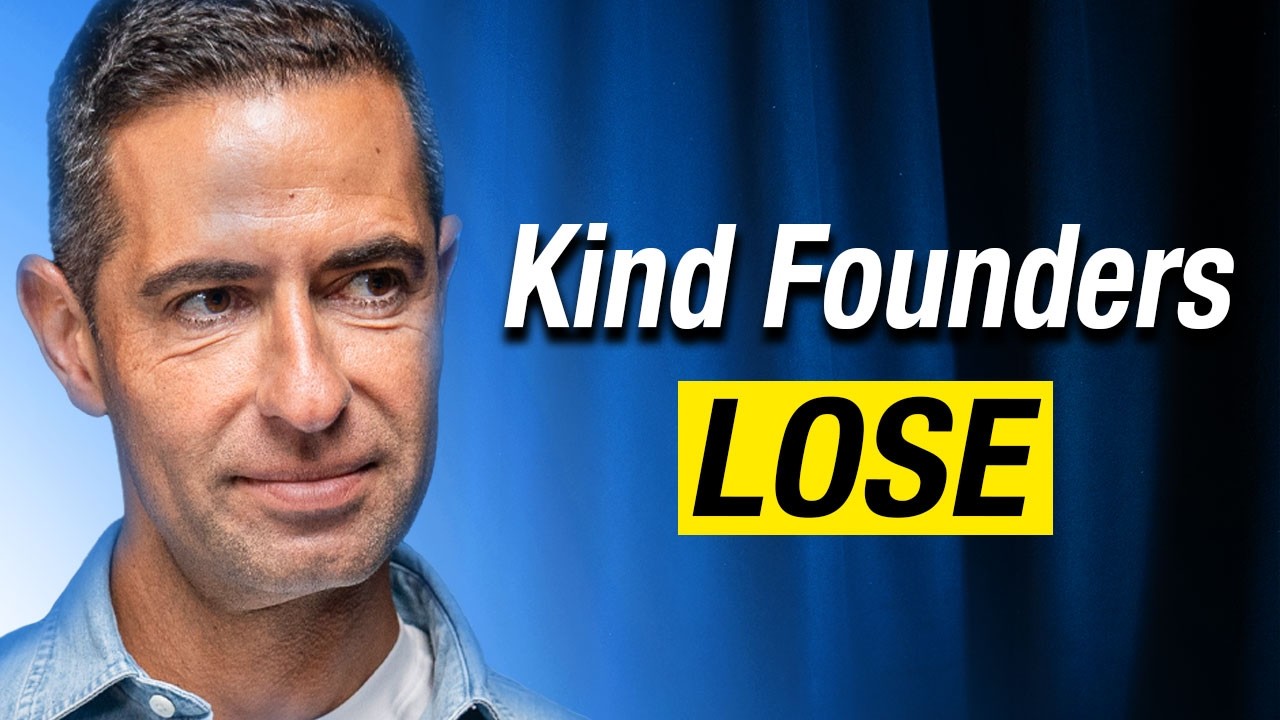
📺 Today’s recommended deep-dive video: https://www.youtube.com/watch?v=dlPCz8Jwypw
The $150 Billion Recovery: Adam Foroughi’s Cutthroat Playbook for AI-Native Growth
Adam Foroughi turned a catastrophic 92% stock collapse into a historic recovery by firing half his staff and betting the entire company on an AI-native engineering overhaul. In this deep dive, the AppLovin CEO reveals why he abolished one-on-one meetings and how he maintains a staggering $10 million EBITDA-per-employee ratio.
Core Question: How can a founder navigate a near-total market wipeout by purging corporate bloat and rebuilding the technology stack from the ground up?
Highlights
- The Axon 2 Pivot: Scrapping a $30 billion IPO-proven tech stack to rebuild for the AI era during a 92% stock drawdown.
- Radical Lean Management: Abolishing HR layers, middle management, and one-on-one meetings to empower “A-player” doers.
- Financial Engineering: Executing a massive $50 billion value-generating buyback by targeting sellers rather than the open float.
- AI Productivity: Moving beyond “token budgeting” to focus engineering output strictly on measurable value creation.
⏱️ Reading time: approx. 7 minutes · Saves you about 73 minutes vs. watching.
Want to take notes while watching? Click the image below and let AI Notebook capture the key points for you 👇

The Anatomy of a 92% Recovery
Conviction in the Trough
Conviction is the only shield against a stock price that drops every single day for a year while investors call to check if you are suicidal.
Foroughi explains that when AppLovin fell from a $40 billion market cap to under $4 billion, he had to ignore the external noise and rebuild the entire recommendation engine from scratch, moving from traditional machine learning to a cutting-edge AI architecture.
The decision to scrap the old system was not merely a technical upgrade; it was a cultural purge that required letting go of talented people who were still wedded to the previous architecture. By focusing on a performance-based model where advertisers only pay for measurable success, the company was able to prove its value even when the market had completely written off its future prospects.

💡 Digging Deeper
Q: How do you maintain confidence when the market says you’re failing?
A: By focusing on the strategy rather than the ticker, ensuring you have a motivated team and a path that makes mathematical sense.
Q: Why rebuild the tech when you were already a multi-billion dollar company?
A: The old system was outdated for the AI era; staying with it would have led to a slow death rather than a recovery.
Q: What was the primary motivator during the drawdown?
A: The fear of a total blowup was a massive motivator, pushing the team to innovate faster than their competitors could react.
Abolishing Corporate Scaffolding
The Culture of Doers
The AppLovin organizational chart is intentionally skeletal, lacking a Chief People Officer or a CMO, because Foroughi believes that A-players do not require the hand-holding of traditional corporate scaffolding.
If you require a formal performance review or a weekly one-on-one to understand your impact, you are likely not the type of doer this organization needs to survive.
By treating engineers as product managers, the company eliminates the friction between “what should be built” and “how it is built,” ensuring that every line of code is directly tied to a business KPI. This lean approach allows the core advertising business to generate staggering revenue per head, reaching figures that simply do not make sense to outsiders used to bloated Silicon Valley structures.

💡 Digging Deeper
Q: How do you develop talent without one-on-ones?
A: High-quality talent develops through curiosity and real-world execution, using tools like AI to summarize documentation and learn as they go.
Q: Isn’t a lack of HR risky for a public company?
A: No, you only need high-output individual contributors in HR who focus on results rather than adding unnecessary process.
Q: What happens if an employee isn’t performing?
A: Feedback is delivered in real-time via chat; if the role is heading toward a dead end due to automation, the company parts ways quickly.
The AI-Native Future and the War on Bloat
Efficiency Over Headcount
Many CEOs make the mistake of firing staff to cut costs, but if you don’t rebuild the culture for AI-native efficiency, you are just left with a smaller version of a mediocre company.
Foroughi argues that 80-90% of code can now be AI-generated, provided the engineer acts as a sophisticated auditor rather than a manual writer.
The material changes coming to the market will likely result in a deluge of layoffs as companies realize they can achieve 10x output with 20% of the staff. This is not about saving pennies on the dollar; it is about creating a competitive moat where imagination becomes product at the speed of thought, unencumbered by the weight of human-centric process.

💡 Digging Deeper
Q: How do you handle “token budgeting” for AI?
A: Budgeting for tokens is flawed logic; if an LLM is driving revenue growth, you should spend as much as possible on it.
Q: Is Enterprise SAS dead?
A: Not dead, but the terminal value is dicey because their growth opportunities are being eaten by frontier AI models.
Q: What is the biggest risk for an AI-native company?
A: Security breaches will increase as products ship faster, but eventually, the same AI models will be used to button up code vulnerabilities.
Key Takeaways
Success in the AI era requires a fundamental rejection of the “growth by headcount” mentality that defined the last decade of Silicon Valley. By prioritizing cash flow minus stock-based compensation (SBC), Foroughi has created a financial model that favors investors over internal bloat. This lean structure isn’t just a cost-saving measure; it is a tactical advantage that allows for rapid pivots like the Axon 2 transition.
The founder’s journey is defined by the trade-offs between professional dominance and personal presence. Foroughi admits that the cost of building a trillion-dollar candidate is often the “blur” of a child’s early years, a reality that few CEOs are willing to voice so candidly. Ultimately, the future belongs to those who view themselves as doers first and managers second, leveraging AI to replace process with pure output.
Q&A
Q1: Why do you prioritize “Winning” over “Avoiding Failure”?
A: Chasing winning allows you to take material shots at upside, whereas fear of failure forces you to protect the downside and get stuck.
Q2: How did the $50 billion buyback actually work?
A: We didn’t just buy the float; we targeted specific large sellers on the cap table who needed liquidity, removing the selling pressure that was depressing the stock.
Q3: Why don’t you have a Chief People Officer?
A: A-players don’t need a management layer to manage the next person who manages the doer; they just need the tools and the freedom to get work done.
Q4: Is stock-based compensation (SBC) a real expense?
A: Yes. Cash is king. If a company generates a billion in cash but gives away a billion in equity, they aren’t actually generating real value for shareholders.
Q5: What is your advice to a CEO with a bloated team?
A: It is almost impossible to go backwards without firing 99% of the people and rebuilding from the ground up to find the “glory days” culture.
Q6: Does AppLovin need to be a social network to hit a $1 trillion valuation?
A: No, we just need to hit roughly $30-$35 billion in annual cash flow, which can be achieved through Connected TV and deeper gaming monetization.
Q7: How do you balance being an aggressive leader with being a “kind” person?
A: Directness is the highest form of efficiency. Sugar-coating things to be “kind” wastes time and slows down the entire organization’s pace.