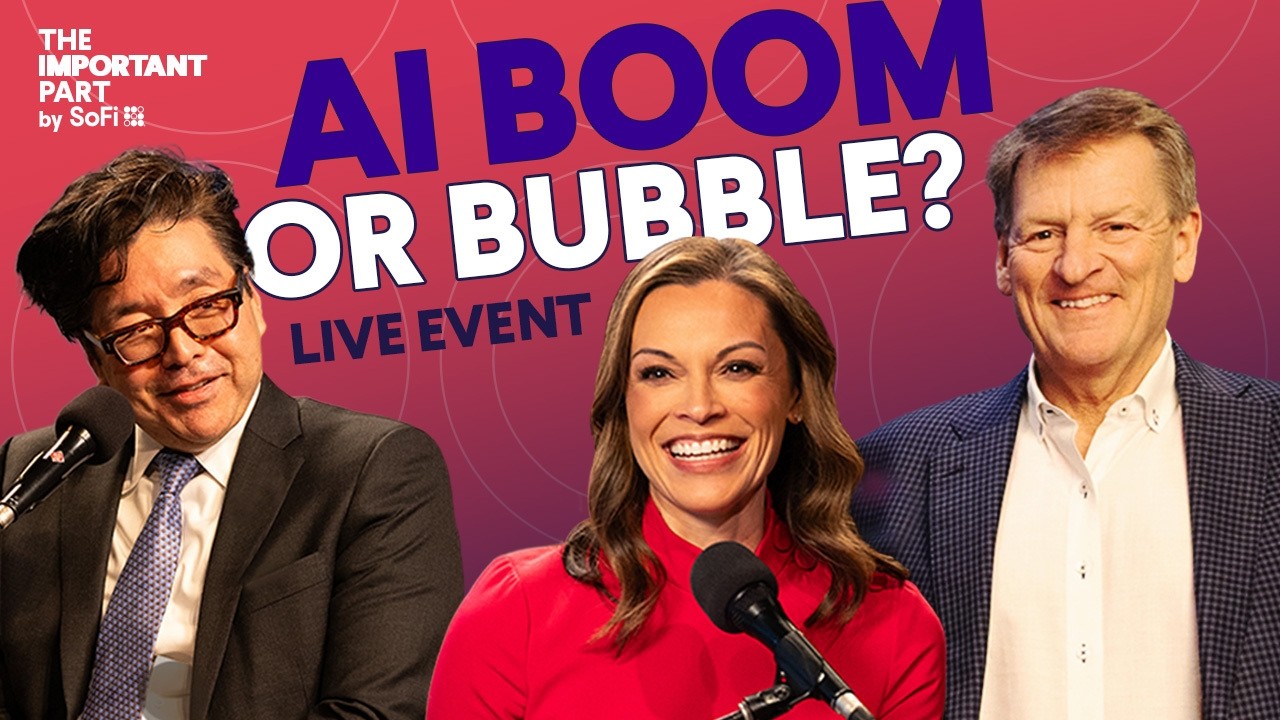
📺 Today’s recommended deep-dive video: https://www.youtube.com/watch?v=sokdBNdjygg
Navigating the AI Hype: When Bubbles Burst and Why Retail is Winning
As artificial intelligence drives markets to unprecedented heights, investors are increasingly looking over their shoulders for the next inevitable collapse. In this high-stakes discussion, market veteran Tom Lee and legendary author Michael Lewis dissect the anatomy of current market excess, the shifting value of gold, and why today’s retail investors might actually be smarter than the institutions chasing them.
Core Question: Is the current AI-driven market a sustainable technological revolution or a historical cycle of irrational exuberance destined for a catastrophic reset?
Highlights
- The sharp contrast between institutional “churn” and the long-term success of retail investors.
- Why gold acts as a hedge for “fear and anxiety” rather than just a traditional store of value.
- The potential for AI to trigger a “nationalization” of key tech firms if private funding cycles fail.
- The dangerous social consequences of legalizing sports gambling and its impact on young men.
⏱️ Reading time: approx. 8 minutes · Saves you about 64 minutes vs. watching.
Want to take notes while watching? Click the image below and let AI Notebook capture the key points for you 👇

The Bubble Paradox and the Cycle of AI
Identifying the Peak of Irrational Exuberance
History consistently suggests that investment bubbles only truly pop when the final skeptic is converted into a believer and the collective consensus declares that a crash is impossible. We haven’t reached that stage yet because too many people are still looking for the exit door, which ironically keeps the market from becoming truly precarious.
Tom Lee, a veteran of the 1990s tech boom at Solomon Brothers, recalls the era of massive telecom overbuild where fiber optic cables were laid across the globe without clear immediate utility. During such periods, analysts are often forced to adjust their valuation models to justify sky-high prices, ignoring rising risk costs in favor of exit multiples that eventually become unsustainable. When that bubble burst, the collapse was indiscriminate, dragging down wireless, hardware, and infrastructure firms simultaneously regardless of their individual merit. It is this specific type of model-shifting behavior that signals a terminal market phase.
Interestingly, the most resilient winners from the 2000 crash were not the glamorous internet startups, but rather “boring” infrastructure like cell towers and even Domino’s Pizza. This pattern indicates that while AI valuations may eventually reset, the underlying productivity gains will eventually favor real-world utility over pure hype.

💡 Digging Deeper
Q: Is the current level of AI Capex spending a red flag?
A: While Capex is higher now than in the 90s, it represents a drive for productivity; the risk is overspending on capacity that doesn’t generate immediate revenue.
Q: How do you identify a bubble in real-time?
A: Watch for “cost of money” exit multiples dropping to single digits while valuations soar—this signals that risk is no longer being priced into the system.
Q: Why did Domino’s outperform tech after the 2000 crash?
A: Because during economic shifts, consumers return to basic staples, and the infrastructure built during the boom (like better delivery tracking) eventually benefits traditional businesses.
The New Guard: Retail Success vs. Institutional Churn
The Advantage of Permanent Capital
The most surprising trend in modern finance is the persistent ability of retail investors to outperform sophisticated hedge funds by simply refusing to sell. By holding stocks for years rather than seconds, they avoid the “churn” that eats into institutional profits.
Today, the average holding period for a stock in an institutional portfolio has shrunk to a mere 40 seconds, driven by high-frequency trading and quant-heavy strategies. In contrast, retail investors often operate with “permanent capital”—their own money—which allows them to ignore daily price gyrations. This psychological edge means they aren’t forced to exit positions during a “bad” week, whereas a hedge fund manager might face career-ending redemptions for the same short-term volatility.
Fidelity once conducted a study on their best-performing accounts and discovered a macabre secret: the highest returns belonged to customers who had died or forgotten their passwords. By effectively removing the human element of active trading, these accounts allowed the natural upward trajectory of the market to compound undisturbed.

💡 Digging Deeper
Q: Why are institutions struggling to keep up with retail in specific sectors?
A: Institutions have a 30-day time horizon for P&L reporting, which forces them to sell during minor dips that retail investors are happy to sit through.
Q: Is Wall Street still attracting the “smartest” graduates?
A: Yes, but the destination has shifted from investment banking to high-frequency quant firms and private equity, where the financial rewards are front-loaded.
Q: What is a “battleground stock”?
A: A stock like Tesla or Palantir where retail investors are overwhelmingly bullish while institutions are shorting the company, creating massive volatility.
Gold, Crypto, and the Psychology of Fear
The Lindy Effect and Demographic Shifts
Gold is essentially a “long fear” trade, serving as a physical manifestation of global anxiety and political instability that index funds cannot replicate. When you buy gold, you aren’t betting on growth; you are betting on the persistence of human uncertainty.
Michael Lewis recounts the story of a friend who studied Roman coins to understand how emperors debased currency over centuries. This “Lindy Effect”—the idea that the longer something has survived, the longer it is likely to survive—gives gold a psychological weight that Bitcoin hasn’t yet earned. Interestingly, demographic data shows that Gen Z and Millennials are returning to gold, skipping the alternative investment preferences of their parents to buy what their grandparents valued.
However, gold faces bizarre “black swan” risks, such as the potential for extraterrestrial mining or technological alchemy. If SpaceX were to successfully land on a gold-heavy asteroid, the scarcity that drives gold’s value would evaporate overnight, potentially turning the central bank of the future into a space exploration company.

💡 Digging Deeper
Q: Is Bitcoin truly “digital gold”?
A: The narrative is shifting; Bitcoin frequently correlates with the NASDAQ, meaning it acts more like a speculative tech asset than a stable store of value.
Q: What is the biggest threat to Bitcoin’s longevity?
A: Quantum computing. If quantum supremacy is achieved, current encryption could be broken, forcing a “fork” in the blockchain that might invalidate older wallets.
Q: Can AI create its own currency?
A: It is possible; if AI systems begin communicating in their own language, they may develop a micro-transaction validation system that bypasses human-led blockchains entirely.
Key Takeaways
The transition into an AI-dominated economy is likely to mirror the agricultural shift of the 1930s, where flash-frozen technology decimated farming employment but ultimately spurred massive productivity. While the displacement of jobs is a legitimate social concern, the historical precedent suggests that technology creates more opportunity than it destroys, provided the “distributional consequences” are managed by sound policy rather than ignored.
We are currently witnessing a blurring of lines between money, digital goods, and technology services. As Wall Street firms transform into technology providers and AI begins to handle autonomous micro-transactions, the financial sector’s share of the global economy will likely grow rather than shrink. Investors must remain wary of the “bubble” narrative but recognize that the underlying innovation is a permanent fixture of the new landscape.
Ultimately, the market remains a mirror of human psychology. Whether it is the speculative frenzy of sports betting or the defensive hoarding of gold bars, the moves we see today are driven by the same fear and greed that Michael Lewis documented in Liar’s Poker decades ago. The tools change—from bond desks to AI quants—but the human impulse to chase the “hot” trade remains identical.
Q&A
Q1: Does the nomination of a hawkish Fed chair like Kevin Warsh change the market outlook?
A1: It signals a potential shift away from Quantitative Easing (QE) and toward a more hands-off approach, though history suggests the Fed will always intervene if the economy truly begins to collapse.
Q2: What happens if major AI companies like NVIDIA or OpenAI face a funding crisis?
A2: Given the strategic importance of AI in the “arms race” against China, there is a significant possibility that the U.S. government would nationalize these assets rather than let them fail.
Q3: Why has sports betting become such a major focus for market analysts?
A3: Some argue it siphons off “irrational” speculative energy from the stock market, though it also creates significant social risks, particularly for young men prone to predatory gambling incentives.
Q4: Is there a specific price point where gold becomes a “bad” investment?
A4: Historically, when the market capitalization of gold exceeds 150% of the total stock market capitalization, it has reached a cyclical top.
Q5: How did Sam Bankman-Fried manage to evade detection for so long?
A5: He built an “industrial strength” exchange that actually worked well for high-frequency traders, leading investors to believe he would never risk such a successful business on fraudulent activity.
Q6: What is the “Crypto Squall” compared to a “Crypto Winter”?
A6: A squall is a painful but temporary deleveraging event—often triggered by external shocks like tariff announcements—whereas a winter is a multi-year period of stagnant transaction activity and falling prices.