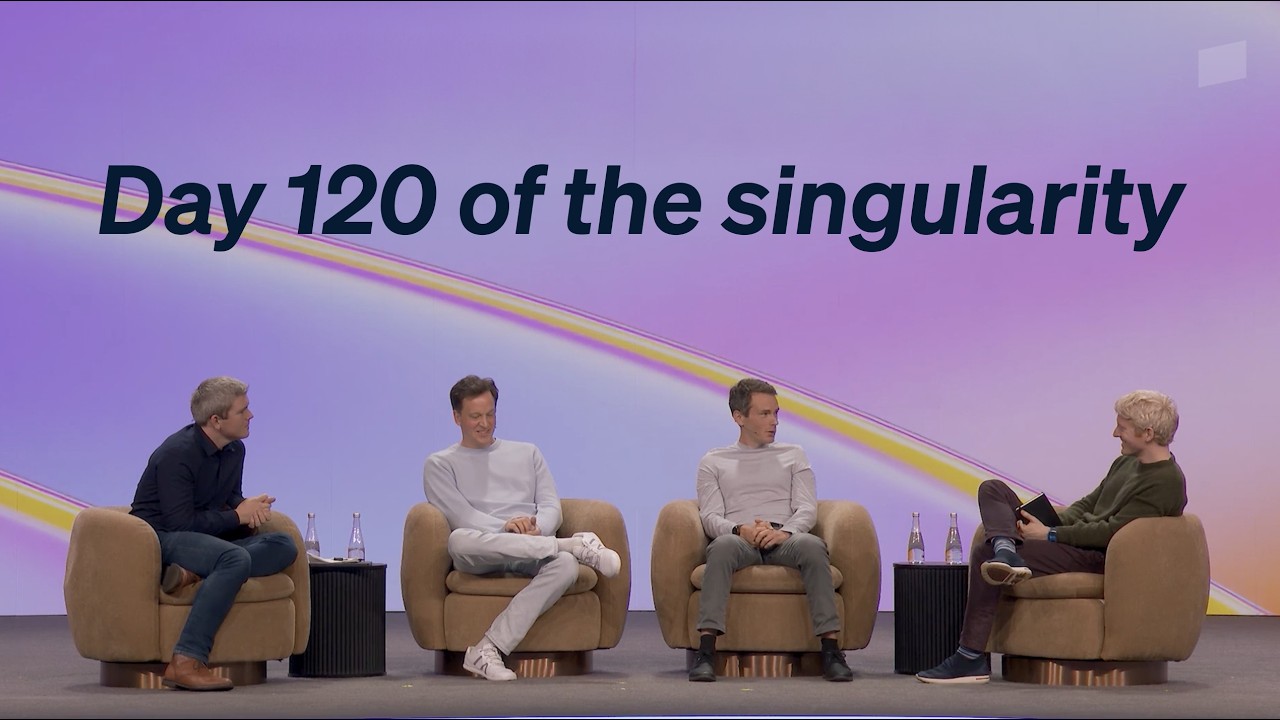
📺 Today’s recommended deep-dive video: https://www.youtube.com/watch?v=l9wzs_QIyp0
120 Days of the Singularity: Scaling Intelligence and the End of the Human Bottleneck
We are currently in the “slow part” of the Singularity, where human effort and organizational friction still bottleneck the speed of AI improvement. As we move toward self-improving models and agentic commerce, the way we build software, manage organizations, and design infrastructure is undergoing a fundamental shift toward total automation.
Core Question: How will the transition from human-led research to self-improving AI agents redefine the global economy and the dignity of engineering?
Highlights
- AI development is currently limited by the “human loop,” but the move toward self-improving models will trigger a massive, non-linear acceleration.
- The economic impact of AI mirrors China’s entry into the WTO—a disinflationary force that collapses structural costs while increasing global purchasing power.
- Personal coding agents are ushering in a “Golden Age of Tinkering,” turning complex hardware into trivial peripherals for autonomous AI assistants.
- Organizational success in the AI era depends on shortening iteration cycles and removing the “indignity of process” to empower high-leverage engineers.
⏱️ Reading time: approx. 8 minutes · Saves you about 48 minutes vs. watching.
Want to take notes while watching? Click the image below and let AI Notebook capture the key points for you 👇

The Human Bottleneck and the Elbow of the Curve
Automating the Researcher
The Singularity officially began on January 1st, meaning we are currently 120 days into a new epoch of technological history.
While observers often feel dazzled by new models and then quickly bored, the current phase is actually the slowest pace we will ever experience. Human researchers are still the bottleneck, forced to sleep, hold meetings, and manually run experiments that limit the speed of model improvement. The prime project at every major lab right now is to remove these humans from the loop of continuous work to reach the stage of recursive self-improvement.
The primary objective is the total automation of the research process to scale improvements at the speed of a data center rather than the speed of a human conversation. By automating the researchers’ tasks and scaling them across massive clusters, we shift from human-speed progress to machine-speed evolution. This transition marks the “elbow” of the curve where growth stops being linear and begins its vertical ascent, eliminating the gaps created by human fatigue and bureaucratic decision-making.

💡 Digging Deeper
Q: Why do we feel like AI progress is “slow” right now?
A: Because the improvement of models still requires human researchers to make decisions, discuss results, and sleep, which introduces significant lag between breakthroughs.
Q: What is the “elbow of the curve”?
A: It is the point where AI models begin to automate their own improvement, leading to an exponential surge in capability that moves much faster than human-managed development.
Q: How does this affect the compute strategy at companies like Meta?
A: It shifts the focus to hyperscaling infrastructure that can support continuous, autonomous experimentation without manual intervention.
The Disinflationary Engine: AI as the New WTO
The China WTO Comparison
Economists struggle to determine if AI is inflationary or disinflationary, but the best historical comparison is China’s modernization and entry into the WTO.
This shift lowered the structural cost of goods globally, drastically increasing the purchasing power of consumers even while aggregate GDP surged. Before this integration, providing a high-quality global live stream on a $200 device would have cost tens of millions; today, it is effectively a commodity. AI is poised to do the same for intelligence-intensive services, acting as a massive disinflationary force that collapses the cost of software, legal, and administrative labor.
AI may mirror this effect by collapsing the cost of software production and intelligence-intensive services, effectively fighting the “cost disease” that has plagued sectors like healthcare and education. While wages in productive sectors may rise, the ability to buy high-quality services for pennies will redefine the standard of living for the global population. This re-industrialization could bring talent back to physical manufacturing, as software production becomes increasingly automated and commoditized, leaving more room for innovation in the physical world.

💡 Digging Deeper
Q: Is AI expected to be inflationary or disinflationary?
A: Like the modernization of China, it is expected to be disinflationary by lowering the structural cost of producing goods and services, even if total money supply increases.
Q: What is “Cost Disease” in this context?
A: It refers to the rising costs in sectors like healthcare and education. AI could fix this by automating the high-cost intellectual labor that has historically been resistant to productivity gains.
The Golden Age of Tinkering
From Consumers to Architects
We are entering a “Golden Age of Tinkering” where individual engineers act like Iron Man, supported by their own personal Jarvis agents.
Nat Friedman’s experience reverse-engineering a face scanner using Claude Code demonstrates that proprietary hardware locks are becoming irrelevant. When an AI can read academic papers, write drivers, and integrate IO devices in hours, the traditional barriers between software and hardware dissolve. Every physical device essentially becomes a peripheral for an AI that understands its functional logic better than the original manufacturer does.
This shift changes our relationship with technology from consumers of fixed products to architects of custom, agent-driven ecosystems.
The challenge remains safety, as current models are still susceptible to prompt injection attacks when given access to private data like email inboxes. Despite these risks, the market is choosing power over safety, with developers frequently bypassing permissions to unlock the full potential of their coding agents and personal assistants. The future of commerce will likely involve agents with their own purchasing power, necessitating a new financial stack for identities and disputes.

💡 Digging Deeper
Q: How did Nat Friedman fix his Vizia face scanner?
A: He used Claude to reverse-engineer the device, read academic papers on its polarization settings, and write new software that was better than the original manufacturer’s version.
Q: What is the main security risk for personal AI agents?
A: Prompt injection. If an agent can read your email, a malicious message could take over the agent to steal data or redirect financial transactions.
Q: Why are Raspberry Pis relevant again?
A: They serve as cheap, universal IO devices that AI agents can easily control to customize the physical environment of the user.
Organizational Velocity and the Dignity of Engineering
The Physics of Cycle Time
Organizational health is best measured by “cycle time”—the duration between a raw idea and the collection of user feedback on a shipped feature.
At GitHub, the turnaround involved breaking a culture of “stage fright” where engineers feared desecrating a beloved product, leading to paralysis. By prioritizing demos over memos and ignoring rigid org charts, leaders can restore the dignity of their best engineers. A healthy organization allows a single developer to cut across multiple layers of the stack without the friction of ten meetings or a dozen design documents.
Impatience is a leadership virtue when organizational entropy naturally gravitates toward mediocrity and unnecessary process.
There is also a growing aesthetic movement regarding the physical footprint of AI. As we spend 2% of GDP on compute infrastructure, the goal should be to build data centers that are not just functional, but beautiful—much like the Victorian pumping stations of the past. If we want society to accept the scale of this new infrastructure, it must elevate the human spirit rather than just process tokens. This “vibe shift” suggests that as our collective potency grows, we must ask how our inventions glorify mankind rather than just maximizing metrics.

💡 Digging Deeper
Q: What was the “stage fright” problem at GitHub?
A: The engineers inherited a beloved product and were so afraid of making a mistake that they stopped shipping new features, leading to stagnation.
Q: How should leaders ignore the org chart?
A: By working directly with the “doers” at the coalface and removing the layers of permission that prevent engineers from making cross-stack changes.
Q: What is the argument for “beautiful” data centers?
A: Since these buildings consume massive energy and space, making them aesthetically pleasing helps earn the public’s right to build them and elevates the local community.
Key Takeaways
The Singularity is not a single moment but a process of removing human friction from the engine of progress. We are currently transitioning from a world where humans manually guide AI to a world where AI agents autonomously improve themselves and interact with the physical world. This shift will collapse the cost of intelligence, much like the integration of the Chinese economy collapsed the cost of manufactured goods, ushering in a period of significant disinflation for software and services.
For organizations, survival in this era requires a radical commitment to speed and the removal of bureaucratic “indignities.” Engineering teams must operate with high autonomy, leveraging agents to tighten iteration loops and ignore traditional hierarchies. As AI agents begin to exercise purchasing power and handle complex integration tasks, the infrastructure of the internet—from payments to security—must be rebuilt to accommodate non-human actors who prioritize efficiency over legacy processes.
Q&A
Q1: How can AI help with “cost disease” in sectors like healthcare?
A: By automating high-value intellectual labor and diagnostic tasks, AI can provide services that were previously expensive and scarce at a near-zero marginal cost.
Q2: Will AI lead to mass layoffs at tech giants like Google?
A: Not necessarily. While efficiency increases, companies may choose to have the same number of people doing many more things, though the way teams are organized will have to change.
Q3: What is the “dignity of the engineer” in the AI era?
A: It is the ability for a talented engineer to make impactful changes across a software stack without being hemmed in by excessive process, meetings, and bureaucratic “pens.”
Q4: Should we be worried about AI agents spending money?
A: Agents will eventually have purchasing power, which requires a new financial stack for identity and disputes. Stablecoins are a likely candidate for how these agents will transact.
Q5: Is now a good time to start a startup?
A: Yes, though the “SaaS” model is changing. The focus is shifting toward applied AI, industrial applications, and solving problems that large, inefficient companies ignore.
Q6: What is the “iron man” feeling in coding?
A: It is the experience of using agents to handle the “boring” parts of development, allowing a single person to build complex systems, reverse-engineer hardware, and innovate at high speed.
Q7: How will AI affect the physical world and manufacturing?
A: As software production is automated, talent may shift back to “re-industrializing” the economy, focusing on physical low-hanging fruit that hasn’t been touched because all the talent was in software.