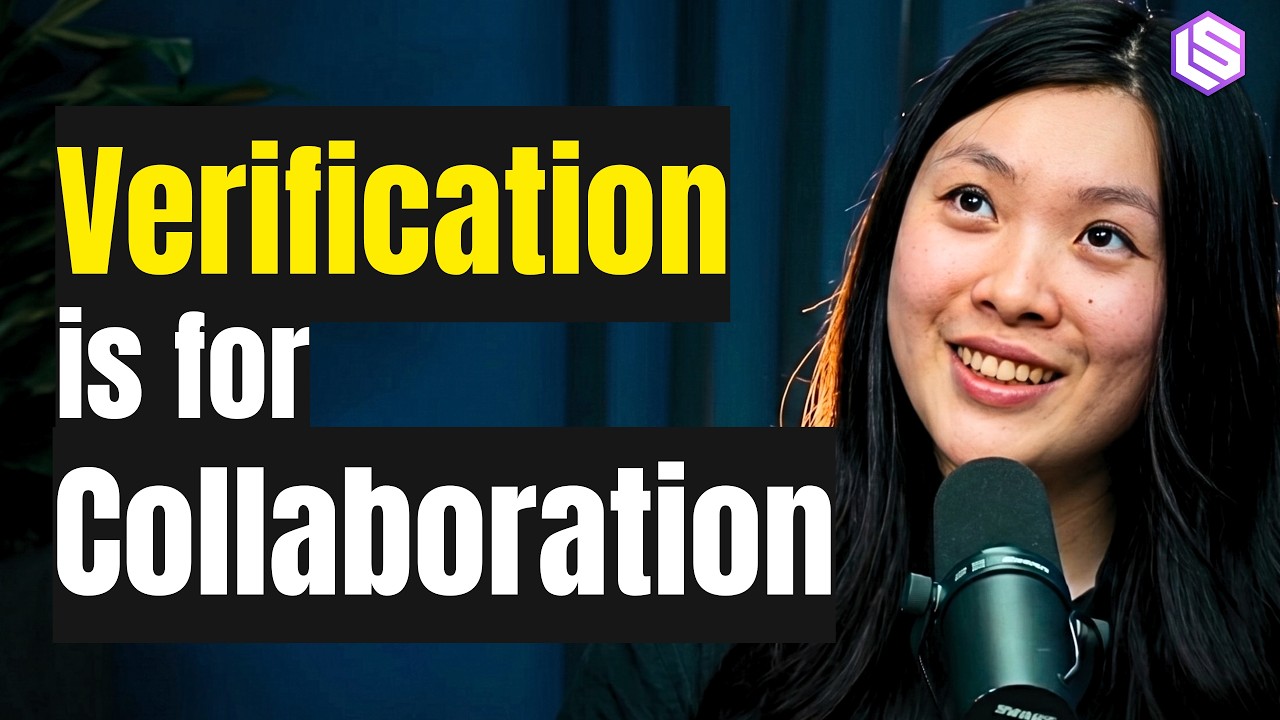
📺 Today’s recommended deep-dive video: https://www.youtube.com/watch?v=abYcV5LHMG4
Scaling Brilliance: Why Axiom Math is Betting $200 Million on Formal Verification
Axiom Math founder Karina Hong explains why formal verification is the key to unlocking superintelligence, moving beyond the “hallucination” problem to build a world where AI-generated reasoning is provably correct. By blending the rigor of Lean with cutting-edge reinforcement learning, Axiom aims to transform how we collaborate with machines.
Core Question: How can formal mathematical verification turn stochastic AI into a reliable engine for scaling human brilliance and scientific discovery?
Highlights
- Axiom achieved a perfect score on the Putnam math exam, surpassing the performance of the world’s top human undergraduate mathematicians.
- “Verified AI” is not just about stopping hallucinations; it is a mechanism for compounding intelligence and scaling the “Ramanujan-style” intuition of the future.
- The company is open-sourcing massive codebases for mathematical discovery, focusing on pre-conjecture steps like construction and example-finding.
- Axiom views math as the ultimate “transfer learning” domain, where formal rigor in proofs directly translates to superior capabilities in coding and hardware design.
⏱️ Reading time: approx. 11 minutes · Saves you about 82 minutes vs. watching.
Want to take notes while watching? Click the image below and let AI Notebook capture the key points for you 👇

The Philosophy of Verified AI
Beyond the Safety Tax
Axiom Math views formal verification not as a safety tax or a boring compliance hurdle, but as the essential engine for scaling and compounding superhuman brilliance.
In the traditional software world, developers often see formal proofs as an annoying bottleneck that slows down delivery times for the sake of edge-case security or regulatory checkboxes. However, Karina Hong argues that by grounding AI in formal languages like Lean, we can turn raw, fuzzy intuition into verified theorems that future systems can build upon without the risk of regression or decay.
Take the legendary mathematician Ramanujan as the primary historical example of this evolution. He possessed incredible mathematical intuition, finding formulas that seemed to appear out of thin air, yet it was only after he moved to Cambridge and learned the rigor of formal proof-writing that his brilliance could be truly scaled and verified by the wider community. This transition from “gut feeling” to “provable fact” is what Axiom aims to replicate for AI agents, creating a foundation of “compounding brilliance” where every new discovery is a solid brick in a growing wall of knowledge.

💡 Digging Deeper
Q: Why isn’t human peer review enough?
A: Current human peer review for advanced math papers can take up to two years and is still prone to oversight; Lean provides a real-time, step-by-step guarantee.
Q: Is formal verification just for “closed” industries like defense?
A: No. Hong argues that verified AI actually opens up collaboration by allowing humans and AI agents to work on different parts of a problem with a shared, grounded language.
Q: What is the “brilliance” vs. “lossiness” distinction?
A: Most people see verification as a way to fix “lossy” hallucinations (errors). Axiom sees it as a way to “scale brilliance” by allowing AI to navigate high-level concepts with low-level certainty.
The Lean Advantage and the Future of Coding
Turning Proofs into Programs
Lean is a functional programming language and theorem prover that allows Axiom to treat mathematical proofs as computer programs through the Curry-Howard correspondence.
The future of software engineering will eventually reach a state where anything that can be specified can also be formally proven.
While frontier labs like OpenAI focus on informal reasoning through large-scale reinforcement learning, Axiom leverages the inherent structure of Lean to provide a hard guarantee of correctness. This approach allows the system to ground its reasoning in a way that traditional LLMs cannot. Instead of relying on a “judge” model that might be just as stochastic as the “generator,” Axiom uses a compiler to verify the logic with 100% certainty.
This methodology creates a unique opportunity for transfer learning. By mastering the extreme rigor required for formal mathematics, AI models develop a “reasoning engine” that translates directly into high-level coding tasks and hardware design. In markets like GPU architecture or financial audits, there is no such thing as “mostly correct.” A perfect prover becomes a trillion-dollar asset that solves the fundamental reliability gap currently plaguing the generative AI industry.

Beyond Proofs: The Renaissance of Discovery
Solving the Specification Problem
One of the greatest challenges in verification is that humans are notoriously bad at specifying exactly what they want a program or a proof to do.
If it isn’t specified, it isn’t proven.
To bridge this gap, Axiom is investing heavily in “mathematical discovery”—a pre-conjecture step where AI helps mathematicians find examples, counter-examples, and constructions. This is an interactive process where the AI acts as a collaborator, proposing “sketches” or “blueprints” that help define the problem before the formal prover ever touches it.
Karina Hong believes that “taste” and “intuition” will remain the ultimate human bottlenecks. Even if an AI can generate a million-line proof for the Riemann Hypothesis, humans will still desire to understand why it works. Attention is the finite resource, meaning the human mathematician’s role shifts from being a “calculator” to being a “curator” who guides the AI’s focus toward elegant and important problems.

Key Takeaways
The shift toward Verified AI represents a move away from the “black box” nature of current Large Language Models. By integrating formal verification into the inference process, Axiom Math is proving that smaller, more specialized models can outperform massive general-purpose models on the most difficult reasoning tasks in existence. The Putnam exam results—where Axiom beat the best human score—serve as a proof of concept for this “sample efficiency” argument.
Furthermore, the $200 million Series A funding signals that the market is ready for AI that doesn’t just “guess” but “knows.” As we move toward autonomous AI agents, the ability to formally verify the code and actions of those agents will be the difference between a helpful assistant and a catastrophic failure. Axiom’s bet is that the path to AGI runs through the absolute, uncompromising rigor of mathematics.
Q&A
Q1: How did Axiom perform on the Putnam math exam?
A: They achieved a perfect score of 120/120, whereas the best human score was 110/120 and the best competing LLM (DeepSeek) scored 103/120.
Q2: What is “Axel” (AXLE)?
A: Axel is the Axiom Lean Engine, a suite of open-source tools released by the company to help the community manipulate, repair, and verify Lean proofs at scale.
Q3: Can everything be formally verified?
A: Theoretically, Rice’s Theorem and Godel’s Incompleteness Theorem suggest bounds on what is decidable, but Hong argues that the “useful majority” of programs can and should be verified.
Q4: Why focus on math instead of just going straight to coding?
A: Math provides a cleaner, more structured data set for reinforcement learning. The reasoning capabilities learned in math have high transferability to coding and general logic.
Q5: Is Axiom competing with OpenAI or Anthropic?
A: In some ways, yes, but Axiom also sees a future where frontier labs might call Axiom’s API for “verification-as-a-service” when their models reach a logic bottleneck.
Q6: What is “Auto-Formalization”?
A: It is the process of converting informal natural language (like a math problem in English) into a formal specification in a language like Lean.
Q7: How does Axiom deal with the “Short-term vs. Long-term” pressure?
A: By setting rigorous competitive milestones (like the Putnam or IMO) while maintaining a long-term research focus on recursive self-improvement and AGI.