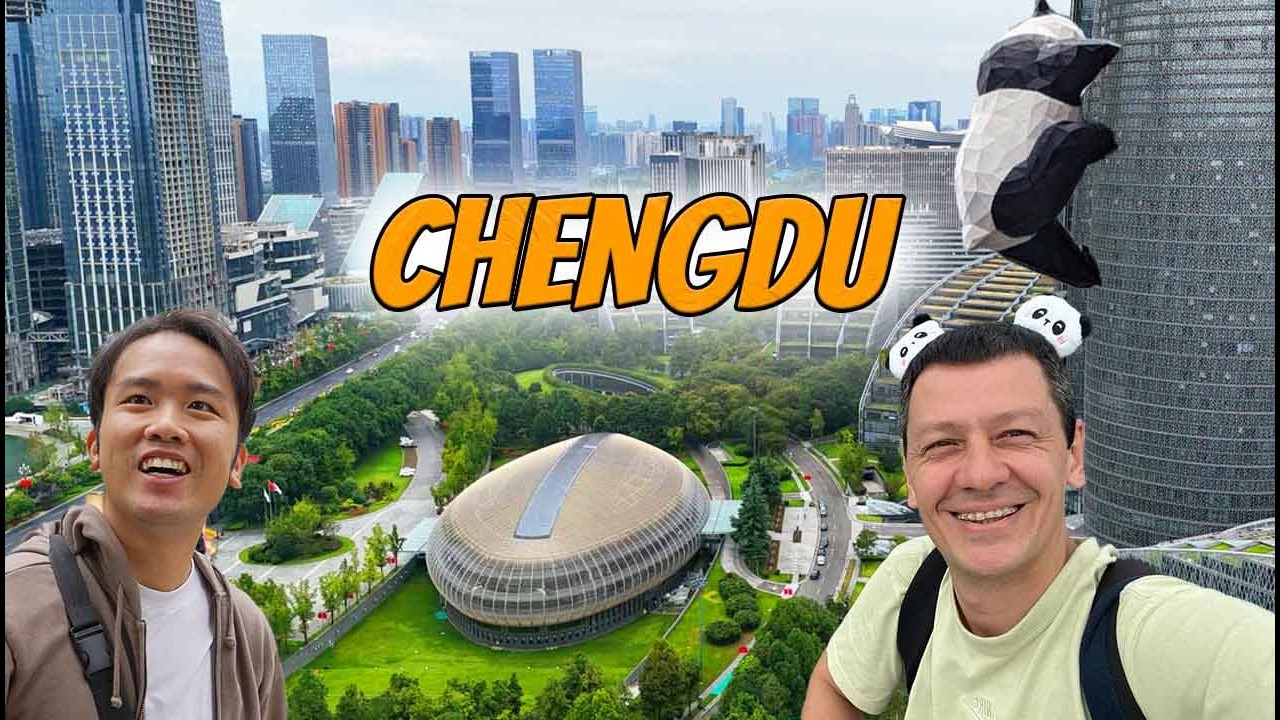
📺 Today’s recommended deep-dive video: https://www.youtube.com/watch?v=mUbizFj0eFg
Chengdu: China’s Futuristic “Park City” Where Tradition and Tech Collide
Chengdu is much more than the global headquarters for giant pandas; it is a sprawling metropolis that seamlessly blends thousands of years of Shu history with a futuristic “Park City” vision. From ancient irrigation systems to the world’s largest standalone building, this Sichuan capital offers a high-speed glimpse into China’s rapid urban evolution.
Core Question: How does Chengdu maintain its status as China’s “happiest city” while simultaneously pioneering the world’s most ambitious modern infrastructure and conservation efforts?
Highlights
- The Chengdu Research Base has successfully transitioned giant pandas from “endangered” to “vulnerable” status.
- A world-class subway network of 558 km was constructed in just under 14 years.
- The “Park City” initiative aims to integrate residential life within a massive 100 km greenway loop.
- Dujiangyan remains the world’s oldest functional irrigation system, dating back to 256 BC.
⏱️ Reading time: approx. 8 minutes · Saves you about 33 minutes vs. watching.
Want to take notes while watching? Click the image below and let AI Notebook capture the key points for you 👇

The Capital of Pandas and Rapid Progress
Conservation and the Giant Panda Research Base
Founded in 1987 with only six rescued pandas, the Chengdu Research Base of Giant Panda Breeding now houses over 240 individuals, serving as a beacon for global wildlife conservation. This government-funded institute has been instrumental in increasing the wild population by 17% over a decade, meaning giant pandas are no longer classified as an endangered species. Visitors can observe these animals in a lush, park-like habitat designed to mimic the Sichuan wilderness, where pandas spend the majority of their day eating bamboo and resting.
The facility is so expansive that shuttle buses are required to navigate the various enclosures and research stations spread across the hills.
While the pandas are the star attraction, the center also protects other rare species, such as the vibrant red panda. The success of this facility highlights China’s shift toward ecological preservation as a core national value, moving beyond simple industrialization to protect its unique biological heritage.

💡 Digging Deeper
Q: How many times do pandas typically defecate?
A: A healthy adult panda can poop up to 40 times a day due to their high-fiber bamboo diet.
Q: Is the Panda Base just for tourists?
A: No, it is primarily a scientific research and breeding facility focused on genetic diversity.
Q: What is the current wild panda population?
A: There are currently more than 1,800 giant pandas living in the wild in southwestern China.
Urban Evolution and the Happiest City in China
The World’s Fastest-Growing Infrastructure
Chengdu didn’t even have a subway system until 2010, yet today it boasts 558 kilometers of operational lines, surpassing the networks of New York City and London in a fraction of the time. This explosion of connectivity is best exemplified by Line 9, a fully automated, driverless system featuring stations designed by world-renowned architecture firms. This efficiency is a result of centralized government planning, which allows projects to move from blueprint to reality without the typical bureaucratic hurdles seen in the West.
The city is remarkably flat, making it a paradise for cyclists who utilize thousands of shared bikes to navigate shorter distances faster than cars.
Beyond the rails, the city’s skyline is dominated by the New Century Global Center, currently the largest building in the world by floor area. This massive structure is large enough to house entire shopping malls, two business centers, a hotel, and even a water park with an artificial beach, standing as a monument to Chengdu’s economic ambition.
A Culture of Leisure and “Slow Life”
Despite the high-tech surroundings, Chengdu has been voted the happiest city in China for 12 consecutive years, largely due to its “lay-back” lifestyle and rich tea culture. In spots like People’s Park, locals gather to drink tea, play Mahjong, and engage in the traditional practice of professional ear cleaning. It is a place where the hustle of the High-Tech Zone is balanced by the historical charm of Kuanzhai Alley, where ancient Qing Dynasty architecture has been repurposed into trendy bars and galleries.
Residents here take leisure seriously, often spending hours in parks to counterbalance the stress of modern work life.

💡 Digging Deeper
Q: Why is Chengdu called the “Happiest City”?
A: It is attributed to the combination of high-quality public services, affordable spicy cuisine, and a culture that prioritizes social gathering over constant labor.
Q: What is the significance of Tianfu Square?
A: It is the city’s central heart, featuring a massive statue of Chairman Mao and a bird’s-eye design that mimics a Taiji (Yin and Yang) symbol.
Q: What is the Jiaozi Ring Bridge?
A: A futuristic pedestrian bridge nicknamed the “Hot Pot Bridge” because its circular shape resembles the famous local dish.
Engineering Harmony: The Park City Vision
The Integration of Nature and Industry
The “Park City” philosophy is Chengdu’s answer to urban sprawl, aiming to build a city inside a park rather than just placing parks inside a city. In the new Tianfu New Area, residential blocks and office buildings are interspersed with massive artificial lakes like Xinglong Lake, ensuring that no resident is more than a few kilometers from a green space. This design reduces traffic congestion by creating self-contained communities where people can live, work, and recreate within a small radius.
Even the concrete pillars of highway overpasses are covered in lush ivy to soften the urban landscape.
This green initiative includes a 100-kilometer greenway that encircles the city, providing a protected corridor for exercise and ecological preservation. By prioritizing green space in the planning phase, Chengdu is attempting to avoid the “gray” atmosphere often associated with mega-cities in developing nations.
Dujiangyan: The 2,000-Year-Old Blueprint
The foundation of Chengdu’s prosperity is the Dujiangyan irrigation system, a marvel of ancient engineering that has prevented floods and droughts for over two millennia. Built around 256 BC, this system diverted the Min River to create a “Land of Abundance” on the fertile Chengdu plain, and it remains in use to this day. It stands as a historical testament to the region’s long-standing expertise in water management and environmental harmony.

💡 Digging Deeper
Q: Who designed the new Science Fiction Museum?
A: It was designed by Zaha Hadid Architects and resembles a seven-pointed metallic star floating on a lake.
Q: What is unique about the Fangsuo Bookstore in Dujiangyan?
A: It features a “Harry Potter-esque” mirrored design that creates an infinite illusion of bookshelves.
Q: How far is Mount Qingcheng from the city?
A: It is about 60 kilometers away, reachable in 30 minutes by high-speed rail.
Key Takeaways
Chengdu represents a unique model of urban development that refuses to sacrifice history for the sake of progress. While the city aggressively pursues Fortune 500 investments and builds record-breaking skyscrapers, it remains deeply rooted in the Taoist principles of balance, as seen in the preservation of Mount Qingcheng and the Dujiangyan irrigation works.
The city’s success in panda conservation and its transition into a “Park City” offer a blueprint for other global metropolises facing ecological crises. By integrating high-speed connectivity with a culture that values the “slow life,” Chengdu proves that a city can be a global economic powerhouse without losing its soul to the relentless pace of modern industry.
Q&A
Q1: What is the most famous food in Chengdu?
A: Chengdu is world-renowned for its Sichuan Hot Pot, which features a spicy, numbing broth made with Sichuan peppercorns and various meats and vegetables.
Q2: How does the “Park City” concept affect daily life?
A: It places residences within 6 km of offices and integrates greenways into the commute, significantly reducing the “concrete jungle” feel of the city.
Q3: Is Chengdu expensive for tourists?
A: Compared to Beijing or Shanghai, Chengdu is very affordable; public transport costs pennies, and world-class street food is available for a few dollars.
Q4: What is the significance of the Golden Sunbird?
A: Unearthed at the Jinsha site, this 3,000-year-old gold foil artifact is the official logo of the city, representing the ancient Shu civilization.
Q5: Can you reach other major cities easily from Chengdu?
A: Yes, Chengdu is a major transport hub with two international airports and high-speed rail links that can reach Chongqing in just over an hour.
Q6: Why are there so many car owners in Chengdu?
A: Chengdu has over 7 million registered vehicles, the most in China, because the city is flat and, unlike Beijing, does not have a lottery system for license plates.
Q7: What is the best time to visit for weather?
A: Autumn is generally best, as the city has a humid subtropical climate with very little sunshine; it is often overcast similar to Northern Europe.