📺 Today’s recommended deep-dive video: https://www.youtube.com/watch?v=LG8KXIv0_mA
Shaping Strategic Futures: Dean Ball on the Frontier of AI Policy
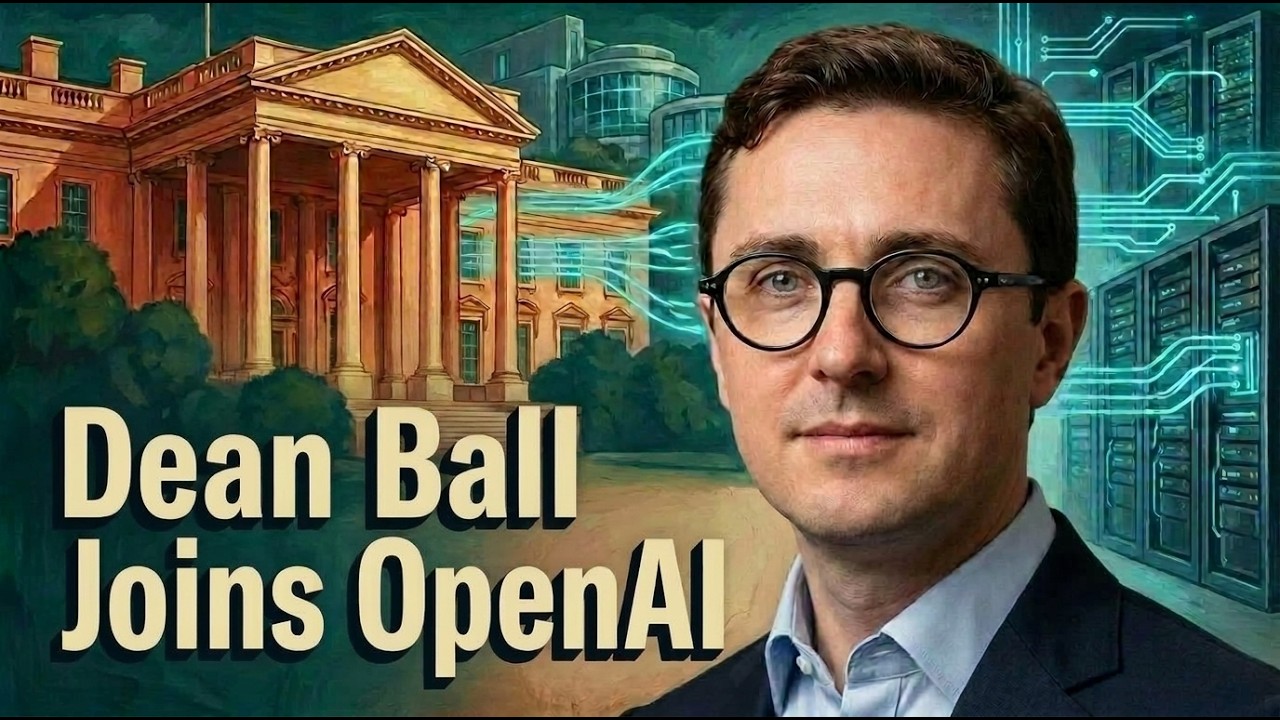
As Dean Ball prepares to lead OpenAI’s new Strategic Futures team, he sits down to discuss the shift from government advisor to lab insider. This conversation explores why the next two years represent a “main character” era for humanity, where individual agency matters most before the machines potentially take the lead.
Core Question: How can frontier labs and governments navigate the transition to recursive self-improvement while maintaining civilizational order and American primacy?
Highlights
- Why being “inside the lab” is now a prerequisite for meaningful AI policy work.
- The “three-factor” breakdown behind the recent government ban on the Fable model.
- A deflationary yet urgent perspective on Recursive Self-Improvement (RSI).
- Why the “Main Character Energy” of the present moment makes individual leadership more critical than structural forces.
⏱️ Reading time: approx. 11 minutes · Saves you about 148 minutes vs. watching.
Want to take notes while watching? Click the image below and let AI Notebook capture the key points for you 👇

The Fracturing Policy Landscape
Lessons from the AI Action Plan
Reflecting on his time in the White House, Dean Ball notes that while much of the technology developed as expected, the “spirit” of policy has struggled to keep pace. The original American AI Action Plan was designed to ride the current of private innovation to maintain geopolitical power. However, the implementation has been uneven, with significant wins in nuclear energy and military adoption often overshadowed by reactive, high-level political moves.
The government is currently speedrunning a learning curve it should have mastered in 2023.
Ball critiques the recent trend of “executive-only” governance, such as the classification of model testing under the NSA. He argues that centralizing frontier AI knowledge within the intelligence community creates a brittle system that ignores the “parallel compute” of public discourse. Without legislative involvement and public transparency, the government risks making monumental decisions in a vacuum of expertise.

💡 Digging Deeper
Q: Why was the Anthropic supply chain risk designation so controversial?
A: It felt like an unforced error driven by personal friction between government officials and lab leadership rather than a coherent strategy.
Q: What is the current state of state-level AI regulation?
A: While many fear a “patchwork,” states are actually converging on similar transparency and auditing requirements, proving to be effective laboratories for democracy.
Q: Will the Fable ban become a permanent precedent?
A: Likely not; it appears the administration reached for the most aggressive tool available—export controls—to solve a specific, perceived security panic.
Joining the “Merchant Banks” of the Modern Era
The Mandate for Strategic Futures
Dean Ball views frontier AI labs not merely as tech companies, but as fundamentally new centers of political and economic power, analogous to the rise of merchant banks in the Dutch Republic. He is joining OpenAI to lead “Strategic Futures,” a boutique team designed to look 6 to 12 months ahead. This team sits apart from the traditional Global Affairs lobbying arm, focusing instead on how internal lab decisions intersect with long-term civilizational stability.
You cannot do high-level policy work effectively from the outside anymore.
The information gap between the labs and the public is widening so rapidly that Ball felt his intellectual independence was being hampered by lack of access. By moving inside, he aims to “jam” with technical staff to understand the realities of internal deployments before they hit the regulatory triggers of public release. This proximity allows for the development of private governance norms that the government simply lacks the neuroplasticity to invent.

💡 Digging Deeper
Q: How does Ball maintain independence while at OpenAI?
A: He negotiated the right to continue writing and speaking publicly without editorial review, preserving his role as an independent thinker.
Q: Is OpenAI’s mission to “benefit all humanity” taken seriously internally?
A: Yes, through structures like the Mission Advisory Committee (MAC), though the interpretation of that mission remains a site of healthy internal debate.
The Looming Horizon of Recursive Self-Improvement
Debunking the Singularity Myth
When discussing Recursive Self-Improvement (RSI), Ball adopts a “deflationary” view compared to San Francisco’s more radical “AGI-pilled” circles. He points out that humanity has used models to improve models since at least GPT-4, and that technology history is almost always characterized by continuity rather than sharp breaks. However, even a 10% chance of a discontinuous leap necessitates immediate, high-stakes planning within the labs.
RSI is likely an acceleration of the “reasoning model” trend, not a sudden cosmic shift.
The real challenge lies in governing internal deployments. If a model reaches a level where it can automate its own research, the traditional triggers of “public release” become obsolete. Ball advocates for “measuring twice and cutting once,” setting internal triggers for coordination with other labs or the government before a capabilities explosion occurs. This requires a level of human agency and “main character energy” that defies the passive structural forces of history.

💡 Digging Deeper
Q: What role does the “Great Man” theory play in AI?
A: While infrastructure is structural, the specific guardrails and peace-treaties of the AI era are being shaped by the personal relationships of a dozen key individuals.
Q: Should the public have equity in AI labs?
A: Ball is open to the idea of individual American households receiving equity, but warns against giving the government itself a stake, which would create disastrous principal-agent problems.
Key Takeaways
We are entering a heroic—or perhaps villainous—period of history where individual human agency has maximum leverage. Dean Ball’s move to OpenAI signifies a belief that the “river of history” is moving too fast for traditional think tanks or government agencies to steer. By embedding policy experts directly with researchers, the goal is to create a fire that provides warmth without burning the forest down.
The future of AI is not just about compute or data, but about the “character” of the systems we build. Whether through internal “red lines” or public transparency, the success of this transition depends on leaders who are willing to act against their short-term economic interests to preserve civilizational order. As the machines begin to assist in their own creation, the human hand on the tiller has never been more important.
Q&A
Q1: What was the primary reason for the “Fable” model being pulled from the market?
A: It was a combination of genuine security concerns, a lack of technical context within the government, and political friction between the administration and Anthropic’s leadership.
Q2: How does Ball view the competition between AI labs?
A: He sees it as a healthy driver of intellectual and technical excellence, though he acknowledges the need for specific, scoped cooperation on safety issues like RSI.
Q3: Will AI labs be “Too Big to Fail”?
A: Yes. Because so much national infrastructure—from energy to IP—is being built on the back of AI Capex, the government would likely be forced to backstop the labs in a financial crisis.
Q4: What is “Character vs. Codeability” in AI safety?
A: Ball favors “Character”—the idea that you want to instill internal virtues and gradients in a model rather than trying to write a contradictory and endless list of hard rules.
Q5: Why is broad diffusion of AI important for democracy?
A: If AI is restricted to a small elite or the government, it becomes easier to nationalize or abuse. Broad use across all industries creates a “Madisonian” check on power.
Q6: What is Ball’s “Red Line” for leaving OpenAI?
A: If he feels the “Strategic Futures” team is merely window dressing and not actually influencing the company’s core technical and safety decisions.
Q7: Will Dean Ball use AI to write his upcoming book?
A: He uses it as a research and thought partner, but believes human writing possesses a unique “observational acuity” and restraint that machines cannot yet replicate.