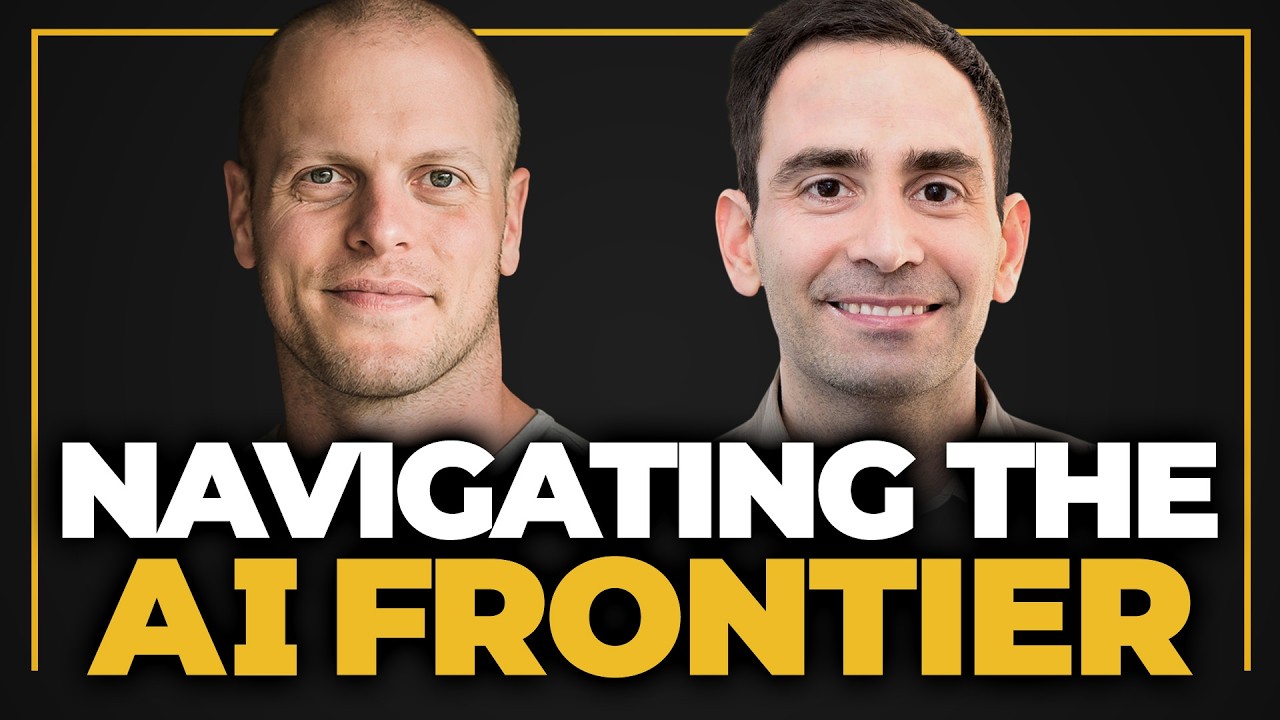
📺 Today’s recommended deep-dive video: https://www.youtube.com/watch?v=HutNi2cNsCg
The Personal IPO: Scaling the Misty Frontier of AI
Silicon Valley is witnessing a transformation where top AI researchers are experiencing wealth events equivalent to an IPO without their companies ever going public. Elad Gil breaks down why we are in a unique era of “consensus” being the right strategy and how compute bottlenecks are leveling the playing field for the next two years.
Core Question: How is the current explosion of artificial intelligence restructuring the global economy, the talent market, and the traditional lifecycle of venture-backed startups?
Highlights
- The “Personal IPO” phenomenon driven by Big Tech’s aggressive bidding for elite AI talent.
- Why High Bandwidth Memory (HBM) acts as a two-year artificial ceiling on AI model scaling.
- The “Value Maximizing Moment” and why many AI founders should consider exiting within 18 months.
- A multi-model research framework for debunking societal dogmas and analyzing clinical data.
⏱️ Reading time: approx. 11 minutes · Saves you about 90 minutes vs. watching.
Want to take notes while watching? Click the image below and let AI Notebook capture the key points for you 👇

The Talent Wars and the Personal IPO
The Bidding War for Minds
We are currently witnessing an unprecedented shift in Silicon Valley’s labor market, specifically regarding the elite class of AI researchers. Unlike previous cycles where wealth was concentrated in a single successful company’s IPO, companies like Meta are now bidding so aggressively that individuals are seeing life-changing compensation packages. These offers often range between tens and hundreds of millions of dollars for a single person.
This is the era of the personal IPO, where a researcher’s market value reflects their pivotal role in the global technology race.
This sudden influx of capital creates a divergence in focus for these newly enriched engineers. While some will inevitably stay the course, others will divert their attention toward massive science projects, politics, or even private quests to solve humanity’s greatest challenges. This shift mirrors the early days of crypto, where a whole class of holders achieved financial independence simultaneously, though the AI boom is tethered more closely to corporate R&D budgets and compute scale.

💡 Digging Deeper
Q: Why are companies like Meta willing to pay such extreme sums?
A: They are spending tens of billions on compute; it is mathematically rational to spend a fraction of that to secure the handful of people capable of optimizing that hardware.
Q: Has this happened in other industries?
A: Only rarely, such as in the early days of crypto or during the peak of the Detroit automotive boom, where a specific class of experts became wealthy regardless of a single company’s fate.
Bottlenecks in the Machine
The Memory Ceiling
Every major lab—OpenAI, Anthropic, Google, xAI—is currently training giant models, but they are all hitting a physical wall. While Nvidia GPUs are the most discussed component, the current primary constraint is actually High Bandwidth Memory (HBM), largely produced by Korean manufacturers. This bottleneck creates an artificial ceiling on how fast any single lab can pull ahead of its competitors.
The supply chain is so tightly wound that no lab can buy ten times more compute than its rivals today.
Consequently, we are entering a two-year window of capabilities parity. Because everyone is using the same scale of chips and memory, the models will likely remain neck-and-neck in performance until the supply chain expands. This “compute moat” protects the laggards while limiting the leaders, forcing a temporary oligopoly where no one can achieve a decisive technical breakout based on raw scale alone.

💡 Digging Deeper
Q: When will the memory constraint resolve?
A: Most industry insiders expect it to take about two years for fabrication plants to catch up with the current demand forecasts.
Q: How does this affect Google differently?
A: While Google produces its own TPUs, they are still reliant on the same global supply chain for memory and packaging, making them just as constrained as those buying from Nvidia.
The Investment Playbook and the Art of the Exit
The Value Maximizing Moment
Founders running successful but non-top-tier AI companies should take a cold, hard look at exiting in the next 12 to 18 months. Historically, in every major tech cycle—from the 1900s automotive industry to the 1990s internet bubble—nearly 95% of companies eventually go bust. For many, this current hype window represents the peak valuation they will ever see before commoditization or lab-driven competition eats their margins.
Most companies reach a “second derivative” plateau where growth slows just enough to signal the coming headwind.
Successful exits often happen through “mergers of competitors” or selling to tech incumbents like Oracle, Salesforce, or even the big labs. During the dot-com era, 900 companies went public, but only a dozen became truly durable giants. If a company isn’t on the path to becoming a permanent pillar of the economy, the current buying power of trillion-dollar tech giants provides a unique, fleeting opportunity for liquidity.

💡 Digging Deeper
Q: What characterizes a “durable” AI company?
A: Deep integration into workflows that require significant “change management” to replace, rather than just providing a better technological tool.
Q: Is the market currently “Founder-limited” or “Market-limited”?
A: In AI, the market is wide open; almost every CEO is asking for an AI story, meaning if you aren’t growing explosively, your product is likely the problem.
Truth-Seeking in the Age of Information
Multi-Model Research
Elad Gil uses a distinct methodology for information consumption: he pings multiple AI models simultaneously to cross-reference data. By asking Claude, GPT-4, and Gemini to aggregate primary clinical literature and summarize findings, he bypasses the noise of social media dogmas. This is particularly effective for deep dives into complex fields like longevity or neurosensory aging where public perception often lags behind clinical reality.
This framework allowed him to investigate the rising rates of autism and ADHD diagnoses.
He discovered that while public discourse focuses on paternal age as a driver, the data suggests maternal age has a stronger impact, and shifted diagnostic criteria in schools play the largest role. These models act as polymathic research assistants, allowing for “recurrent” truth-seeking. By hanging out with polymaths and using models to verify their claims, he maintains a high-signal information diet in an increasingly noisy world.

💡 Digging Deeper
Q: Why use multiple models instead of just one?
A: Each model has different training biases and access to different corpora; cross-referencing helps identify “hallucinations” or gaps in any single model’s knowledge.
Q: What is the “reboot” hypothesis in health?
A: The idea that certain interventions, like fasting or specific neurological blocks, act as a system reboot for the human body, similar to restarting a laptop.
Key Takeaways
The current AI cycle is defined by a temporary “consensus” where being aggressive and following the trend is more profitable than being contrarian. This is driven by the fact that the technology’s capabilities are finally meeting massive enterprise demand. However, the physical reality of the supply chain—specifically memory and packaging—acts as a governor on this growth, preventing any single entity from achieving a monopoly in the short term.
For founders and investors, the lesson is one of durability versus liquidity. While the revenue ramps for AI companies are the fastest in history, the vast majority of these startups will not survive the next decade. Identifying the “value maximizing moment” to sell is as critical as the initial build. Only those who embed themselves deeply into the “change management” and workflows of the enterprise will emerge as the new oligopoly.
Finally, the future of health and performance will likely move away from “pills and potions” toward bioelectric medicine and targeted neurological interventions. As we learn to “reboot” systems like the dopaminergic or immune pathways through non-invasive stimulation, we may find more effective ways to manage aging than traditional supplements.
Q&A
Q1: How do “Personal IPOs” change the AI research community?
A: It creates a class of “independent scientists” who are no longer tethered to corporate missions. This may lead to a surge in “big science” projects aimed at humanity’s fundamental problems rather than just commercial product optimization.
Q2: Why is HBM (High Bandwidth Memory) the current bottleneck?
A: Manufacturers under-invested in HBM fabrication because they didn’t anticipate the explosive demand. It takes years to build new fabs and put the lines in place, creating a fixed supply ceiling.
Q3: Is the “Market first, Team second” rule still valid?
A: Yes, about 90% of the time. Even an exceptional team can be crushed by a terrible market, whereas a mediocre team in an explosive market (like AI today) can achieve massive revenue scale.
Q4: What is the biggest misconception about autism and ADHD rates?
A: That they are driven purely by environmental toxins or parent age. Much of the data suggests that shifting diagnostic criteria and financial incentives within school systems are the primary drivers for the increased prevalence.
Q5: What is the “Value Maximizing Moment” for a startup?
A: It is a 6-to-12-month window where growth is high but headwinds (like lab competition or commoditization) are becoming visible in the “second derivative” of the company’s growth rate.
Q6: Why is Google’s Firefox/Toolbar story relevant today?
A: It proves that even the best products (like Google Search) often need “aggressive distribution” tactics to win. Today, companies like TikTok spend billions on ads to build the network effects that eventually make the product “organic.”
Q7: What is the most promising “next frontier” in medicine?
A: Bioelectric medicine and non-invasive brain stimulation. These interventions could potentially treat psychiatric disorders and neurosensory aging without the side effects and complexities of systemic pharmacological drugs.