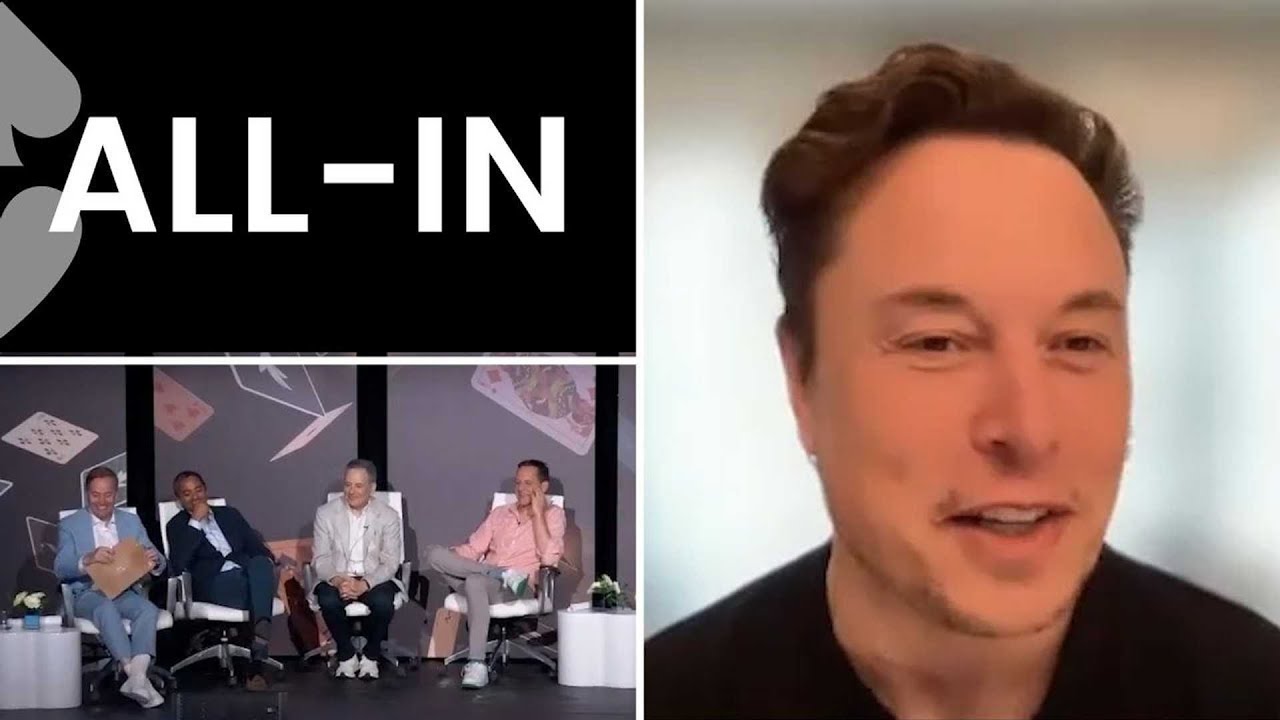
📺 Today’s recommended deep-dive video: https://www.youtube.com/watch?v=xRSnatFVmo4
Termites, Town Squares, and the Multi-Planetary Future: A Deep Dive with Elon Musk
In a wide-ranging conversation at the All-In Summit, Elon Musk explores the structural challenges of the Twitter acquisition and the engineering feats required to scale Tesla’s vertical integration. He pivots from the pragmatics of space exploration to the looming threat of global population collapse and the necessity of maintaining a high-trust digital town square.
Core Question: Can a single entrepreneur fix the digital town square, solve the energy crisis, and make humanity multi-planetary before civilization succumbs to regulatory and demographic decay?
Highlights
- The Twitter bot count is likely 20% or higher, fundamentally altering the company’s valuation and advertising effectiveness.
- Tesla’s success stems from deep vertical integration, treating the factory itself as a “machine that makes machines.”
- Global population decline is a greater threat to civilization than climate change, potentially leading to a “whimper” in adult diapers.
- Economics is an information system; inflation is the inevitable result of the government printing money faster than the output of goods.
⏱️ Reading time: approx. 8 minutes · Saves you about 77 minutes vs. watching.
Want to take notes while watching? Click the image below and let AI Notebook capture the key points for you 👇

The Twitter Entanglement and the Bot Audit
Auditing the Digital Town Square
Musk remains skeptical about the metrics provided by Twitter, comparing the potential bot infestation to a house filled with 90% termites rather than a mere 5%.
The acquisition isn’t just about business metrics for Musk; it represents an attempt to preserve a digital town square where speech is free and transparent. By moving the algorithm to GitHub, he hopes to eliminate shadow-banning and manual interventions that currently skew the public discourse toward a specific political bias.
The fundamental issue with Twitter’s valuation lies in its reliance on brand advertising, which requires real human eyeballs to be effective. If the user base is significantly smaller than the reported 217 million daily active users, the revenue potential drops precipitously. Musk argues that the scientific method must be applied to audit these accounts before any deal can close, as misstatements in public filings are material and would fundamentally change the price of the transaction.

💡 Digging Deeper
Q: Why is the “Most Liked Tweet” metric so important?
A: Musk notes that the most popular tweets only receive about 2% of the total daily active user count in likes, a ratio that is significantly lower than engagement patterns on platforms like YouTube.
Q: What is the “Moderate Wing Takeover”?
A: Musk describes his goal not as a right-wing coup, but as a shift toward a balanced platform where both sides feel equally uncomfortable, ensuring a truly inclusive public square.
Q: Can the bot problem be solved technically?
A: He believes it is not like “splitting the atom”; identifying common patterns in crypto-scams and spam armies is a manageable engineering task if the company prioritizes it.
Tesla: The Machine That Makes Machines
Radical Vertical Integration
Tesla functions more like a group of six interconnected startups than a traditional automotive manufacturer, handling everything from insurance to chip design and battery chemistry.
Most car companies act as assemblers for a legacy supply chain, but Tesla’s need for speed forced it to build its own operating system and high-performance AI hardware. By bypassing the dealer model and building a global supercharger network, they created a closed-loop ecosystem that traditional OEMs cannot easily replicate without abandoning their current business structures.
The true innovation at the new Giga-factories is the use of “Giga-casting,” where 120 separate metal parts are replaced by a single, massive casted piece. This reduces the body shop footprint by 60% and eliminates the complex issues of galvanic corrosion and dissimilar metal joining. Musk credits toy manufacturing for the inspiration, proving that the most efficient way to build a complex machine is to treat it like a single, scalable unit of production.

Economics, Energy, and the Great Filter
The Economic Enema and Inflation
Musk predicts a recession lasting 12 to 18 months, which he describes as an “economic enema” necessary to clear out the misallocation of capital and “money raining on fools.”
Inflation is not a mystery; it is the direct result of the federal government printing more currency than the actual output of goods and services. Money is simply a database for labor allocation, and when that database is flooded with “dropped packets” of value through deficit spending, the entire information system breaks down. To survive, companies must pivot to positive cash flow and ensure they have enough capital reserves to outlast irrational market corrections.
Regarding the “Great Filter” of civilization, Musk views becoming a multi-planetary species as a race against time. If we do not establish a self-sustaining city on Mars, humanity remains vulnerable to extinction events, ranging from World War III to natural catastrophes. Starlink serves as the financial engine for this mission, turning global telecommunications profits into the propellant for Martian colonization.

💡 Digging Deeper
Q: Is fusion energy the answer to our climate problems?
A: While scientifically possible, Musk believes terrestrial fusion is not economically competitive compared to the “giant fusion reactor in the sky”—the sun—which requires zero maintenance.
Q: What is the biggest threat to humanity?
A: Musk identifies the collapsing birth rate as the primary risk, noting that as societies get wealthier and more educated, they stop having children, leading to demographic collapse.
Q: How does the “Money as Information” theory work?
A: He views money through the lens of information theory; it should be high-bandwidth, low-latency, and low-jitter to efficiently move labor and goods through time and space.
Key Takeaways
The overarching theme of Musk’s current worldview is a frantic drive toward efficiency and transparency in both digital and physical systems. Whether he is auditing Twitter’s bot percentage or casting Tesla chassis in a single piece, the goal is to remove the “cruft” that slows down progress. He views the United States as a team that needs to recruit “aces” through better immigration policies to remain competitive against the rising productivity and work ethic of China.
Ultimately, Musk’s ventures are a hedge against the stagnation of civilization. He advocates for a return to meritocracy, hard work, and the scientific method to solve problems ranging from traffic to interplanetary travel. Without a shift away from over-regulation and demographic decline, he fears the future will be a “whimper” rather than an explosion of innovation.
Q&A
Q1: Why did Musk move his operations from California to Texas?
A1: He cites the “jesus taxidermy” of California’s over-regulation and litigation, noting that building the Giga Texas factory in 18 months would have been an “infinite” timeline in California.
Q2: What is the “WeChat” model for Twitter?
A2: Musk envisions a “super-app” that combines payments, social media, and content creator revenue sharing, creating a high-utility interface that doesn’t exist outside of China.
Q3: How does Tesla Insurance differ from traditional providers?
A3: It uses real-time driving scores to lower premiums for safe drivers, closing the feedback loop and encouraging better road behavior rather than relying on outdated demographics.
Q4: What is the status of the SpaceX Mars mission?
A4: The goal is to build a self-sustaining city so that if supply ships from Earth stop coming for any reason—like World War III—the Martian civilization survives.
Q5: Does Musk believe in aliens?
A5: He has seen no evidence of them yet but jokes that if they were found, it would likely help SpaceX’s revenue as people would want to upgrade their space defense technology immediately.
Q6: What is his view on the current U.S. administration?
A6: Musk feels the administration is “captured by unions” and trial lawyers, leading to a lack of drive to get things done compared to previous administrations or private enterprises.
Q7: How should we view China’s economic rise?
A7: He warns that China’s economy will eventually be two to three times the size of the U.S., necessitating that America stops “punching itself in the face” with internal political infighting.