📺 Today’s recommended deep-dive video: https://www.youtube.com/watch?v=j6_VfR-CyuM
Reengineering Truth: The Evolution of X and Grapedia
Elon Musk reflects on three years of owning X, detailing the technical transition from legacy code to a semantic AI architecture. He explains how “maximally truth-seeking” models are disrupting established knowledge bases like Wikipedia and reshaping the landscape of global free speech.
Core Question: How can distributed AI and physics-based energy solutions fix the systemic biases of modern information and power systems?
Highlights
- The transition of the X algorithm from hard-coded heuristics to a Grok-driven semantic search engine.
- Why Grapedia aims to replace Wikipedia with an AI-generated, neutral, and auto-updating knowledge base.
- The necessity of 25% voting control at Tesla to ensure the safe deployment of autonomous robotics.
- A scientific defense of solar energy as the primary path for civilizational scaling over fossil fuels.
⏱️ Reading time: approx. 8 minutes · Saves you about 86 minutes vs. watching.
Want to take notes while watching? Click the image below and let AI Notebook capture the key points for you 👇

Reengineering Truth: The Evolution of X and Grapedia
From Heuristics to Semantic Intelligence
X is fundamentally evolving beyond its legacy codebases to embrace a new semantic architecture powered almost entirely by the Grok AI model. This shift moves away from old-school “interaction gain,” where the system would flood a user’s feed with repetitive content based on a single click, toward a nuanced understanding of what is actually interesting.
Musk explains the transition as a process of deleting legacy Twitter heuristics that often acted as wooden sticks holding up a crumbling machine. By utilizing a cluster of 50,000 H100 GPUs, Grok can now read and categorize 100 million posts per day, providing a 360-degree view of topics rather than a narrow chronological feed. This allows for “semantic search,” where users can query the platform in plain language to find text, images, or video that match the intent of their question.
Grapedia represents the next logical step in this evolution, acting as an AI-driven competitor to Wikipedia’s perceived institutional bias. The platform uses Grok to analyze existing articles, identify axiomatic errors, and supplement them with real-world data and generated explanatory videos.

💡 Digging Deeper
Q: Why is Grapedia better than Wikipedia?
A: It utilizes “maximally truth-seeking” AI to strip away the political axes people grind in human-edited biographies and keeps info updated in real-time.
Q: How does the new algorithm handle “over-correction”?
A: The team reduced the “gain” on specific interactions so that liking one post doesn’t immediately result in a torrent of identical content.
Q: What is the role of the Grok icon on X?
A: It provides a one-tap deep dive, allowing users to verify if a post is the “whole truth” or needs supplemental context.
Uncovering the Rot: A Three-Year Post-Mortem of Twitter
The “Stay Woke” Era and Operational Waste
Reflecting on the 2022 acquisition, Musk describes the “sink” moment as the beginning of a massive cleanup of operational absurdity and corporate inefficiency. The Twitter headquarters were essentially empty shells, staffed by a cafeteria crew producing $400 lunches for the 5% of employees who actually showed up to work.
The acquisition served as a stark case study in corporate rot, highlighting how ideological capture can lead to massive financial and physical waste.
Beyond the financial leakage, the “Twitter Files” exposed an elaborate shadow-banning infrastructure that allowed the FBI and other government agencies to dictate content moderation. Musk notes that the “Trust and Safety” group acted as a modern Ministry of Truth, using secret checkboxes to deboost accounts without notifying the users. By making the code and the internal emails public, the new leadership aimed to break the “galloping trend” of censorship that had expanded to include gender, climate, and general dissent.

💡 Digging Deeper
Q: What was the weirdest discovery in the old headquarters?
A: Fresh boxes of tampons were being restocked weekly in the men’s bathroom of an entirely unoccupied building for years.
Q: How did the government influence speech?
A: The FBI had roughly 80 agents submitting takedown requests and collaborating directly with Twitter’s moderation teams.
Q: Does X follow local censorship laws?
A: Musk states the policy is to follow the law of each country, but he draws the line when judges ask the company to break local laws themselves.
The Battle for AI Safety: Tesla, OpenAI, and Governance
The Necessity of Control
Musk’s concern for the future of Tesla centers on the safe deployment of Optimus robots and the transition to a dedicated autonomous fleet. He argues that without 25% voting control, he cannot ensure a “Terminator-proof” scenario because activist investors or proxy firms like ISS and Glass Lewis could oust him for purely political reasons.
If he cannot maintain enough influence to guide the safety protocols of an army of robots, he simply will not build them at Tesla.
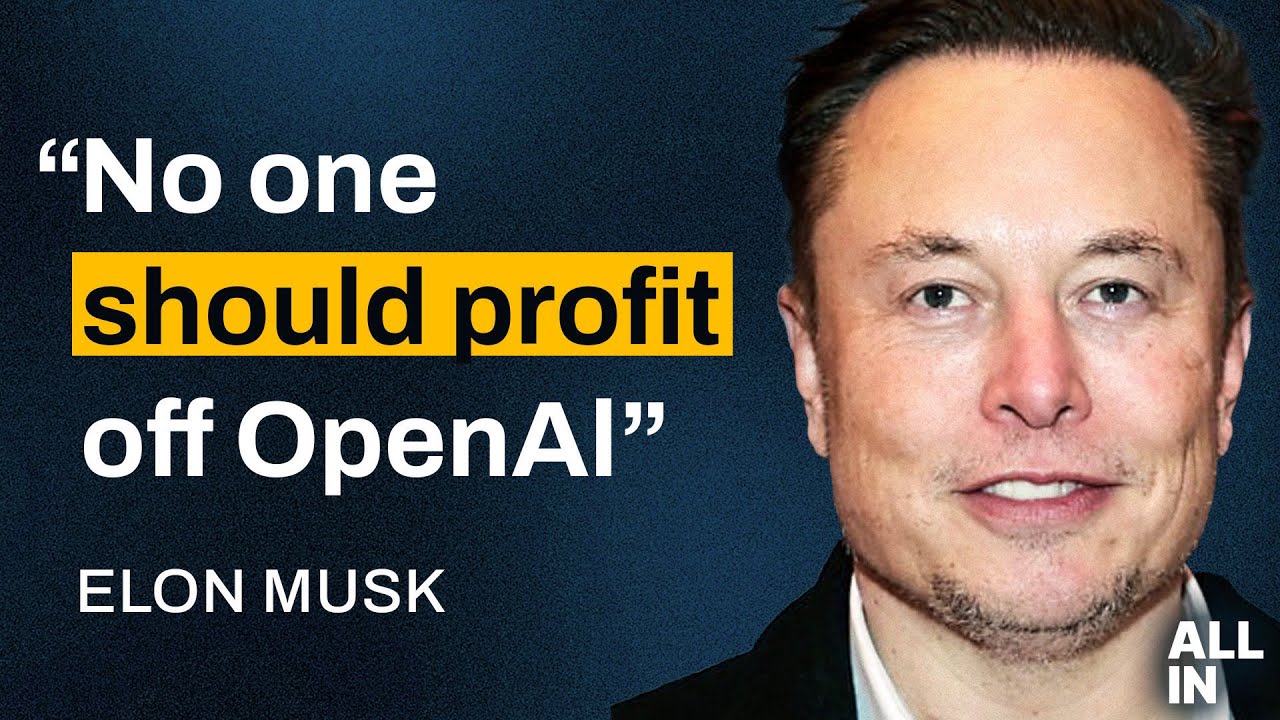
The conversation shifts to OpenAI, which Musk describes as a “Bond villain-level” pivot from an open-source nonprofit to a “maximum profit” closed-source corporation. He highlights the irony that the company he named and funded as a counterweight to Google has become more secretive than its competitors. He remains committed to his lawsuit against them, asserting that the incorporation documents explicitly forbade officers from profiting, a rule he claims has been fundamentally violated.

💡 Digging Deeper
Q: Why 25% voting control?
A: It provides enough influence to ensure safety guardrails while remaining low enough that he could still be fired if he were to “go insane.”
Q: What happened with OpenAI’s open-source models?
A: Musk calls them a “fig leaf,” arguing they are essentially broken, non-working versions released only for public relations.
Q: What is the “supersonic tsunami”?
A: This is Musk’s term for the pace of AI development—a massive wall of change moving faster than human systems can easily process.
The Solar Epoch: Physics, Energy, and Civilizational Scale
The Sun as the Ultimate Reactor
The long-term solution to Earth’s energy needs is not found in complex terrestrial fusion or fossil fuels, but in the massive, free thermonuclear reactor in the sky. Musk points out that the Sun accounts for 99.8% of the mass in the solar system, meaning all other energy sources are statistically insignificant by comparison.
Solar power, paired with lithium-iron-phosphate batteries, is the only mathematically viable path to scaling civilization to a “Kardashev Scale 1” level.
Musk dismisses Bill Gates’ skepticism regarding electric semi-trucks, citing that Pepsi is already operating them successfully and verifying their range. He clarifies that the transition to sustainable energy doesn’t require massive subsidies, but rather the removal of the “stealth subsidies” currently enjoyed by the oil and gas industry. By leveraging the abundance of iron, phosphorus, and silicon, humanity can build a sustainable grid that captures just a fraction of the gigawatt-per-square-kilometer energy the Sun provides.

💡 Digging Deeper
Q: Is nuclear power safe?
A: Yes, Musk views fission as very safe, citing the U.S. Navy’s use in submarines, but notes the regulatory hurdles are massive.
Q: How efficient is the human brain compared to AI?
A: The human brain operates on just 10-20 watts, showing there is massive room for AI to become more power-efficient.
Q: Is there a shortage of battery materials?
A: No; iron and phosphorus are some of the most common elements in Earth’s crust, making LFP batteries highly scalable.
Key Takeaways
The overarching theme of this discussion is the restoration of objective truth through physics-based reasoning and transparent technology. Whether it is cleaning up the “rot” of social media censorship or building autonomous transport, Musk emphasizes that systems must be built on “axiomatic elements” that are likely to be true and non-contradictory.
This philosophy extends to the “Cybercab” and the Tesla fleet, which Musk envisions as a massive, distributed inference engine. By utilizing the downtime of 100 million vehicles, the world could gain access to 100 gigawatts of compute, effectively turning the transportation network into the world’s largest supercomputer.
Ultimately, the goal is to shift toward a sustainable, solar-powered future where human intelligence is augmented by AI. By moving away from tribal “confirmation bias” and toward systems like Community Notes and Grok, Musk believes we can navigate the “supersonic tsunami” of AI while ensuring civilization remains pro-human and safety-focused.
Q&A
Q1: How does the “Mad Max” mode in Tesla’s FSD work?
A: It assumes the driver wants to reach their destination quickly, prioritizing more aggressive lane changes and assertive navigation maneuvers.
Q2: Why does the Cybercab lack a steering wheel or pedals?
A: Musk believes these are “vestigial” in an autonomous world; most people in an Uber never wish they could take over the driving themselves.
Q3: What is the main criticism of proxy firms like ISS and Glass Lewis?
A: Musk calls them “corporate ISIS,” arguing they hold massive power over the stock market without owning any shares, often pushing far-left activist agendas.
Q4: How does China’s solar production compare to the U.S.?
A: China can produce 1.5 terawatts of solar per year, which is enough to power the entire U.S. economy’s electricity needs every 18 months.
Q5: Will AI lead to massive job displacement?
A: Yes, Musk acknowledges this but suggests that as a society, we will need to mitigate the transition if it happens too quickly.
Q6: What was the resolution of the Brazil censorship conflict?
A: X was temporarily banned in Brazil because a judge ordered the company to break Brazilian law and issued a gag order to hide the action.
Q7: Can terrestrial fusion be a viable energy source?
A: It is a “fun science project,” but Musk argues it’s unnecessary given the Sun’s existing power and the simplicity of scaling solar and batteries.