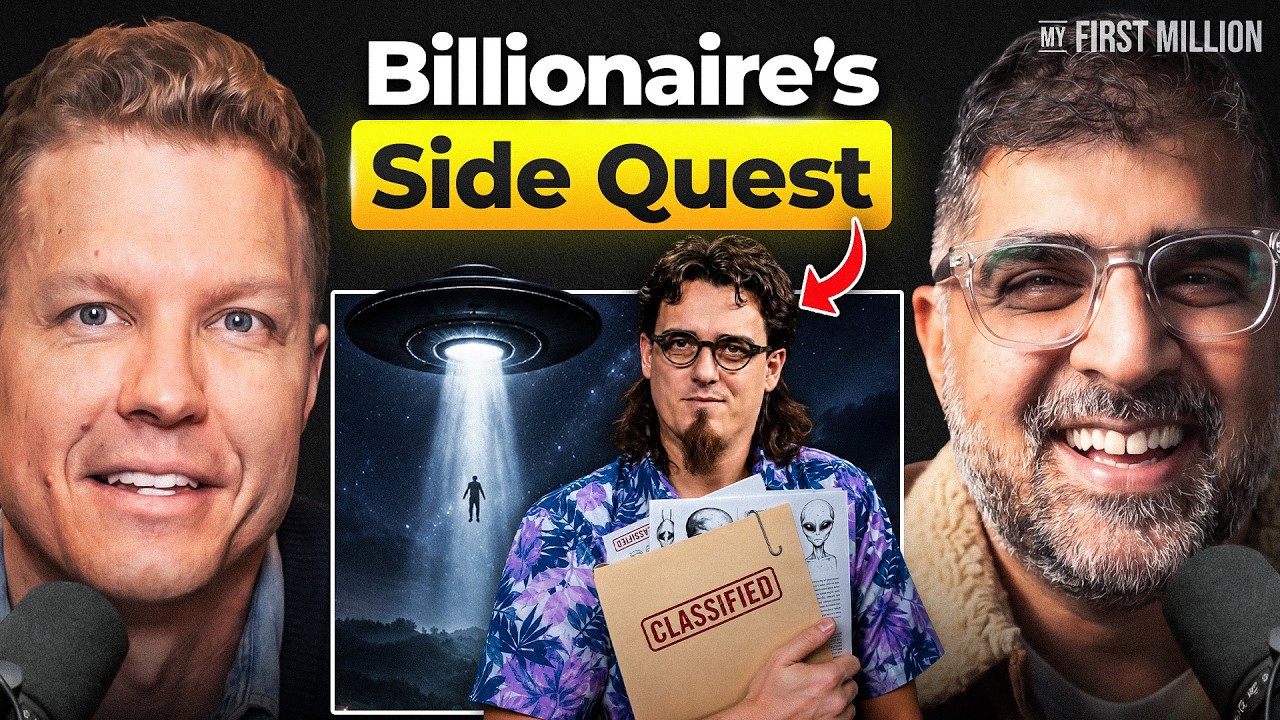
📺 Today’s recommended deep-dive video: https://www.youtube.com/watch?v=Kpd7XKjODbQ
The “FU” Energy Playbook: From Chemical Empires to Hunting Aliens
Most billionaires play it safe, but Sir Jim Ratcliffe and Palmer Luckey prove that “side quests” are the ultimate wealth flex. Whether it’s building a $40B chemical empire to fund a custom SUV or hunting for aliens after selling Oculus, the secret to massive success lies in embracing childhood weirdness and a “because I can” attitude.
Core Question: How does combining high-leverage business models with unapologetic personal obsessions lead to multi-billion dollar outcomes?
Highlights
- The Jim Ratcliffe Strategy: Buying boring chemical spin-offs with 96% debt to build a $40B revenue titan.
- The “Side Quest Hall of Fame”: Why elite founders like Palmer Luckey are pivoting from defense tech to retro Game Boys and alien hunting.
- The 12-Year-Old Rule: Reverting to your pre-jaded childhood interests to find your ultimate professional flow state.
- The New E-commerce Playbook: How brands go from $0 to $500M by crowdsourcing 5,000+ pieces of UGC a month.
⏱️ Reading time: approx. 8 minutes · Saves you about 40 minutes vs. watching.
Want to take notes while watching? Click the image below and let AI Notebook capture the key points for you 👇

The Chemical King of Side Quests
Leverage and the Art of the Spin-off
Sir Jim Ratcliffe wasn’t a tech prodigy; he was a chemical engineer and accountant from a blue-collar Manchester background who didn’t take his big swing until age 40. He partnered up, mortgaged his house, and used just £3 million in equity to buy an £80 million chemical division from BP—a move that would eventually balloon into Ineos, a conglomerate doing $40 billion in annual revenue.
His strategy was simple but ballsy: find the “boring” distractions that giant oil companies no longer wanted, buy them with massive leverage, and double the EBITDA within five years.
He is now one of the richest men in Britain, but his wealth is merely the fuel for his true passion: being a “sports nut” who funds two-hour marathons and owns chunks of Manchester United and Mercedes F1.

The $2 Billion SUV Spite Project
When Jaguar Land Rover refused to sell Ratcliffe the tooling to keep the old, boxy Defender alive, he didn’t just buy a vintage fleet; he started a rival car company called Ineos Automotive. The result was the Grenadier, a rugged, mechanical off-roader designed specifically for enthusiasts who hate modern, “luxurious” SUVs that feel too soft.
It is objectively a terrible business.
Since 2018, Ratcliffe has burned roughly $2 billion on the Grenadier, including a $300 million loss last year alone. When journalists pointed out that the car didn’t meet modern environmental or safety expectations, Ratcliffe’s response was pure “FU” energy: “What’s wrong with that? They’re effing great cars.”
💡 Digging Deeper
Q: Why did Ratcliffe wait until 40 to start?
A: He spent his 30s in Private Equity, learning how to buy companies using other people’s money before he felt confident enough to risk his own home on a BP spin-off.
Q: Is the Grenadier a failure if it loses money?
A: Not to Ratcliffe. It’s a “side quest”—a project funded by a massive cash-flowing engine (Ineos Chemicals) to satisfy a personal obsession, regardless of the P&L.
Q: What is the “Manchester of America”?
A: The speakers compare it to Boston—a hardworking, blue-collar, “white-grit” environment that shapes a specific kind of relentless personality.
The 12-Year-Old Theory
Hunting Aliens and Retro Handhelds
The “Side Quest Hall of Fame” is best exemplified by Palmer Luckey, the creator of Oculus and Anduril. After building a multi-billion dollar defense company, Luckey told Joe Rogan he wanted to start a privately funded version of the “X-Files” to hunt for aliens because he feels the government isn’t telling us everything.
This isn’t just eccentric billionaire behavior; it’s a return to the “golden window” of ages 8 to 18, where obsessions are pure and uninfluenced by social pressure.

Reverting to Your Nature
To find what you should dedicate your life to, you have to look at what you were doing at age 12 before you realized certain things were “stupid” or “uncool.”
For some, it was building remote-controlled mops to avoid chores; for others, it was simulating decades of NBA 2K franchise mode as a general manager rather than actually playing the basketball games. These weird childhood habits are the “faint whispers” of your natural inclination. Success comes when you stop trying to screw a screw into a wall at the wrong angle and align your career with that internal nature.
The New $500M E-commerce Playbook
The Death of In-House Creative
The old way of scaling a brand involved an in-house team laboring over a few high-production ads. The new way, used by brands like Goalie and Comfort, is “seeding” product to thousands of non-famous creators who generate high volumes of User Generated Content (UGC).
Instead of 20 polished videos, these brands get 5,000 raw, “authentic” TikToks a month.
Most of these videos get zero views, but because the volume is so high, the “hive mind” of the crowd eventually discovers exactly what hooks the audience. The brand then pours ad spend behind the winners, creating a feedback loop that can take a company from $0 to $30 million in revenue in mere months.

The Native Deodorant Blueprint
Moiz Ali’s story of Native Deodorant is the ultimate example of “faking it until you make it” legit. He started by finding a top-selling natural deodorant on Etsy, asking the maker to put his label on it, and testing formulas by running around the block and having his brother smell his armpits.
He didn’t need a lab or a degree in chemistry; he needed a marketing hook and the persistence to eventually sell to Proctor & Gamble for $100 million.
Key Takeaways
Confidence isn’t something you’re born with; it’s a byproduct of adventure and adversity. By putting yourself in unfamiliar situations where you survive—even if you don’t win—you harden yourself against the fear of the next challenge. This is why many top performers come from disadvantaged backgrounds or have “disadvantages” like dyslexia; they were forced to develop an insatiable hunger and a coping mechanism that eventually became their greatest professional strength.
Don’t fight your nature. If you are naturally a “General Manager” who likes to scout and invest rather than a “Player” who likes the daily grind, build your life around that. The most successful founders often incubate multiple companies with different CEOs, playing the “franchise mode” of business rather than trying to be the hero on the field for every single project.
Finally, the most important signals in your life are rarely loud. They are faint nudges and whispers toward certain topics or activities. If you find yourself going down a rabbit hole at 2:00 AM, pay attention. That obsession is the fuel for a “side quest” that might just turn into your primary empire.
Q&A
Q1: What is “Social Commerce”?
A1: It’s a model where everyday creators sell products via short-form video (like TikTok Shop) for a commission. Unlike traditional influencers, they don’t need a following; they just need one video to hit the “For You” page.
Q2: How did Jim Ratcliffe afford his first deal?
A2: He used $3 million of his own money (mortgaging his home) and borrowed the other $77 million to buy a BP spin-off, a high-risk move that paid off when the company’s value skyrocketed.
Q3: What was the “Goalie” incentive structure?
A3: They treated their affiliates like a “Chuck-E-Cheese” prize wall. Small sales got you a commission; massive sales got you a trip to Miami, a Lamborghini, or even a condo.
Q4: Can these B2C tactics work for B2B?
A4: Yes. B2B businesses often ignore proven B2C marketing tactics. Borrowing playbooks like UGC and high-volume social seeding is a massive arbitrage opportunity for boring business-to-business companies.
Q5: What is the “Golden Window”?
A5: It’s the period between ages 8 and 18 when the human brain is most capable of specializing. Obsessions formed during this time often dictate an adult’s “unfair advantage.”
Q6: What happened to the supplement brand that did $0 to $30M?
A6: It imploded after being banned by Amazon for manipulating reviews of competitors. It serves as a warning that while “hacky” tactics work for growth, they can’t replace long-term brand stability.
Q7: Why does Palmer Luckey wear Hawaiian shirts?
A7: It started because he was poor and only had his dad’s old shirts. After getting rich, he tried to dress “fancy” but realized he preferred the shirts that made him feel like himself, embracing the “FU” energy of not needing to validate his success through clothes.