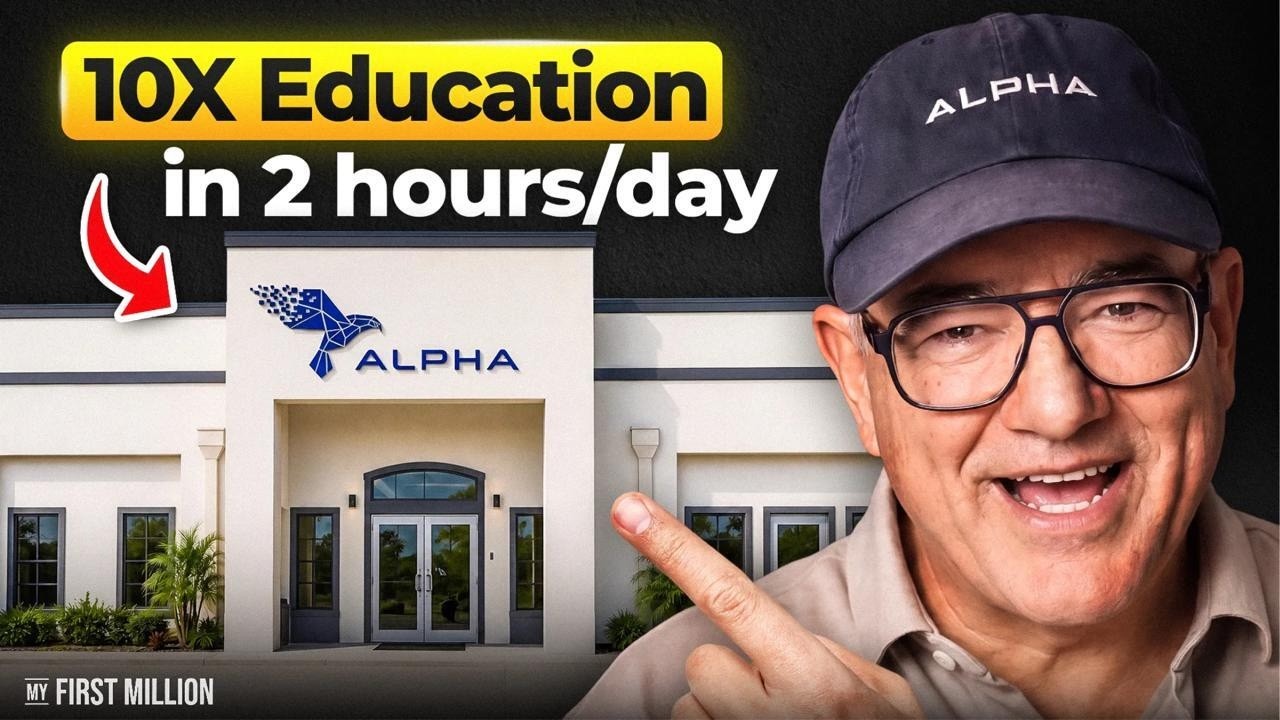
📺 Today’s recommended deep-dive video: https://www.youtube.com/watch?v=GaXsABG1_GM
Beating Bill Gates and the $1 Billion Bet on Kindergarten: The High-Stakes World of Joe Liemandt
After building a billion-dollar software empire in his twenties and out-recruiting Microsoft for the world’s best talent, Joe Liemandt disappeared for two decades. Now, he’s returned with a billion dollars of his own money to prove that five-year-olds can learn ten times faster than the current system allows.
Core Question: Can the high-intensity, high-standard culture of elite tech recruiting be applied to transform global education for a billion children?
Highlights
- The Talent War: How a tiny startup beat Bill Gates by offering recruits the “hardest 100 days of their lives” instead of soft perks.
- High Standards, High Support: Why mediocrity in schools stems from low expectations and how “100-point” standards build genuine grit.
- The 2-Hour School Day: The technology that allows students to learn twice as much in two hours as they previously did in six.
- Depth of Knowledge (DOK): Why the future of human potential lies in moving past facts (DOK 1) to creating new knowledge (DOK 4) with AI assistance.
⏱️ Reading time: approx. 10 minutes · Saves you about 52 minutes vs. watching.
Want to take notes while watching? Click the image below and let AI Notebook capture the key points for you 👇

The Trilogy Era: Engineering Intensity
Out-Recruiting the Giants
Fortune 500 companies do not usually buy multi-million dollar software from a college dropout, yet that is exactly what happened in the 1990s. Joe Liemandt founded Trilogy after dropping out of Stanford, focusing on the “configurator”—a software solution for products so complex that human sales reps couldn’t build accurate orders for mainframe computers or Boeing airplanes. By solving this technical impossibility, Liemandt turned a niche AI problem into a billion-dollar revenue stream before his 30th birthday.
Intensity was the company’s oxygen. Liemandt recounts how he out-recruited Microsoft by promising Ivy League graduates the hardest 100 days of their lives rather than the perks of Silicon Valley. This culminated in a legendary dinner with Bill Gates, who was so perplexed by Trilogy’s talent-acquisition success that he personally attempted to reverse-engineer their offers. Liemandt simply doubled down, taking recruits on ski trips and reminding them that at Trilogy, they were the mission, not just another cog in the machine.
Ambition is a magnet for the ultra-talented.

💡 Digging Deeper
Q: Why did Liemandt force recruits to bet a month’s salary on a roulette wheel?
A: It was a filter for risk-tolerance. He argued that if an employee wouldn’t risk their own money, they had no business asking venture capitalists to risk millions on their ideas.
Q: What was the “extra gear” mentioned in the transcript?
A: It is the relentless pursuit of a goal where no amount of work is too much. Liemandt cites Elon Musk as the modern gold standard for this level of focus.
The Philosophy of “100-Point” Excellence
Support vs. Standards
Most parents and managers fall into a trap: they choose between being high-support/low-standards (protecting kids from stress) or high-standards/low-support (throwing them into the deep end). Liemandt argues that both are failures. Genuine growth only happens when you combine elite expectations with the scaffolding necessary to reach them, a “mentor mindset” that pushes for a perfect 100% score while providing the AI tools to get there.
Your life is what you tolerate.
If you allow a student to settle for an 80%, you are teaching them that 20% of the world is a mystery they aren’t capable of solving. At Alpha, students are incentivized to master subjects completely, starting with tests from lower grade levels to build a “mastery mindset.” Once a child realizes they can get a 100 on a third-grade test, their psychological barrier to acing a seventh-grade test vanishes.

💡 Digging Deeper
Q: What is the significance of the “100-point wine”?
A: It serves as a physical reminder of what perfection looks like in a craft. It sets a benchmark that “excellent” isn’t subjective; it’s a specific, reachable standard.
Q: How does Alpha handle the “impossible” task of a 5K run for second graders?
A: They use scaffolding. They start by walking a quarter, then half, then jogging, proving to the child—and the parent—that their perceived boundaries are actually illusions.
Alpha: The 2-Hour Academic Revolution
Giving Time Back to Kids
The current education system is a massive time-sink that hasn’t changed in a century, largely because it functions as a bundle of daycare and slow-paced instruction. Alpha School unbundles this, using generative AI to create a “learning engine” that compresses six hours of traditional classroom time into two hours of hyper-focused mastery. This isn’t just about speed; it’s about “Time Back”—giving children four extra hours a day to pursue life skills like leadership, entrepreneurship, and public speaking.
Students should love school more than they love vacation.
Liemandt admits this sounds like a marketing slogan until you look at the data: 46% of Alpha students recently reported they would rather be at school than on break. This engagement comes from the camaraderie of doing hard things together. Whether it’s eighth graders completing a Tough Mudder or a high schooler being published in Nature as a lead researcher, the school operates on the belief that human potential is the world’s most untapped resource.

💡 Digging Deeper
Q: Is Alpha just for geniuses?
A: No. The system is designed to take students from the bottom 25th percentile to the top 1% by using AI tutors that identify and fix specific knowledge gaps.
Q: How does Liemandt plan to scale a physical school to a billion kids?
A: He is building a “Tesla Roadster” model: starting with high-end private schools to fund the R&D, then expanding into specialized sports and academic academies, and eventually licensing the “Time Back” software to public and religious schools globally.
The Human-AI Knowledge Graph
Mastering the “Brainlift”
As AI becomes more capable, the role of the human shifts from a repository of facts to a generator of novel insights. Liemandt uses a framework called “Depth of Knowledge” (DOK) to explain this transition. DOK 1 is knowing facts; DOK 2 is summarizing them; DOK 3 is finding insights; and DOK 4 is creating new knowledge that doesn’t exist yet. AI can handle the first three levels, but humans are still the masters of level four.
To stay relevant, you must build a “Brainlift”—a curated context of DOK 1-3 information that you feed into an AI to help you reach DOK 4. Liemandt himself spends an hour a day summarizing expert content and scientific papers to refine his own internal knowledge graph. By teaching high schoolers to use AI as a collaborator rather than a shortcut, Alpha is preparing them for a world where “expertise” means the ability to synthesize vast amounts of data into original action.
AI shouldn’t make us dumber; it should raise the floor so we can reach a higher ceiling.

Key Takeaways
The overarching theme of Liemandt’s career is the rejection of “good enough.” From the early days of Trilogy to the current expansion of Alpha, the focus has remained on identifying technical impossibilities and applying relentless intensity to solve them. By treating education as a high-growth technology problem rather than a stagnant philanthropic one, he is attempting to build the “SpaceX of Education.”
The success of this model hinges on the “Time Back” philosophy. By proving that academics can be mastered in a fraction of the time, Alpha opens the door for a holistic childhood that includes physical grit, emotional intelligence, and professional-level skills before the age of 18. This is not just a school; it is a laboratory for human potential.
Ultimately, Liemandt believes the biggest obstacle to this revolution isn’t the technology or the kids—it’s the parents. Overcoming the “fish in water” syndrome, where we assume our own mediocre school experiences are the only way to learn, is the primary mission of his current public outreach.
Q&A
Q1: Why did Joe Liemandt stay silent for 20 years?
A: He wanted to focus on building his family and his business without the distraction of the limelight, which he felt didn’t add value to his companies during that specific period.
Q2: What is the “configurator” software that made him his first billion?
A: It was an expert system (an early form of AI) that allowed sales reps to accurately configure incredibly complex products, like airplanes or room-sized phone switches, which were previously prone to unbuildable errors.
Q3: How does Alpha School measure “Love of School”?
A: They ask a very high-bar question: “Would you rather be at school or on vacation?” Currently, nearly half of their students choose school.
Q4: What is the “Founder School” being developed for high schoolers?
A: It is a specialized physical school model focused on teaching entrepreneurship and business building as a primary life skill, alongside elite academics.
Q5: What is the main problem with non-profit charter schools?
A: Liemandt argues they aren’t scalable. The better the product, the more they rely on donations, whereas a profitable model allows capitalism to fund the massive capital requirements for new campuses.
Q6: Can AI really make kids 10 times smarter?
A: Liemandt clarifies that while AI can’t necessarily change a child’s base IQ, it can load their “knowledge graph” 10x faster, allowing them to reach the boundaries of their human potential much earlier.
Q7: What two books are mandatory for Alpha parents or staff?
A: 10 to 25: The Science of Motivating Young People by Dr. David Yeager and The Self-Driven Child.