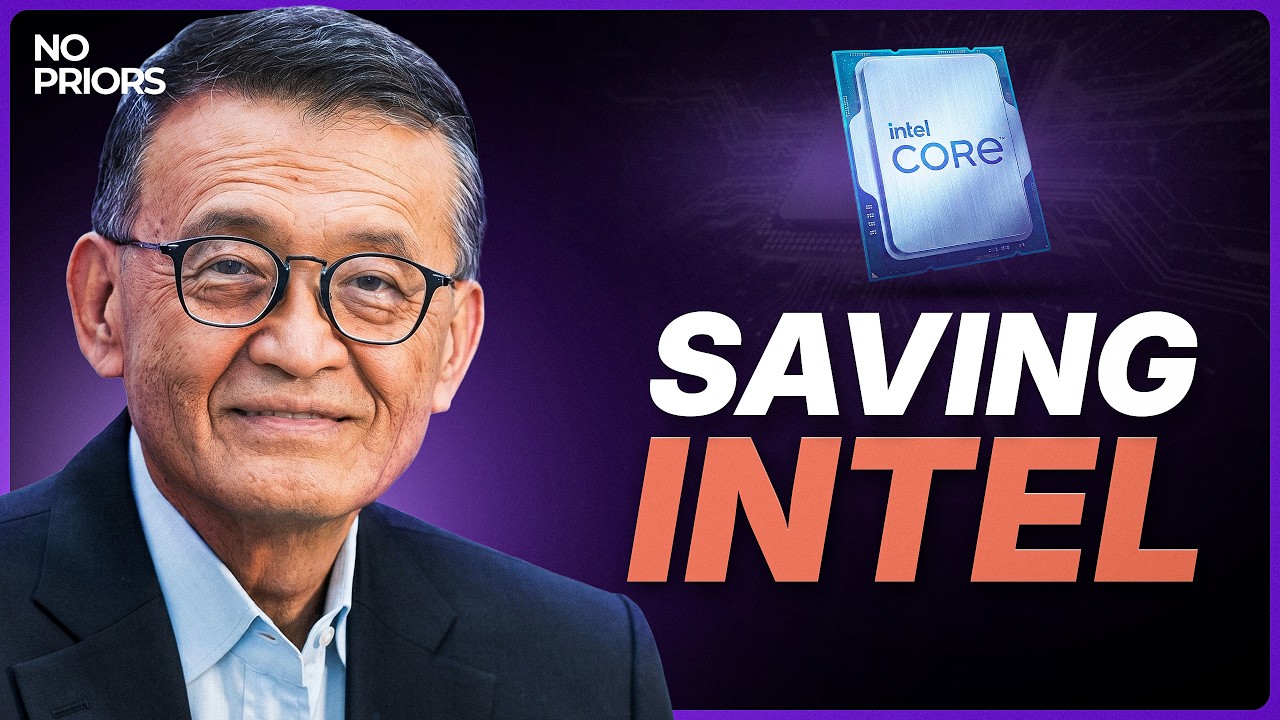
📺 Today’s recommended deep-dive video: https://www.youtube.com/watch?v=asCgCv2XB4s
The Silicon Architect: Lip-Bu Tan’s Vision for the Intel Resurrection
Intel stands at a historical crossroads, caught between its legacy as the king of CPUs and the frantic, GPU-driven demands of the AI revolution. In this deep dive, legendary investor and Intel veteran Lip-Bu Tan outlines his “crawl, walk, run” strategy to return the iconic company to its former glory through cultural accountability and a radical “full stack” foundry model.
Core Question: Can Intel successfully pivot from a legacy chipmaker to a global AI infrastructure powerhouse while competing with titans like TSMC and Nvidia?
Highlights
- The “Crawl, Walk, Run” Framework: A three-stage approach to cultural transformation and balance sheet strengthening.
- The Resurgence of the CPU: Why reinforcement learning and agentic AI are driving renewed demand for Intel’s core compute products.
- The Materials Revolution: Moving beyond traditional silicon to explore glass substrates, artificial diamonds, and gallium nitride.
- The Terafab Concept: Collaborating with Elon Musk to rethink semiconductor manufacturing speed and conventional cleanroom logic.
⏱️ Reading time: approx. 8 minutes · Saves you about 37 minutes vs. watching.
Want to take notes while watching? Click the image below and let AI Notebook capture the key points for you 👇

The Cultural Pivot: From Bureaucracy to Startup Speed
Rebuilding the Intel Engine
Lip-Bu Tan’s return to Intel wasn’t a career move born of necessity, but a mission to save an American icon critical to the global semiconductor ecosystem. After 15 years at Cadence and a storied career in venture capital, Tan recognized that Intel’s greatest hurdle wasn’t just technical, but cultural; the company had become mired in “layer upon layer” of bureaucracy that stifled the speed of light required in the modern market.
By eliminating search firms and handling high-level recruitment personally, Tan is injecting a “startup culture” back into the giant, demanding faster decision-making and direct engineering accountability.
The strategy is simple: strengthen the balance sheet, listen to the customer, and simplify the product line to focus on next-generation leadership. This isn’t just about cutting costs, but about reclaiming the technical edge that once made Intel synonymous with the “Intel Inside” era of computing.

💡 Digging Deeper
Q: Why did Lip-Bu Tan take this job at 66?
A: He views Intel as an iconic company that is too important for the US and the global semiconductor ecosystem to fail.
Q: What was the most surprising moment in his first year?
A: Navigating an early conflict-of-interest challenge from the Trump administration, which required him to prove his singular focus on saving the company.
The Foundry Future: Trust, Yield, and Advanced Packaging
Competing in a Resilient Supply Chain
The decision to double down on the foundry business—manufacturing chips for other companies—is Intel’s most expensive and controversial bet. Tan argues that the world can no longer depend on one or two geographical players for the entire supply chain, making a US-based, advanced foundry not just a business opportunity, but a strategic necessity for global resilience.
Intel’s roadmap is aggressive, moving from 18A to 14A (1.4 nanometer) and eventually toward sub-1-nanometer processes.
However, manufacturing is no longer just about the silicon itself; it is a “trust business” where yield, defect density, and cycle time determine whether a customer survives or misses their revenue targets. To win, Intel is pivoting toward a “full stack” foundry model that provides the silicon, the software, and the advanced packaging (like EMIB-T) required to house the massive compute clusters of the AI era.
💡 Digging Deeper
Q: How does Intel view its relationship with TSMC?
A: As a respectful partnership where both players are needed to provide the massive capacity the global market currently demands.
Q: What is the significance of the “Full Stack” foundry?
A: Customers are no longer just asking for chips; they are asking for entire racks and systems, requiring Intel to integrate software and packaging.
The AI Horizon: Beyond Training to Agents and Materials
The Rise of Physical and Agentic AI
While the current market is obsessed with training large language models on GPUs, Tan sees a massive second wave coming: Physical AI and Agentic AI. As millions of autonomous agents begin to orchestrate complex tasks, the CPU is regaining its status as a critical component for reinforcement learning and system orchestration, leading to a shift in the traditional 1:8 CPU-to-GPU ratio in data centers.
To stay ahead of the “Moore’s Law wall,” Intel is looking back at the periodic table.
Traditional materials are reaching their physical limits, prompting Tan to invest in glass substrates for better heat insulation, as well as gallium nitride and even artificial diamonds. These materials are essential for managing the thermal and power bottlenecks that currently constrain AI growth. This focus on “bottleneck-driven investment” ensures that Intel isn’t just building for today’s workloads, but for the 10-year horizon of robotics and autonomous systems.

💡 Digging Deeper
Q: What is “Terafab”?
A: A collaboration with Elon Musk to rethink fab construction, questioning traditional cleanroom logic to drive faster production and higher efficiency.
Q: Why is glass becoming important in chip packaging?
A: Glass acts as a superior heat insulator and substrate material as traditional organic materials run out of steam at smaller nanometer scales.
Key Takeaways
Intel’s transformation is a marathon, not a sprint, predicated on shifting from a “legacy spreadsheet company” to an AI-native organization. By leveraging the expertise of veterans who have seen the industry cycle multiple times, the company is betting that the massive demand for AI infrastructure will create enough room for a second major foundry player. The “crawl, walk, run” methodology ensures that cultural accountability and balance sheet health precede any attempt at market dominance.
The future of semiconductors lies in solving fundamental physical bottlenecks: power, thermal management, and interconnect speed. Intel’s pivot toward advanced packaging, new material sciences like glass and diamond, and a “full stack” system approach positions it to capture the upcoming waves of Agentic and Physical AI. If the company can execute its 14A and 18A roadmaps with high yields, it may well achieve the “10x venture return” that Lip-Bu Tan envisions.
Q&A
Q1: How did Jensen Huang and Nvidia support Intel’s transformation?
A: Jensen Huang, a long-time friend of Tan, invested $5 billion in supporting Intel’s efforts, an investment that has reportedly grown to $25 billion in value as the companies collaborate on the ecosystem.
Q2: What role does the US government play in Intel’s new strategy?
A: Tan views the US government as a critical shareholder and infrastructure provider, similar to how the Taiwanese government supported the early days of TSMC.
Q3: Is the CPU still relevant in the age of the GPU?
A: Yes. For reinforcement learning and orchestrating AI agents, the CPU is often more efficient. Tan notes that demand for Intel’s CPUs remains very high as AI models evolve.
Q4: What is Lip-Bu Tan’s philosophy on choosing investment targets?
A: He looks for the “bottleneck”—where is the customer crying for a solution? He focuses on power management, interconnects (like optical/photonic), and thermal issues.
Q5: Why is Israel such a large part of Tan’s investment portfolio?
A: He prizes the “resilient entrepreneurship” of Israeli founders, who continue to innovate and hold conference calls even under wartime conditions.
Q6: What is the most significant bottleneck for AI growth today?
A: Beyond power and memory shortages, Tan highlights helium availability and thermal management as underrated but critical constraints.
Q7: How is Intel changing its talent pool for the AI era?
A: The company is moving away from its “legacy spreadsheet” roots to recruit talent in the 30s-50s age range who understand full-stack software, AI agents, and frontier models.