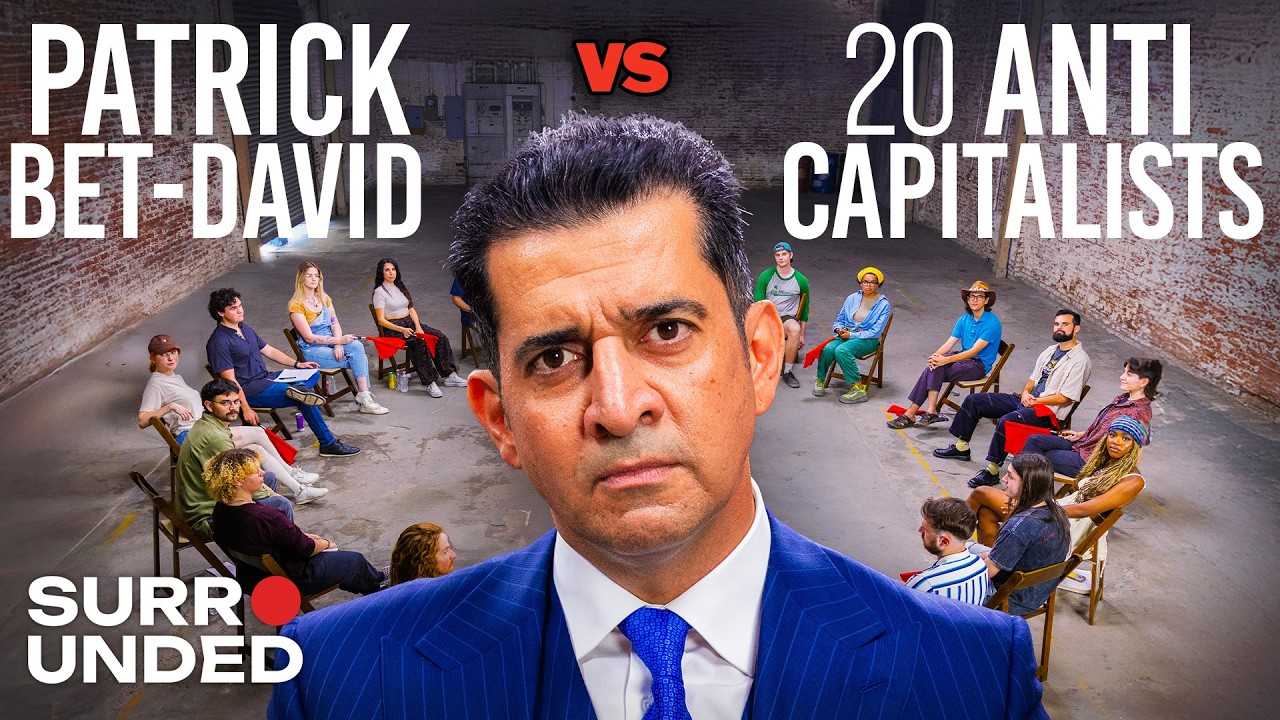
📺 Today’s recommended deep-dive video: https://www.youtube.com/watch?v=cwSXDr7XkNc
The Profit Motive vs. The Common Good: Patrick Bet-David Faces 20 Anti-Capitalists
Entrepreneur and podcast host Patrick Bet-David sits down with a room of twenty vocal anti-capitalists to debate the morality and efficiency of the American economic system. From the nature of human incentive to the definition of a “living wage,” the discussion highlights the growing philosophical divide between individualists and collectivists in modern America.
Core Question: Does capitalism provide the most effective path to prosperity, or is it a coercive system that necessitates the exploitation of the many for the benefit of the few?
Highlights
- The debate over whether incentives must be monetary or if “intrinsic passion” can drive innovation.
- A heated exchange regarding whether single motherhood and poverty are individual failures or systemic outcomes.
- Critical analysis of the U.S. healthcare system and the “perverse incentives” of medical debt.
- A real-time job offer that tests the boundaries of “selective employment” and the “victim” mentality.
⏱️ Reading time: approx. 12 minutes · Saves you about 92 minutes vs. watching.
Want to take notes while watching? Click the image below and let AI Notebook capture the key points for you 👇

The Engine of Human Effort
Scarcity vs. Intrinsic Motivation
Patrick Bet-David opens the floor with a core claim: incentive is the engine of capitalism, and without it, the system fails. He argues that levels of motivation are tiered, beginning with survival and progressing through status, freedom, and finally, legacy. For an entrepreneur who rose from a 99-cent store upbringing to multi-millionaire status, the fear of scarcity is not a bug in the system but the very feature that drives market value.
His opponents, however, reject the idea that people must be “scared” into working. They propose that humans possess an inherent desire to contribute to their communities, citing the persistence of passion-driven work even in the absence of high pay.
Intrinsic motivation—the desire to hone a skill or help others—is seen by the anti-capitalist side as a more sustainable and ethical driver than the “monetary gain” prioritized by the capitalist framework.

💡 Digging Deeper
Q: Is scarcity a necessary motivator for progress?
A: Bet-David argues it is essential for survival-level effort, while critics claim it creates “insecure positions” that prevent true meritocracy.
Q: How do the speakers view North vs. South Korea?
A: Patrick uses the GDP gap ($23B vs. $1.7T) as proof of capitalist success; opponents argue South Korea’s wealth is controlled by a few corporate dynasties.
Q: What is the “Communist” view of incentive?
A: Participants suggest that in a stateless society, incentive evolves into “the common good,” similar to why one performs household chores.
Meritocracy and the “Starting Line”
The Myth of Equal Opportunity
The discussion shifts to whether America truly functions as a meritocracy. The anti-capitalist participants argue that the “race” is rigged because some start inches from the finish line while others start miles back. They point to the “dynasties of wealth” that capitalism creates, suggesting that success is more a product of inherited influence than raw talent or hard work.
Patrick responds by emphasizing that while not everyone starts with the same resources, the system remains the most effective at allowing individuals to increase their own market value.
He posits that individuals often choose “short-term thinking,” like consuming entertainment, rather than investing time into self-improvement and market-relevant skills.
One of the most intense moments occurs when a participant named James, who claims to have applied to 477 jobs without a callback, is offered an interview on the spot. Patrick uses James’s hesitation to inquire about the company as evidence of being “too selective,” while James argues that a worker should have the right to know if a wage is “livable” before committing.

💡 Digging Deeper
Q: Why do some workers struggle to find jobs despite high effort?
A: Critics point to a lack of degrees and geographic limitations; Patrick suggests it often stems from a lack of “marketable skills” or being too selective.
Q: What was the significance of the “job offer” to James?
A: It served as a real-world test of the “victim” narrative, highlighting the tension between a desperate need for work and the desire for “noble” employment.
Q: Is the 1% paying their fair share?
A: Patrick notes the top 1% pays 42% of all federal income taxes, whereas opponents argue the bottom 50% can’t pay because they have “negative wealth.”
The Role of Government and Safety Nets
Defining Modern American Socialism
A major point of contention arises when Patrick claims that the United States is “more socialist than capitalist” today. He bases this on the fact that approximately 68% of federal tax revenue is directed toward “entitlement programs” like Social Security and Medicare. To a staunch capitalist, this redistribution of wealth represents a significant departure from free-market principles and a move toward state control.
The participants find this definition “ridiculous,” arguing that socialism requires worker ownership of the means of production, not just government spending.
They highlight that billions in subsidies flow to billionaires like Elon Musk, which they label “corporate socialism.”
The debate over the “livable wage” highlights this divide. Using the MIT living wage calculator, participants argue for a $27.81 starting wage in California to combat the rising cost of rent. Patrick warns that government-mandated wage hikes often backfire by crushing small family businesses that cannot compete with the deep pockets of giants like Amazon or Walmart.

💡 Digging Deeper
Q: Is the U.S. currently socialist?
A: By tax distribution (68% to entitlements), Patrick says yes; by “worker ownership,” the participants say no.
Q: What is the argument against the “wealth tax”?
A: Patrick argues it stifles those who “create jobs,” while opponents believe no one should be allowed to be a billionaire while others starve.
Q: How does the “AOC vs. Amazon” example work?
A: Patrick notes that AOC’s opposition cost New York 25,000 high-paying jobs; critics argue those jobs were exploitative and didn’t serve the community.
Perverse Incentives and Systemic Failures
The Crisis in Healthcare and Regulation
The anti-capitalist side brings the focus to healthcare, arguing that the profit motive is “perverse” when applied to life-saving services. They cite that 66.5% of U.S. bankruptcies are due to medical debt, a statistic largely absent in other developed nations with nationalized systems. Because demand for life-saving care is “inelastic”—meaning a person will pay any price to not die—the market cannot regulate itself fairly.
Patrick counters by pointing to American innovation, suggesting that the profit motive is exactly what funded the development of life-saving drugs like blood thinners.
He argues that many people come to the U.S. specifically for its superior medical expertise and that “overregulation” by the government is the true cause of high costs.
The conversation ends on a reflective note regarding Social Security. Patrick points out the math: when the program started, life expectancy was lower than the retirement age. Today, with a massive aging population, the system is mathematically unsustainable, leaving younger generations to foot a bill for benefits they may never see themselves.

💡 Digging Deeper
Q: Why is medical debt so high in the U.S.?
A: Critics blame the profit motive in a market where consumers can’t “shop around”; Patrick blames government spending and regulation.
Q: What is the “Congo” history lesson mentioned?
A: A participant used King Leopold II’s exploitation of the Congo to show that “unregulated capitalism” leads to atrocities and human rights abuses.
Q: Does regulation stifle innovation?
A: Patrick uses the drone industry as an example, where FAA laws have supposedly pushed innovators out of the U.S. and into the hands of Chinese competitors.
Key Takeaways
The debate highlights a fundamental disagreement on the nature of “freedom.” For the capitalist, freedom is the absence of government interference and the right to build as “big a life” as one’s merit allows. For the anti-capitalist, true freedom cannot exist without a guaranteed “floor” of basic needs—food, shelter, and healthcare—because the alternative to work in a capitalist system is “starvation,” which they define as coercion.
A striking theme throughout the discussion is the role of data versus ideology. Patrick relies heavily on tax statistics, GDP comparisons, and migration patterns (the “long line” of people wanting to enter the U.S.) to prove his system’s superiority. Conversely, the participants lean on psychological theories of motivation and historical accounts of capitalist exploitation to argue that the current system is morally bankrupt and due for an overhaul.
Ultimately, the session serves as a microcosm of the American political landscape: two sides speaking the same language but using different definitions for “merit,” “socialism,” and “incentive.” While the dialogue was respectful, the lack of consensus on even the most basic facts suggests that the gap between these two worldviews is widening rather than closing.
Q&A
Q1: Why does Patrick think capitalism is the best system?
A: He believes it provides the strongest incentive for individuals to innovate and solve problems, resulting in the most prosperity for the most people.
Q2: What is “intrinsic motivation” according to the anti-capitalists?
A: It is the idea that people will work hard based on passion, creativity, and a desire to help their community, even without a high monetary reward.
Q3: How much of the U.S. budget goes to “entitlements”?
A: Patrick cites that 68% of the revenue collected by the government is spent on entitlement programs, which he defines as a form of socialism.
Q4: What is a “monopsony”?
A: It is a market situation with only one buyer (like a single large employer in a town), which gives that employer the power to dictate low wages to the workers.
Q5: Why did the discussion on single mothers become so heated?
A: Patrick suggested that welfare incentives and the feminist movement “brainwashed” women into thinking they don’t need men, while critics saw this as blaming victims of poverty.
Q6: What is a “wealth tax” proposal from the group?
A: Some participants proposed that wealth should be capped at $999 million, with every dollar over that being taxed 100% to fund social programs.
Q7: Is the U.S. a meritocracy?
A: Patrick says yes, because individuals can choose to increase their value; opponents say no, because wealth disparity creates an unequal starting line.