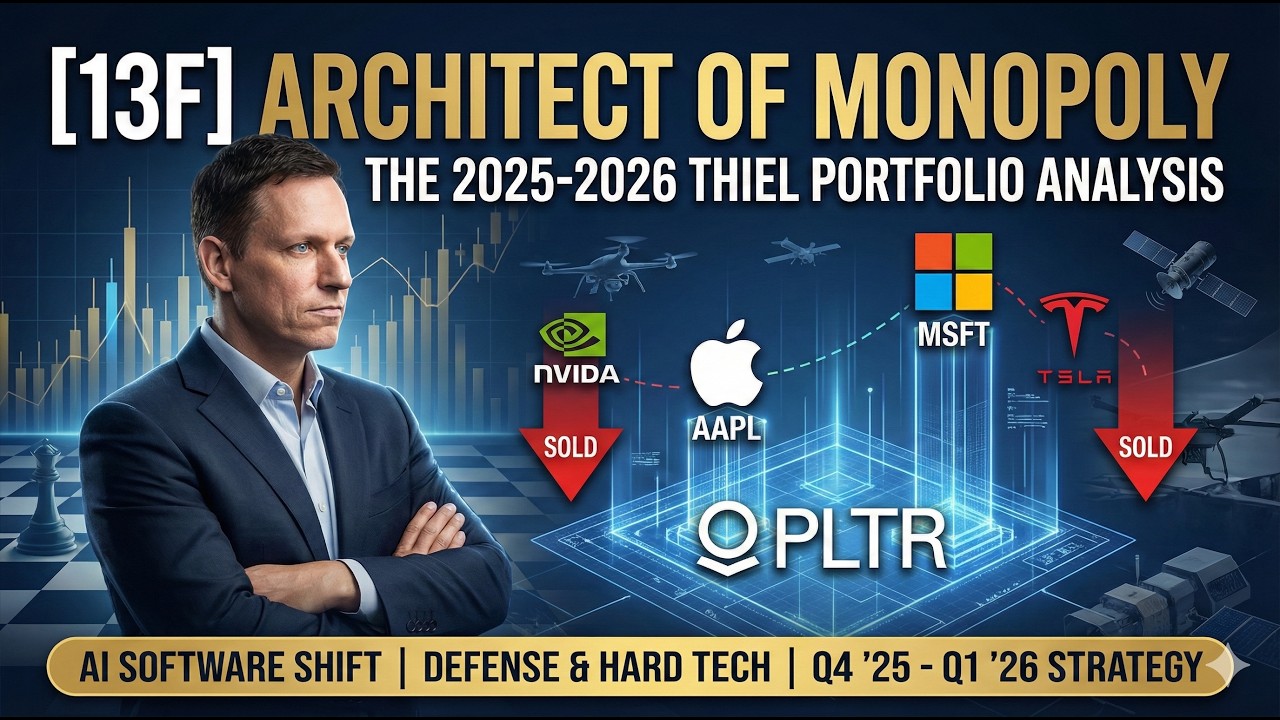
📺 Today’s recommended deep-dive video: https://www.youtube.com/watch?v=U-78mutpFr4
The 2026 Portfolio Reset: Peter Thiel’s Zero-Sum Bet on the Future
On February 17, 2026, the financial world was jolted by a 13F filing that revealed Peter Thiel’s Macro Fund had liquidated every single one of its public equity holdings. This wasn’t a standard sector rotation, but a “burn the boats” moment that saw the complete abandonment of legacy winners like Apple and Microsoft in favor of radical cash optionality.
Core Question: Is Thiel’s total exit from big tech a warning of a systemic market peak or a tactical relocation of capital into the next decade’s “Zero to One” monopolies?
Highlights
- Thiel Macro LLC reported zero holdings as of December 31, 2025, exiting Nvidia, Apple, Microsoft, and Tesla.
- Mithril II has concentrated nearly 50% of its capital into a single fintech disruptor, Figure Technology Solutions (FIGR).
- Palantir has achieved an “elite” Rule of 40 score of 127%, signaling a breakdown of traditional software growth constraints.
- The portfolio shift emphasizes “Hard Tech”—blockchain infrastructure, rapid satellite intelligence, and automated biotech platforms.
⏱️ Reading time: approx. 7 minutes · Saves you about 27 minutes vs. watching.
Want to take notes while watching? Click the image below and let AI Notebook capture the key points for you 👇

The Great Liquidation
From “Safety” to Zero
The exodus began quietly in Q3 2025 when Thiel Macro dumped its entire stake in Nvidia, signaling an early exit from the hardware side of the AI boom. While analysts initially interpreted this as a defensive flight to the “quality” of Apple and Microsoft, the Q4 filings revealed a far more aggressive truth: the fund wiped the slate clean.
Thiel fundamentally rejects Modern Portfolio Theory, famously viewing diversification as a mere “hedge against ignorance” for those who lack conviction.
By selling 49,000 shares of Microsoft and 79,000 shares of Apple, Thiel is making a loud, neon-lit statement that the risk-reward ratio for legacy tech is now broken. He is no longer interested in playing the index game or waiting for the music to stop in a potential valuation bubble; he has simply left the room and taken his chips with him. This tactical retreat suggests that cash is now a more valuable asset than the companies that defined the last decade of American growth.

💡 Digging Deeper
Q: Why would a fund sell Apple and Microsoft if they are still profitable?
A: Thiel believes their upside is capped and the “law of large numbers” makes generational returns impossible from here.
Q: Is this a sign of a market crash?
A: It’s a signal that Thiel finds the “Buffett Indicator” (market cap to GDP) alarming and prefers the optionality of cash.
Q: Could there be other reasons for the sale?
A: The transcript notes liquidity needs for private ventures or political movements are always possible with family offices.
The Monopoly Scorecard
Palantir: The Digital Tollbridge
While one bucket went to cash, the other—Mithril II—doubled down on Palantir Technologies, the “anchor” of the Thiel ecosystem. Palantir operates on the “Zero to One” doctrine, where the goal is not to compete, but to build a creative monopoly through proprietary technology that is at least 10 times better than the status quo.
In the eyes of a value investor, Palantir’s “moat” is built on massive switching costs.
Once a government agency or a global corporation integrates its data into Palantir’s “ontology”—a dynamic digital map of its entire reality—removing the software is akin to a corporate lobotomy. This creates a “tollbridge” effect where the customer must pay to access their own decision-making architecture. With revenue growth hitting 70% and a free cash flow margin of 51%, the company has moved beyond the “startup” phase and into a period of inexplicable, elite-level scaling.

💡 Digging Deeper
Q: What is the “Rule of 40” exactly?
A: It is the sum of a company’s growth rate and profit margin; anything over 40% is elite. Palantir’s 127% is almost unprecedented.
Q: How does Palantir justify a 170x P/E ratio?
A: Thiel bets on the “Power Law,” believing the winner-take-all nature of AI infrastructure justifies a massive upfront premium.
Q: What are “AIP Bootcamps”?
A: They are rapid deployment sessions that compressed Palantir’s sales cycle from 18 months down to a single week.
New Plumbing and Orbital Eyes
Figure: Blockchain as Infrastructure
The most shocking move in the Mithril portfolio is the 48.6% concentration in Figure Technology Solutions (FIGR), a company using blockchain to reinvent home equity lending. Unlike the speculative world of crypto trading, Figure uses the “Providence” blockchain as boring, back-office plumbing to automate the chain of custody for loans.
By removing manual auditors and legal intermediaries, Figure reduces the cost of loan securitization by a staggering 85 basis points.
This is the Geico model applied to banking: using a structural technology advantage to become the permanent low-cost provider. While legacy banks are anchored to ancient COBALT mainframes, Figure’s volume grew 131% in Q4 2025 alone. Thiel isn’t betting on a “token”; he is betting that the $2 trillion consumer credit market will eventually migrate to this more efficient, automated rail.
Black Sky and the Tactical Edge
The portfolio also holds a 32% stake in Black Sky (BKSY), a “hard tech” bet on real-time satellite intelligence. Unlike traditional satellites that map the Earth once a day, Black Sky’s constellation offers “rapid revisit” imagery, allowing military and intelligence clients to watch the world in a low-frame-rate movie format. In a fractured geopolitical landscape, the ability to track troop movements or supply chain disruptions from dawn until dusk is a monopoly on “the now.”

Key Takeaways
The 2026 Thiel reset is a masterclass in high-conviction, contrarian investing that prioritizes structural monopolies over broad market participation. By exiting the “Magnificent 7,” Thiel is signaling that the era of easy gains from smartphone and cloud ubiquity is over, replaced by a much harder, more vertical era of progress.
This new portfolio focuses on companies that own the foundational “operating systems” of their respective industries—Palantir for data, Figure for credit, and Black Sky for orbital intelligence. These aren’t just businesses; they are infrastructure plays designed to capture the “Power Law,” where one dominant player captures the vast majority of a market’s value.
For the individual investor, the lesson is clear: distinguish between companies that are merely “good” and those that are “essential.” As the macro environment becomes increasingly unstable, the only true safety may lie in owning the “tollbridges” of the future—proprietary code and integrated data systems that are 10 times better than anything the competition can offer.
Q&A
Q1: Why did Thiel move entirely to cash in his macro fund?
A: He believes the risk-reward ratio for the current public market is broken, likely due to high valuations and macroeconomic instability, making cash a better “optionality” play than overvalued tech giants.
Q2: What is “Vertical Progress” vs. “Horizontal Progress”?
A: Horizontal progress is 1 to N (copying things that work/globalization), while vertical progress is 0 to 1 (doing something entirely new, like moving from a horse to an automobile).
Q3: How does Figure Technology use blockchain differently than a crypto exchange?
A: Figure uses it strictly as a private, immutable ledger to automate the legal and financial paperwork of lending, cutting out human middlemen to save 85 basis points in costs.
Q4: Is Palantir considered a “value” stock?
A: Only in the sense of “deep value” in its business moat; its current trading price (170x earnings) makes it the opposite of a traditional Buffett-style value bargain.
Q5: What is the significance of Black Sky’s “backlog”?
A: The $322 million backlog provides revenue visibility, showing that international governments are already locked into long-term contracts for their high-frequency imagery.
Q6: What is Invivyd (IVD) and why is it in the portfolio?
A: It is a biotech play focusing on a platform that engineers antibodies for viruses in months rather than years, aiming for a monopoly on speed in drug discovery.
Q7: Can a company really grow at 70% while maintaining a 50% cash flow margin?
A: It is extremely rare, but Palantir’s Q4 2025 results prove that software with low marginal costs can scale explosively without the usual “gravity” of slowing growth.